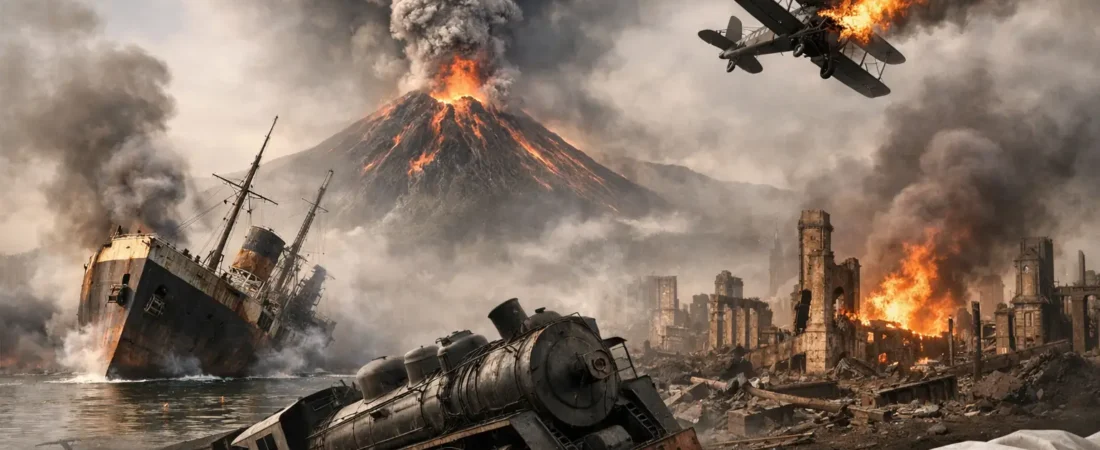
Some disasters leave monuments, memorial days, and chapters in every textbook. Others vanish into the margins. The story of forgotten historical disasters begins there – not with small tragedies, but with catastrophes that once terrified entire regions and then slowly slipped from public memory.
What gets remembered is not always what caused the greatest suffering. Sometimes the deadliest events happened far from imperial capitals. Sometimes records were lost, governments concealed the scale, or later wars buried the story under newer grief. Yet when we return to these overlooked catastrophes, the past feels startlingly close: ash falling on roofs, water climbing staircases, streets buckling, bells sounding over ruined towns.
Why forgotten historical disasters disappear from memory
Historical memory is selective. A disaster tied to a famous empire, a celebrated city, or a dramatic image has a better chance of surviving in public consciousness. Others, even when they killed tens of thousands, can fade if they struck colonial territories, rural populations, or communities with limited political power.
There is also a simple archival problem. Many older disasters were poorly measured at the time. Death tolls vary wildly across sources. Eyewitnesses exaggerated some details and missed others entirely. In some cases, governments minimized losses to protect trade, maintain public order, or avoid blame. The result is not that the event mattered less, but that later generations inherited a thinner, less stable record.
That is why these events deserve another look. They reveal how fragile cities were before modern engineering, how exposed ordinary people were to weather and disease, and how often recovery depended on neighbors long before national relief systems existed.
1. The 1815 eruption of Mount Tambora
When Mount Tambora erupted on the Indonesian island of Sumbawa in April 1815, the explosion was among the most powerful in recorded history. Entire villages disappeared under ash and pyroclastic flows. The immediate destruction was terrible, but Tambora’s larger impact spread far beyond the island.
The eruption hurled enormous quantities of material into the atmosphere, dimming sunlight and disrupting global climate. The following year became known in parts of Europe and North America as the Year Without a Summer. Crops failed. Frost struck in months that should have brought warmth. Food prices surged, and hunger followed.
Tambora is not wholly unknown, but its human cost is often reduced to a footnote in climate history. That misses the lived reality: coastal settlements buried, famine moving through island communities, and families on distant continents facing empty fields because of a volcano they had never heard of. Few disasters show more clearly how local violence in nature can become global crisis.
2. The 1839 Coringa cyclone
On India’s eastern coast stood the busy port of Coringa, a shipbuilding center linked to Indian Ocean trade. In November 1839, a cyclone drove a catastrophic storm surge into the harbor and surrounding settlements. Contemporary reports suggest that as many as 300,000 people may have died, though exact numbers remain debated.
Imagine the geography for a moment: low-lying land, tidal waters, densely occupied coastal communities, and little warning. When the surge arrived, it did not simply flood streets. It erased them. Ships were carried inland. Homes, warehouses, and human lives were swept into a landscape suddenly unrecognizable.
Today, the Coringa cyclone is rarely mentioned beside more familiar storms. Part of the reason is documentary unevenness. Colonial reporting preserved fragments, not full local memory. Another reason is that tropical cyclone history tends to be remembered through modern disasters with photography and film. But Coringa reminds us that the vulnerability of port cities is an old story, and one written repeatedly in water.
3. The 1883 eruption of Krakatoa
Krakatoa, in the Sunda Strait between Java and Sumatra, exploded in August 1883 with a force heard thousands of miles away. The eruption itself was apocalyptic, but the deadliest blow came from the tsunamis it triggered. Coastal towns were obliterated. More than 36,000 people are believed to have died.
Unlike some entries on this list, Krakatoa is remembered in name. Yet its memory is strangely distorted. Many people know it as a dramatic natural event, almost a geologic spectacle, while the destroyed communities remain shadowy. Old accounts describe walls of water smashing through settlements, bodies carried out to sea, and shorelines altered beyond recognition.
Krakatoa also mattered because it became one of the first global media disasters. Telegraph networks spread the news quickly, turning regional loss into international sensation. Even so, popular memory often kept the explosion and dropped the victims. It is a pattern that repeats often in disaster history: the image survives, the people fade.
4. The 1902 eruption of Mount Pelée
In the Caribbean, the French colony of Martinique had a thriving city at Saint-Pierre, often called the Paris of the Antilles. On May 8, 1902, Mount Pelée released a fast-moving pyroclastic surge that swept into the city and killed nearly 30,000 people within minutes.
The destruction was so sudden that clocks reportedly stopped at the moment buildings collapsed and metal warped in the heat. Streets, shops, homes, and harborfront structures became a field of ruin almost instantly. One of the few famous survivors, a prisoner named Louis-Auguste Cyparis, endured inside a jail cell whose thick walls offered some protection.
Pelée deserves remembrance not only because of the scale of death, but because it changed volcanology. Scientists studying the eruption gained a clearer understanding of pyroclastic flows and the unique dangers they pose. In that sense, Saint-Pierre became both a graveyard and a classroom for modern hazard science. The trade-off is painful: knowledge advanced because a city was lost.
5. The 1917 Halifax Explosion
On a cold morning in December 1917, the harbor in Halifax, Nova Scotia, became the site of one of the largest non-nuclear explosions in history. A collision between the French munitions ship Mont-Blanc and another vessel set off a fire. Crowds gathered at windows and along the waterfront to watch. Then the ship exploded.
The blast leveled neighborhoods, shattered glass across the city, and generated a pressure wave so strong that people were thrown from their feet far inland. Nearly 2,000 people were killed, and thousands more were injured, many by flying glass. A snowstorm arrived soon after, deepening the misery of survivors.
The Halifax Explosion is better remembered in Canada than in the United States, but internationally it often sits in the shadow of World War I itself. That is understandable, but it also shows how major wars can absorb adjacent tragedies. In another era, Halifax might stand in public memory alongside the most famous urban disasters of the modern age.
6. The 1931 China floods
If one disaster on this list most clearly deserves the word forgotten, it may be the 1931 China floods. After years of drought, heavy snow, and intense seasonal rains, major river systems including the Yangtze and Huai overflowed on a colossal scale. Vast areas disappeared under water.
Estimating the death toll is difficult, and that difficulty partly explains why the disaster is less widely known than it should be. Modern estimates often range into the hundreds of thousands from immediate drowning, with total deaths from flood, famine, and disease reaching into the millions. Cholera and other illnesses spread through displaced populations. Agricultural losses made hunger a second disaster after the first.
There are few single iconic images attached to the 1931 floods, and no one ruined city to symbolize the event. Instead there was slow devastation over an enormous landscape. That kind of suffering is harder for public memory to hold, even when it is larger than more famous catastrophes.
7. The 1970 Bhola cyclone
In November 1970, the Bhola cyclone struck what was then East Pakistan, now Bangladesh. The storm surge moved over the low-lying Ganges-Brahmaputra delta and killed hundreds of thousands of people. Entire villages were swept away. In many places, few structures stood high enough or strong enough to offer protection.
Bhola is one of the deadliest cyclones ever recorded, yet outside South Asia it remains surprisingly absent from popular history. Part of that may be geographical distance for Western audiences. Part of it is that the disaster quickly became entangled with political crisis, helping fuel anger at the Pakistani government’s response and feeding momentum toward the Bangladesh Liberation War.
This is where disaster history becomes especially revealing. A cyclone is not only a weather event. It exposes governance, inequality, infrastructure, and whose lives were considered worth protecting. Bhola was a natural hazard, but the scale of its death toll was shaped by human systems.
What forgotten historical disasters still teach us
These forgotten historical disasters are not merely stories of bad luck. They show recurring fault lines in human society: cities built in danger zones, poor warning systems, weak building standards, political neglect, and the tendency to rebuild memory around spectacle instead of suffering.
They also ask something of us as readers. To remember responsibly is to look past the headline fact – the eruption, the flood, the blast – and notice the ordinary lives inside it. The dockworkers in Coringa, the market families of Saint-Pierre, the children along flooded Chinese riverbanks, the harbor residents of Halifax who stepped to the window one second too late.
At Time Vault Capsule, that is where history becomes most vivid. Not in the scale alone, but in the recovered human presence. When we return these disasters to memory, we do more than correct the record. We restore voices to events that once shook the world, and we become a little less certain that oblivion is the natural end of tragedy.
The past is full of wreckage that still speaks, if we are willing to listen closely enough.