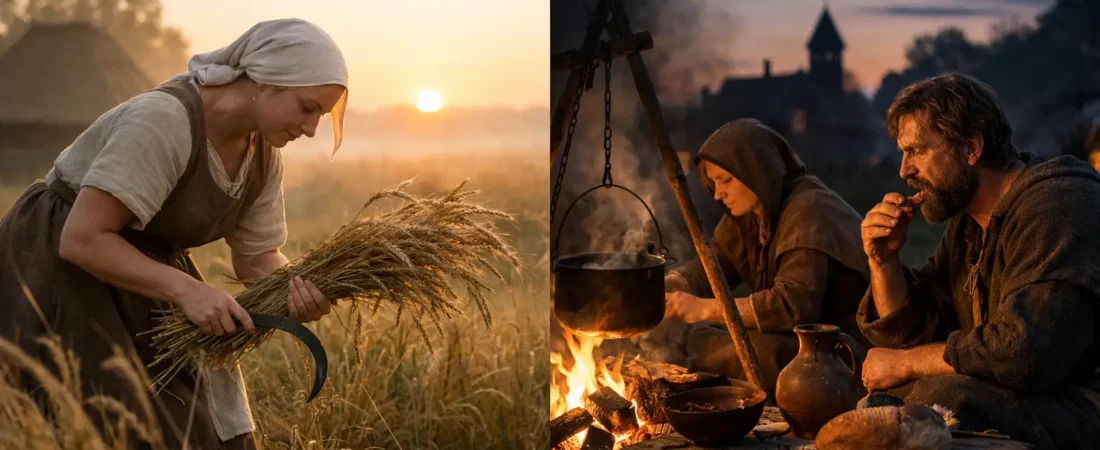
Before sunrise, a household’s fire had to be stirred back to life. Water had to be fetched, animals fed, bread prepared, and, when the season demanded it, people sent into wet fields with tools in hand. Medieval peasant daily life was not a single unchanging experience, but for most rural Europeans it revolved around this demanding rhythm: work governed by daylight, weather, obligations, and the fragile hope of a successful harvest.
The surviving records can seem dry at first – rent rolls, manor court proceedings, tax lists, and farming manuals. Yet alongside archaeological traces of hearths, cooking pots, worn paths, and village fields, they reveal lives full of skill, family responsibility, humor, faith, exhaustion, and occasional celebration. The medieval countryside was not a silent backdrop to castles and kings. It was where most people lived.
Who Were the Medieval Peasants?
“Peasant” is a useful broad term, but it can hide important differences. In medieval Europe, some rural people were free tenants who rented land, while others were unfree serfs whose movement, marriage, inheritance, or labor could be restricted by a lord. Some held enough acreage to employ help; others survived on a cottage, a garden, and the wages they could earn from neighbors.
Conditions also changed by place and century. An English villager in the 1300s did not live exactly like a French tenant in the 1100s or a farmer in the German lands of the 1400s. Still, many shared a dependence on agriculture and a close connection to the manor, parish, and village community.
For a family with land in the open-field system, strips of farmland were often scattered across several large communal fields. This arrangement spread risk: one patch might fare better than another after frost, drought, or flooding. It also meant cooperation was unavoidable. Neighbors needed to follow agreed times for plowing, sowing, harvesting, and grazing animals on common land.
Medieval Peasant Daily Life Began at the Hearth
The home was the center of labor as much as rest. Many peasant houses were modest timber structures, built with wattle and daub walls or local stone, with thatched roofs and packed-earth floors. A central hearth provided heat and a place to cook, though smoke often escaped slowly through a roof opening or door rather than a chimney.
Privacy, as modern visitors understand it, was rare. A household might include parents, children, older relatives, servants, or laborers. People slept on straw-filled mattresses, benches, or loft spaces, with wool blankets offering protection from cold. Archaeology reminds us that these homes were practical spaces, not merely poor versions of elite residences: spindle whorls, quern stones for grinding grain, pottery, iron tools, and animal bones all speak to daily work.
Breakfast was often simple, perhaps bread with ale, pottage, cheese, or leftovers. Pottage – a thick stew of grains, beans, vegetables, and, when available, meat or fat – was a dependable meal because ingredients could be added gradually to a cooking pot. Bread was fundamental, although its quality varied. Better-off households could eat wheat bread more often, while rye, barley, oats, and mixed grains were common among poorer families.
Ale was widely consumed, including at meals, because brewing made use of grain and produced a drink that could be safer than uncertain water sources. This does not mean medieval people were constantly drunk. Everyday ale was often relatively weak, and it was part of the ordinary food economy.
The Workday Followed the Season
No clock announced the start of work for most villagers. Bells from the parish church, the changing light, and the urgent tasks of the season structured the day. In spring, fields were plowed and sown. Summer brought weeding, haymaking, and repair work. Autumn was the great test of the year: harvest. Winter, though less busy in the fields, still required threshing grain, tending animals, mending tools, spinning wool, hauling fuel, and preserving food.
A peasant’s work was rarely limited to one occupation. Men and women both contributed to food production, though tasks were shaped by local custom, household status, and need. Men commonly handled heavier plowing and field labor, especially where oxen or horses were used. Women brewed, baked, cooked, cared for children, kept poultry, made dairy products, tended gardens, and spun thread. Spinning was so central that the distaff, the tool used to hold fibers, became a familiar symbol of women’s work.
Children entered this world of responsibility early. They might gather firewood, scare birds from crops, watch geese or pigs, carry water, or help with planting and harvest. Such work was not always grim exploitation. It was part of learning how a household survived. Yet childhood could be harsh, especially when disease, hunger, or the death of a parent disrupted the family’s security.
Harvest demanded every available hand. Grain had to be cut, gathered, bound, and carried before rain spoiled it. In many places, a lord could require labor services from dependent tenants on his own demesne land during critical periods. These duties sat alongside the work needed for a family’s own strips, creating a difficult trade-off. A peasant household might need to serve the manor precisely when its own crop required attention.
Food, Hunger, and Small Comforts
The image of peasants eating nothing but coarse bread is too narrow, but so is the romantic picture of rustic abundance. Diet depended heavily on season, status, local ecology, and luck. Gardens could supply onions, leeks, cabbages, herbs, peas, and beans. Eggs, milk, cheese, and occasional fish added nutrition. Meat was less frequent for many households, though pigs, poultry, and animals culled in autumn could provide it.
The leanest months often came in late winter and early spring, when stored grain ran low and fresh crops had not yet arrived. A failed harvest could turn ordinary scarcity into catastrophe. The Great Famine of 1315-1317, caused by prolonged wet weather and poor harvests across much of northern Europe, showed how quickly the rural system could break under environmental pressure. Hunger weakened bodies, livestock died, prices rose, and disease found easier prey.
Still, peasant life included pleasures and rituals. Feast days interrupted work. Weddings, church ales, markets, seasonal games, music, and storytelling brought people together. Medieval church calendars provided numerous holy days, although how freely a family could observe them depended on workload and local authority. A village was a place of watchful neighbors, but also mutual aid: shared plowing teams, collective harvest labor, and help after a fire or death could make survival possible.
The Manor, the Parish, and the Village Court
Peasants did not live outside power. They encountered it regularly through rents, taxes, labor obligations, tithes to the church, and the rules of the manor. A manor court might deal with matters that sound surprisingly familiar: wandering animals, broken fences, unpaid dues, brewing disputes, inheritance, and arguments between neighbors.
These records reveal that villagers were not passive figures bent silently over the soil. They complained, negotiated, sued, remarried, bought and sold small parcels, and defended what they believed was theirs. The degree of freedom varied sharply, particularly for serfs, but even under restrictive systems people made choices within narrow boundaries.
The parish church stood at the center of this social landscape. It marked baptisms, marriages, funerals, and the annual cycle of worship. Its bells carried across fields, measuring time in a world where written calendars and clocks were beyond most households. Faith could offer comfort, but the church also claimed tithes, usually a portion of agricultural produce, adding another obligation to a household already balancing many demands.
A Life More Skilled Than the Stereotype
It is easy to mistake physical hardship for simplicity. Medieval peasants possessed detailed knowledge of soils, animals, weather, seeds, tools, and local landscapes. They knew which low field held water after rain, when hay was ready to cut, how long grain could be stored, and which herbs might ease an illness. Their survival depended on observation refined across generations.
Their lives were vulnerable, certainly. A bad harvest, a landlord’s demand, war passing through the region, or an outbreak of disease could undo years of careful work. But the medieval peasant was not merely a victim in the shadow of the castle. At dawn, beside a smoky hearth or in a field bright with ripening grain, rural families sustained the food, labor, and communities on which medieval society depended.
To picture their world honestly is to notice both the burden and the achievement: hands roughened by work, a shared loaf on the table, a repaired roof before winter, and the hard-won relief of seeing a harvest safely gathered.