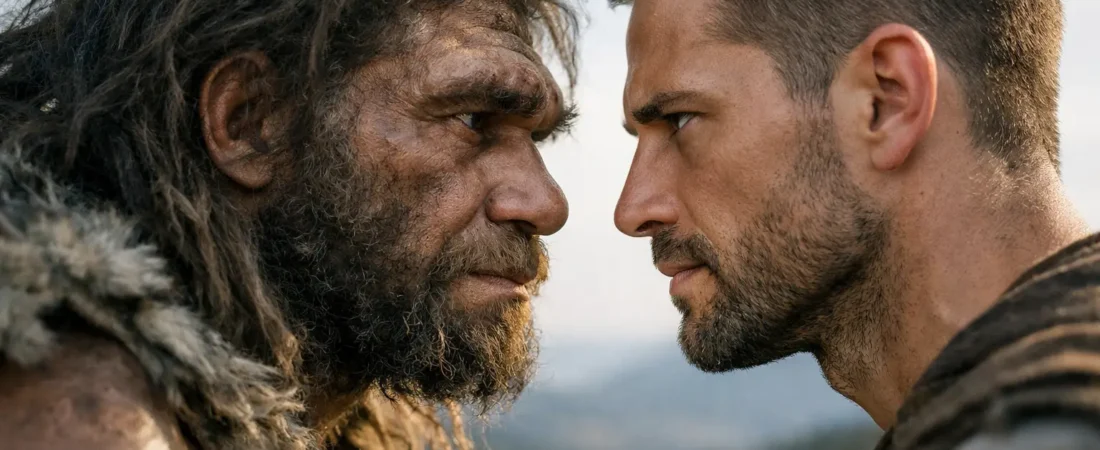
A cold wind moves through a limestone valley in Ice Age Europe. Beneath a rock shelter, a small group tends a fire, shapes a stone blade, and watches the changing season. They are Neanderthals. Not far away, perhaps within a few generations, another kind of human enters the same continent: Homo sapiens. The story of neanderthals vs homo sapiens is not a simple contest between a primitive loser and a superior winner. It is the meeting of two closely related human lineages, each resourceful, social, and remarkably adapted to a demanding world.
For tens of thousands of years, they shared parts of Eurasia. They hunted some of the same animals, sheltered in some of the same caves, and, as genetics has shown, had children together. Yet Neanderthals disappeared as a distinct population roughly 40,000 years ago, while Homo sapiens continued. The evidence left in caves, bones, pigments, and ancient DNA gives us a moving, incomplete record of that encounter.
Neanderthals vs Homo Sapiens: Close Relatives, Not Strangers
Neanderthals, formally known as Homo neanderthalensis, lived across Europe and western Asia for hundreds of thousands of years. Their fossils were first recognized in Germany’s Neander Valley in 1856, though scientists now know their history reaches much deeper. They evolved in Eurasia from earlier human populations after the ancestors of modern humans remained largely in Africa.
Modern humans, Homo sapiens, emerged in Africa at least 300,000 years ago. Groups of Homo sapiens later expanded beyond Africa in several waves. By around 45,000 years ago, they had reached much of Europe, where Neanderthals had long been at home.
The two groups had a common ancestor, likely a population related to Homo heidelbergensis, but they were not the same. Their separation had lasted for hundreds of thousands of years. Still, it was not so deep that they could not reproduce. Most people with ancestry outside sub-Saharan Africa carry about 1 to 2 percent Neanderthal DNA today. That small inheritance is a direct biological record of ancient encounters between real people.
Built for Different Conditions
Neanderthals were generally shorter, broader, and more powerfully built than most early Homo sapiens. Their wide rib cages, strong limbs, and compact bodies helped conserve heat in the cold climates of Ice Age Eurasia. Their large noses may also have helped warm and humidify frigid air, although scientists continue to debate exactly how facial shape related to climate.
Homo sapiens tended to have lighter skeletons, narrower bodies, rounder skulls, and more prominent chins. These are broad patterns, not rules. Both populations varied by age, sex, region, and individual life history. A skeleton tells us about physical form, but it does not reveal the full person: their voice, humor, family bonds, fears, or knowledge of the land.
What Neanderthals Could Do
Older museum displays often portrayed Neanderthals as hunched, dim-witted figures dragging clubs through the snow. Archaeology has thoroughly dismantled that image. Neanderthals were skilled hunters who understood animal behavior and seasonal landscapes. They made sophisticated stone tools, used fire, and processed hides and food with practiced efficiency.
At sites across Europe and the Near East, archaeologists have found evidence of carefully made tools created through the Mousterian tradition. Neanderthals selected stone, planned the removal of flakes, and sometimes carried prized raw materials over considerable distances. At some sites, traces of adhesives made from birch bark suggest that they could produce complex materials by controlling heat in low-oxygen conditions.
They also cared for one another. Several Neanderthal skeletons show injuries or serious illnesses survived long enough to indicate help from others. Shanidar Cave in modern-day Iraqi Kurdistan produced the remains of individuals who lived with major impairments. Care does not prove that Neanderthals thought exactly as we do, but it reveals something deeply recognizable: injured people were not automatically abandoned.
Questions about art, ritual, and language are harder to settle. Neanderthals used mineral pigments, and some cave markings in Spain may predate Homo sapiens in the region. Perforated shells and eagle talons possibly used as ornaments hint at symbolic behavior. A hyoid bone associated with speech anatomy and genetic evidence related to language make it plausible that Neanderthals had complex vocal communication. Plausible, however, is not the same as proven. The archaeological record is too fragmentary to reconstruct their language or beliefs with certainty.
The Arrival of Homo Sapiens
When Homo sapiens entered Europe, they brought traditions that often leave a different archaeological signature. Upper Paleolithic sites contain long blades, bone and antler tools, sewing needles, personal ornaments, and, later, spectacular painted caves and carved figures. These discoveries suggest wide social networks through which materials, skills, and perhaps marriage partners could move.
It would be a mistake to assume every tool change marks the arrival of a new people. Archaeological cultures are patterns of objects, not ethnic labels. Neanderthals could innovate, and Homo sapiens could learn local techniques. The Châtelperronian culture of France and Spain, which includes ornate personal ornaments, remains a famous and debated example of this complexity. Did Neanderthals independently develop these practices, borrow ideas from incoming humans, or were the sites disturbed over time? The answer may differ from one location to another.
What is clear is that Homo sapiens often maintained larger and more connected populations. In a harsh, unpredictable climate, wider social ties could make a decisive difference. A group facing hunger, injury, or local scarcity might obtain mates, tools, information, or aid through distant contacts. This was not necessarily a matter of greater intelligence. It may have been a matter of population size, network reach, and the luck of being connected when conditions turned difficult.
Why Did Neanderthals Disappear?
No single disaster neatly explains the end of the Neanderthals. Their disappearance likely resulted from several pressures acting together over many generations.
First, Neanderthal populations were probably small and scattered. Ancient DNA suggests they often lived in communities with limited genetic diversity, which can make a population more vulnerable to disease, environmental change, and the loss of even a few adults. Europe itself was unstable. Ice sheets advanced and retreated, forests changed into open steppe, and the animals people depended upon shifted with the climate.
Second, Homo sapiens may have competed with Neanderthals in some regions for prey, shelter, and territory. Competition need not mean constant fighting. Two groups can affect each other simply by relying on the same resources in a landscape that can support only so many people.
Third, interbreeding blurred the boundary between them. Neanderthals did not vanish without a trace. Some of their genes entered Homo sapiens populations and persisted. Certain inherited variants have been linked to immune responses, skin biology, and adaptation to environments outside Africa. Other Neanderthal DNA appears to have been removed over time by natural selection, reminding us that gene flow brought both benefits and costs.
A final possibility is simple demographic imbalance. If Homo sapiens populations were larger, even modest advantages in survival or reproduction could eventually overwhelm smaller Neanderthal communities. The end, then, may not have been a final battle. It may have been a long process of shrinking populations, changing climates, intermarriage, and cultural contact.
A Brief Timeline of Their Shared World
- About 400,000 years ago: Neanderthal ancestors are established in Europe and begin developing distinctive traits.
- About 300,000 years ago: Early Homo sapiens are present in Africa.
- About 60,000 to 50,000 years ago: Major Homo sapiens expansions carry populations across Eurasia.
- About 45,000 years ago: Homo sapiens appear in Europe, where Neanderthals are already living.
- About 40,000 years ago: Neanderthals disappear as a distinct population, though their DNA remains in many living people.
What Their Story Changes About Us
The deepest lesson of Neanderthals vs Homo sapiens is that human history was never a straight line leading inevitably to us. For much of prehistory, several human groups lived on Earth. Neanderthals were not failed versions of modern people. They were humans shaped by a different journey, with their own bodies, skills, communities, and solutions to survival.
When we stand before a Neanderthal brow ridge in a museum case or see a flint tool recovered from an ancient hearth, the distance can feel immense. Then genetics closes it. Their legacy survives in living bodies, while their archaeological traces preserve moments of labor, care, invention, and endurance. The next time you picture the Ice Age, do not imagine an empty wilderness waiting for us to arrive. Imagine a populated world, full of people who were already making it home.