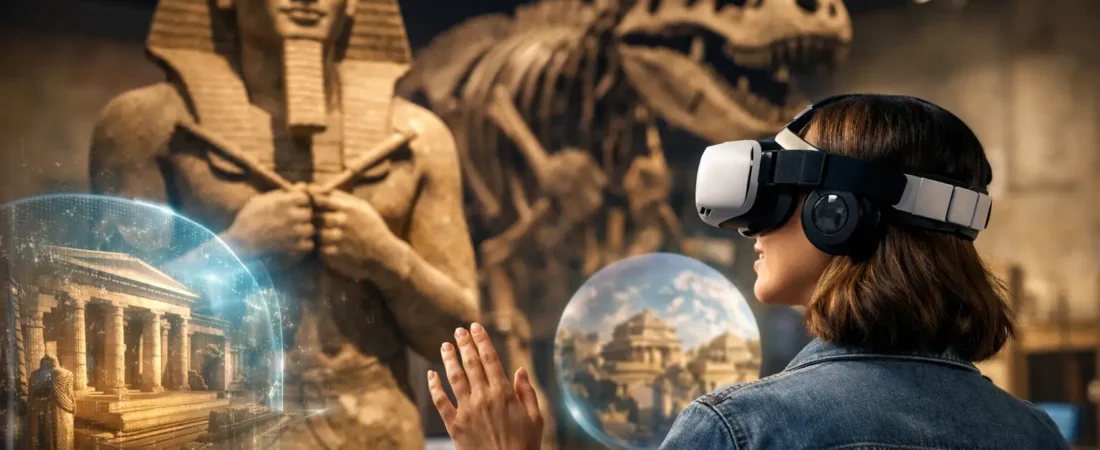
A Roman street flickers into being around you. Marble temples rise beyond the forum, vendors call from shaded stalls, and the distant sound of sandals crosses the paving stones. Then you remove a headset and find yourself standing in a modern gallery. This is the promise of virtual reality museums: not merely to display the past, but to place us inside the spaces where history unfolded.
For centuries, museums have protected the physical evidence of human experience – a chipped amphora, a soldier’s letter, a fossilized bone, a woven garment preserved against astonishing odds. Virtual reality cannot replace those objects. What it can do is restore their setting, scale, movement, and human context. Used with care, it turns a quiet label beside a case into a doorway.
What Virtual Reality Museums Actually Do
The phrase can describe several related experiences. Some are traditional museums that use VR headsets within their galleries. Others create digital exhibitions that visitors enter from home. Still others use immersive reconstruction to let audiences walk through a place that is damaged, inaccessible, or entirely gone.
The best examples begin with evidence rather than spectacle. Archaeological measurements, excavation records, surviving architecture, archival photographs, contemporary accounts, and material culture all help shape the virtual environment. Where evidence is incomplete, responsible creators distinguish between what is known and what has been reconstructed as a likely interpretation.
That distinction matters. A beautifully rendered ancient city can feel authoritative even when parts of it are uncertain. Museum-quality VR should not hide those uncertainties. It should invite visitors to notice them, much as a curator might point to the missing portion of a shattered statue and explain what can – and cannot – be restored.
When an Artifact Needs Its Lost World
A museum object rarely arrives alone. It once belonged to a room, a ritual, a trade route, a battlefield, or a family. Glass cases preserve artifacts, but they also separate them from the world that gave them meaning.
Consider a shipwreck cargo displayed in a gallery. Rows of amphorae can be impressive, yet VR can place those jars back in a rolling ship’s hold, reveal the Mediterranean routes they traveled, and show how a storm or navigational failure turned commerce into an underwater time capsule. The artifact remains essential, but the story gains depth.
The same is true of architecture. A visitor looking at fragments of painted plaster may struggle to imagine a Roman villa. In a virtual reconstruction, those fragments can reappear on walls around a courtyard, catching afternoon light as they may have two thousand years ago. The effect is not simply visual. Scale changes understanding. A doorway becomes an entrance used by real people; a column becomes part of a crowded civic space rather than an isolated stone shaft.
This is especially valuable for sites that cannot safely absorb large crowds. Tombs, caves, ruins, and fragile historic interiors face constant pressure from moisture, vibration, light, and foot traffic. Digital access can reduce some of that strain while still allowing the public to encounter the site in an emotionally direct way.
From the Gallery to the Ancient City
Virtual reconstruction has already shown its potential with places such as ancient Rome and Palmyra. Digital models of Rome draw on surviving ruins, literary evidence, maps, and decades of archaeological study to convey the density of the imperial capital. Palmyra, the Syrian oasis city whose monuments suffered severe damage during conflict, has also become a powerful example of why detailed documentation matters.
A virtual model cannot repair a destroyed temple or return displaced communities to a damaged heritage landscape. Yet it can preserve a record, support research, and help people understand what was lost. In that sense, VR is not only an entertainment tool. It can become part of cultural memory.
The Most Powerful Experiences Are Often the Smallest
Not every virtual museum needs a grand civilization rising from the dust. Some of the most moving experiences bring visitors into confined, ordinary spaces.
The Anne Frank House has used virtual reality to recreate the Secret Annex, allowing people who may never travel to Amsterdam to examine its rooms and understand their cramped reality. The experience does not need invented drama. The narrow staircase, covered windows, and close quarters carry their own historical weight.
This is where virtual reality can serve empathy without turning suffering into a game. A well-designed experience gives visitors time to observe, listen, and reflect. It does not reward them for rushing through a tragedy or ask them to “play” at being a historical victim. The ethical line is clear: immersion should deepen understanding, not turn trauma into a spectacle.
For educators, these intimate environments can make history more tangible than a textbook paragraph alone. A student may forget a date, but remember the dimensions of a hiding place, the soundscape of a wartime street, or the unsettling silence of an evacuated home. Those impressions can become a starting point for deeper study rather than an ending.
What VR Gets Right – and Where It Falls Short
Virtual reality museums offer unusual access. A teenager in a rural town can examine a scanned sculpture without crossing an ocean. A visitor with limited mobility may enter a historic site with steep stairs or uneven ground. Researchers can compare high-resolution models, test visual hypotheses, and revisit an environment without handling a fragile original.
They can also reveal things invisible in a gallery. Layers of a painted object may be digitally separated. A ruined building can be shown across several phases of construction. An archaeological trench can be reconstructed layer by layer, making the slow process of excavation easier to grasp.
But there is a trade-off. A digital model has no weight, temperature, smell, or true material presence. Standing before an Egyptian mummy case, a Civil War uniform, or a handprint pressed into ancient clay creates a connection that pixels cannot fully reproduce. The physical object carries its own quiet authority because it has survived.
There are practical limitations, too. Headsets can cause motion sickness or discomfort. Some experiences require expensive equipment, reliable internet, and technical support. A poorly designed program may prioritize visual tricks over clear interpretation, leaving visitors impressed but not better informed.
Accessibility must also be considered from the beginning. Captions, audio description, seated options, adjustable controls, and non-headset versions are not extras. They determine who gets to enter the historical space being created.
A Curator’s Test for a Worthwhile Virtual Visit
Before accepting a virtual reconstruction at face value, ask a few simple questions. What evidence supports this environment? Does the experience explain uncertainty? Are original artifacts, site records, or historical sources visible somewhere in the interpretation? And does the technology help tell a story that could not be told as clearly through an ordinary screen or display case?
A strong virtual museum experience leaves room for curiosity. It may show a temple before its collapse, but it should also help visitors understand how archaeologists know its likely appearance. It may let us stand on a medieval street, but it should acknowledge that the sounds, colors, and crowds are carefully reasoned approximations.
That honesty does not weaken the illusion. It makes the encounter more compelling. History is not a finished film waiting to be replayed. It is an ongoing act of recovery, built from fragments, documents, landscapes, and questions.
The Future Is Not a Museum Without Walls
It is tempting to imagine VR replacing the museum visit altogether. More likely, its greatest future lies in partnership with physical collections. A visitor might first walk through a virtual version of a ruined sanctuary, then encounter the weathered inscriptions and broken capitals that survived it. The headset provides context; the artifact provides presence.
For Time Vault Capsule readers, that partnership offers something especially valuable: a chance to approach the past at human scale. We can stand beneath vanished roofs, trace the route of a lost voyage, or enter a room preserved only in memory and documentation. Then we can return to the evidence with sharper eyes.
The finest virtual reality museums do not ask us to abandon the real world for a digital one. They remind us that every object in a case once belonged to a living world – and that, with careful research and imagination, some part of that world can be encountered again.