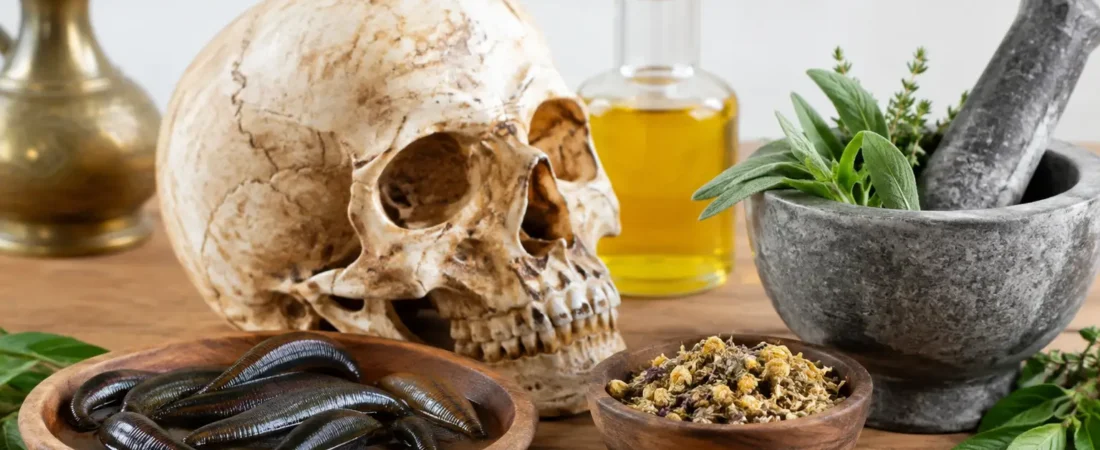
A patient sits beneath the hard light of an Egyptian courtyard. Nearby, a healer opens a chest of linen, honey, resins, and ingredients that would make a modern pharmacy seem almost ordinary. In the ancient world, illness could be an injury, a bodily imbalance, a hostile spirit, or a message from the gods. The strangest ancient medical treatments grew from that uncertain landscape – but they were not all foolish. Some rested on careful observation, and a few contained the faint beginnings of practices medicine still recognizes.
Why Ancient Healing Could Look So Unfamiliar
Ancient healers worked without germ theory, anesthesia, modern anatomy, or laboratory testing. Yet they saw wounds heal, fevers rise and fall, and certain plants soothe pain. Their remedies joined practical experience to religious belief, local materials, and inherited tradition. A treatment that seems bizarre now could have felt logical to a family facing sickness two thousand years ago.
The surviving evidence is uneven. Medical papyri, clay tablets, Greek and Roman writings, excavated instruments, and human remains offer remarkable windows into past care, but they do not tell us how often every prescription was used or whether it worked. What they do reveal is humanity’s long, inventive effort to push back against pain.
1. Drilling Holes in the Skull
Trepanation, the practice of cutting or scraping an opening into the skull, is among the oldest surgical procedures known. Archaeologists have found trepanned skulls from prehistoric communities across Europe, Africa, Asia, and the Americas. Some bear clear signs of bone healing, meaning patients survived the operation for months or years.
Why was it done? The answer depends on place and period. A head injury may have prompted surgery to remove damaged bone or relieve pressure. In other cases, healers may have hoped to treat seizures, severe headaches, or behavior understood as spirit possession. The procedure was dangerous, but it was also a real act of intervention, carried out with surprising skill in some communities.
2. Crocodile Dung as Contraception
In ancient Egypt, recipes preserved in the Kahun Gynecological Papyrus describe contraceptive pessaries made with ingredients including crocodile dung. The material was mixed with substances such as sour milk or honey and placed in the vagina before intercourse.
The thought behind it was not entirely random. A physical barrier could, in theory, impede sperm, and acidic mixtures may have been believed to alter the conditions needed for conception. But crocodile dung was not a safe or reliable contraceptive. It could introduce infection and irritation. Its presence in a medical text reminds us that reproduction, like childbirth, was an urgent concern in every ancient society.
3. Mouse Medicine in Egypt
Egyptian medical texts sometimes prescribed mice or parts of mice for ailments ranging from eye complaints to hair loss. One remedy called for a whole mouse to be eaten, while other recipes used the animal in mixtures or applications. To modern readers, it is an especially unsettling image: an animal associated with decay becoming part of a healer’s toolkit.
Ancient Egyptian medicine often relied on symbolic associations as well as ingredients. A mouse’s quick, hidden movement or perceived vitality may have contributed to its medicinal role. There is no sound medical basis for consuming mice as treatment, and the practice carried obvious risks. Still, these recipes belong to a culture that also used honey on wounds, an approach with genuine antibacterial value.
4. Garlic, Bread, and a Mouthful of Mold
Long before penicillin, people noticed that certain molds and fermented substances sometimes seemed useful on wounds. Ancient Egyptian prescriptions included moldy bread in preparations for infections, though the evidence does not show a direct, controlled predecessor to modern antibiotics. Not every mold produces a helpful substance, and applying spoiled food to an injury could easily make matters worse.
This is a useful caution against treating ancient remedies as either nonsense or lost miracles. Observation may have pointed healers toward something real, but they lacked the tools to isolate, dose, or safely reproduce it. The distance between a moldy loaf and a purified antibiotic is enormous.
5. Mercury Elixirs for Immortality
At imperial Chinese courts, alchemists pursued elixirs meant to preserve health and extend life. Some contained mercury compounds, prized for their dramatic color and transformation in the furnace. Cinnabar, a mercury sulfide mineral, held particular importance in Chinese alchemical traditions.
The tragic irony is plain: mercury is toxic. Prolonged exposure can damage the nervous system, kidneys, and digestive tract. Historical accounts connect the deaths of some rulers with elixir consumption, although individual diagnoses from distant centuries must be treated carefully. The quest for immortality had turned a striking mineral into a lethal medicine.
6. Gladiator Blood for Epilepsy
In Roman writing, epilepsy was sometimes treated with the fresh blood of a slain gladiator. Pliny the Elder described people with epilepsy drinking blood from the wounds of fighters in the arena, believing the vitality of a powerful dying man could overcome the disorder.
This was medicine shaped by spectacle and social hierarchy. Gladiators were admired for courage and physical strength, while also being exploited as enslaved or marginalized performers. Their blood became, in the imagination of desperate patients, a concentrated dose of life force. It offered no treatment for epilepsy, but it exposes how hope could attach itself to ritual, violence, and fame.
7. Fumigating the Wandering Womb
Greek medical writers sometimes described the uterus as a mobile organ that could drift through the body and cause choking, pain, fainting, or emotional distress. This mistaken idea helped shape treatments for what later writers called hysteria. Physicians recommended fragrant fumigation near the vagina to lure the womb downward, while unpleasant odors near the nose were meant to drive it away from the chest.
The underlying anatomy was wrong. Yet the treatment reveals a serious attempt to explain symptoms that physicians could see but not understand, including conditions now recognized as neurological, reproductive, or psychological. Ancient theories often imposed order on experiences that were frighteningly unpredictable.
8. Urine as a Roman Rinse
Urine had practical uses in the Roman world, especially in laundering, because aged urine produces ammonia. Some ancient writers also mention it in dental care, and later Roman satire mocked the idea of people using urine to whiten teeth.
The chemistry behind its cleaning power was real, but that does not make it a wise mouthwash. Aged urine may have helped lift stains from cloth, not safely improve oral health. The episode is a reminder that the boundary between household craft and medical treatment was often porous. A substance used in one corner of daily life could readily migrate into another.
9. Bloodletting to Restore Balance
For Greek and Roman physicians influenced by humoral theory, health depended on the balance of blood, phlegm, yellow bile, and black bile. When disease appeared, removing blood could seem perfectly rational: the body had become dangerously overfull or imbalanced.
Bloodletting endured for centuries because some illnesses improve on their own, and because a dramatic intervention can persuade both patient and practitioner that action has been taken. In rare modern conditions involving excess red blood cells, controlled removal of blood has a legitimate role. For most ancient patients, however, bleeding likely weakened people already struggling with infection, injury, or malnutrition.
10. Exorcism Beside the Medicine Cabinet
In ancient Mesopotamia, healing was often shared between different specialists. The asu used practical remedies – poultices, bandages, plants, and potions – while the ashipu addressed illness understood as the work of gods, ghosts, or malevolent forces through rituals, prayers, and incantations.
To call this simply superstition misses the human reality. Illness can isolate and terrify; ritual gave sufferers explanation, community, and a sense that someone was fighting on their behalf. But spiritual treatment could not replace care for a broken bone, an infected wound, or a parasite. Mesopotamian healing shows medicine at a crossroads where empirical practice and sacred meaning traveled together.
What the Strangest Ancient Medical Treatments Still Tell Us
These treatments are not merely curiosities from a less enlightened age. They record people improvising with what they had: plants, minerals, animals, surgical tools, prayer, and the stubborn conviction that suffering should be answered. Their failures can be sobering, especially when vulnerable patients were harmed by toxic substances or painful procedures. Their occasional successes – clean wound care, honey dressings, skilled bone treatment, and surgery that patients survived – are equally revealing.
The next time an ancient prescription sounds absurd, pause before laughing. Somewhere behind it is a healer working by lamplight, a family waiting beside a bed, and a patient hoping that this remedy, however strange, might bring them safely back to ordinary life.