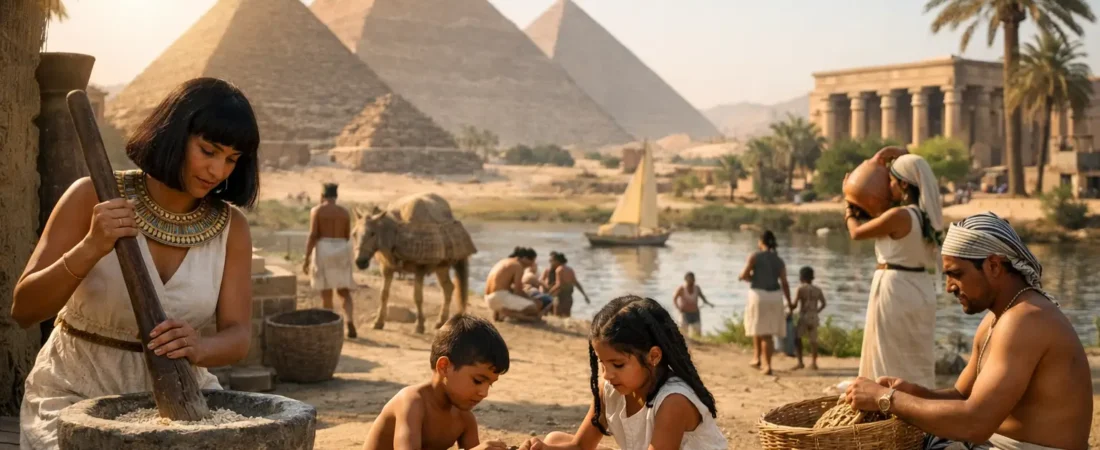
At sunrise, the Nile valley stirred before the desert heat took hold. Bakers tended clay ovens, scribes unrolled reed pens and palettes, fishermen checked their nets, and farmers studied the river that governed nearly every hope they had. If we want to understand how ancient egyptians lived, we have to step away from the pyramids for a moment and enter kitchens, workshops, fields, and crowded streets – the places where most lives unfolded.
Ancient Egypt lasted for more than three thousand years, so daily life was never frozen in a single scene. Customs changed from the Old Kingdom to the New Kingdom and beyond, and life in a wealthy household looked nothing like life in a mud-brick village. Still, some patterns remained strikingly consistent. The Nile fed the country, religion shaped routine, social rank mattered deeply, and ordinary people built a civilization famous for its monuments.
How Ancient Egyptians Lived Along the Nile
Egypt was, in the words of later writers, a gift of the Nile. That was not poetic exaggeration. Most Egyptians lived in the narrow strip of fertile black soil bordering the river, while the surrounding desert marked a hard boundary between life and emptiness. The annual inundation deposited rich silt, and agriculture revolved around that rhythm.
The year was often divided into three seasons: Akhet, the flood; Peret, the growing season; and Shemu, the harvest. During the flood, fields could not be worked in the usual way, and that made space for repairing tools, joining state labor projects, or transporting goods. When the waters receded, farmers planted emmer wheat, barley, flax, onions, lettuce, beans, and other crops. Timing mattered, but so did local conditions. A strong flood could mean abundance. A weak one could bring hunger.
This landscape shaped settlement itself. Villages clustered near fields and canals, and towns developed where trade, administration, and temple activity met. In places like Deir el-Medina, the famous workers’ village for the builders of royal tombs, archaeology preserves something unusually intimate: houses, letters, tools, broken pottery, and even complaints. Through such sites, daily life becomes less abstract and more human.
Home, Family, and the Shape of Daily Life
Most homes were built from mud brick, a practical material that kept interiors relatively cool and could be made from Nile silt mixed with straw. Stone was for tombs and temples, not for ordinary houses. A modest house might include a small courtyard, a main room, storage jars, mats for sitting or sleeping, and a staircase to the roof, where people could work, rest, or sleep in hotter weather.
Wealth changed the scale, not the basic logic. Larger homes had multiple rooms, granaries, servants’ quarters, and decorative features such as painted walls or carved furniture. Yet even humble spaces were organized carefully. Storage was survival. Grain, beer, oil, linen, and tools all had to be protected from heat, pests, and theft.
Family life sat at the center of society. Marriage was not usually marked by a formal religious ceremony in the modern sense, but households formed the backbone of economic and social life. Men and women both had legal identities, and Egyptian women could own property, inherit, make contracts, and in some cases initiate divorce. That did not make society equal in a modern way, but compared with many other ancient societies, women in Egypt had notable legal and economic standing.
Children were woven into the household economy early. They learned by watching, helping, and eventually taking on adult tasks. Some boys entered scribal training, a path that offered prestige and escape from hard physical labor. Many others remained in agriculture or crafts. Girls often learned spinning, weaving, food preparation, and household management, though evidence shows women also worked in temple estates, music, mourning rituals, and other occupations.
Food, Clothing, and Comfort
The Egyptian table was built on bread and beer. That combination appears so often in texts and tomb scenes that it formed the nutritional and symbolic basis of life. Bread came in many forms, from coarse everyday loaves to molded or flavored varieties. Beer, usually thick and nourishing rather than clear and modern, was consumed across social classes.
Alongside these staples came onions, garlic, leeks, dates, figs, lentils, cucumbers, fish, and sometimes meat. Wealthier families had more regular access to beef, poultry, wine, and imported luxuries. Diet depended heavily on rank, season, and geography. A laborer and a temple official did not eat the same meals, though both lived in a world where grain measured stability.
Clothing was usually made from linen spun from flax. In Egypt’s heat, light fabric made sense. Men commonly wore kilts or wraparound garments, while women wore fitted dresses in many periods, later with more variation in style. Jewelry was common, not only among elites. Beads, amulets, bracelets, and cosmetics all played roles in appearance and protection. Eye paint, often made with minerals such as galena or malachite, reduced glare and may have offered some protection against irritation and infection. Beauty and practicality often met in the same object.
Work in a Civilization of Specialists
When people picture Egypt, they often imagine masses of enslaved workers dragging stones. The reality was more complicated. While slavery existed in various forms, especially involving prisoners and dependent labor, the great state projects were not built simply by chains of anonymous slaves. Evidence suggests many laborers were organized workers supported by rations, housing, and administration, especially in major royal building programs.
Most Egyptians, however, were not pyramid builders. They were farmers, herders, fishermen, potters, carpenters, brewers, weavers, stonecutters, soldiers, merchants, priests, and scribes. Egypt functioned because it was highly organized. Officials counted grain, measured land, collected taxes, recorded labor, and managed redistribution. The scribe stood at the heart of this system, pen in hand, turning harvests and households into state knowledge.
Craft production could be astonishingly skilled. Goldsmiths, faience makers, glassworkers, and painters supplied both daily needs and sacred spaces. In royal and temple workshops, artisans produced objects of remarkable precision. Yet even the finest crafted piece begins with ordinary labor: mining, hauling, grinding, firing, polishing.
Religion in the Middle of Everyday Life
To ask how ancient Egyptians lived is also to ask how they understood existence itself. Religion was not confined to temples. It saturated daily routine. People prayed for health, fertility, safe childbirth, justice, and protection from illness or snakes. They wore amulets, kept household shrines, and made offerings to gods and ancestors.
The great temples were economic as well as sacred centers, owning land, employing workers, and storing wealth. Priests performed rituals to sustain divine order, but ordinary people engaged religion more locally and personally too. A carved stela, a spoken prayer, or a small figurine could carry deep meaning.
Underlying all this was the concept often translated as maat – truth, balance, order, rightness. Maat was cosmic and practical at once. The king was expected to maintain it on a grand scale, but ordinary people also participated through fairness, piety, and social duty. That idea helps explain why tomb inscriptions so often emphasize honesty, generosity, and proper conduct.
Health, Hardship, and Inequality
Ancient Egypt could be prosperous, but it was never easy. Teeth were often badly worn from gritty bread contaminated by stone particles from grinding grain. Labor damaged backs and joints. Parasites, infections, and injuries were common. Childbirth was dangerous. So was the river itself, with crocodiles, hippos, and waterborne disease.
Medical texts show a society attentive to treatment, blending practical remedies with incantations and ritual language. Physicians could identify symptoms and prescribe drugs made from honey, herbs, fats, and minerals. Some methods were thoughtful. Others rested on symbolic logic. As in much of the ancient world, medicine lived in the space between observation and belief.
Inequality shaped everything. Elite tomb paintings can make life look elegant and orderly, but they were designed to present an ideal world. Archaeology tells a fuller story. Many people lived with cramped space, heavy labor, uncertain harvests, and vulnerability to state demands. Corvee labor, taxation in grain, and obligations to temples or officials placed real pressure on households. Egypt was stable by ancient standards, but stability had a cost, and it was not borne equally.
What Archaeology Reveals About How Ancient Egyptians Lived
Some of the clearest evidence comes not from kings but from debris. Broken bowls, workmen’s notes, food remains, toys, sandals, combs, and letters preserve the texture of ordinary life better than any royal boast. At Deir el-Medina, workers recorded absences with reasons that still sound startlingly familiar: illness, family problems, religious observances, even hangovers. That kind of evidence strips away the stone grandeur and leaves us face to face with real people.
Burials reveal another side of life because Egyptians prepared intensely for death. Graves contain clothing, tools, cosmetics, food offerings, and protective texts, all meant to support existence beyond the tomb. These objects also show what people valued in life itself: nourishment, memory, status, craft, family connection, and divine protection.
To stand inside ancient Egypt, even imaginatively, is to notice how much of this civilization was built by repetition. Water carried, grain ground, linen woven, accounts copied, prayers spoken, children taught. Monumental history rises from these small acts. The pharaoh may dominate the skyline, but the civilization endured because millions of ordinary Egyptians kept households running beside the river, season after season. When we look closely at their daily lives, the ancient world becomes less distant and far more recognizable.