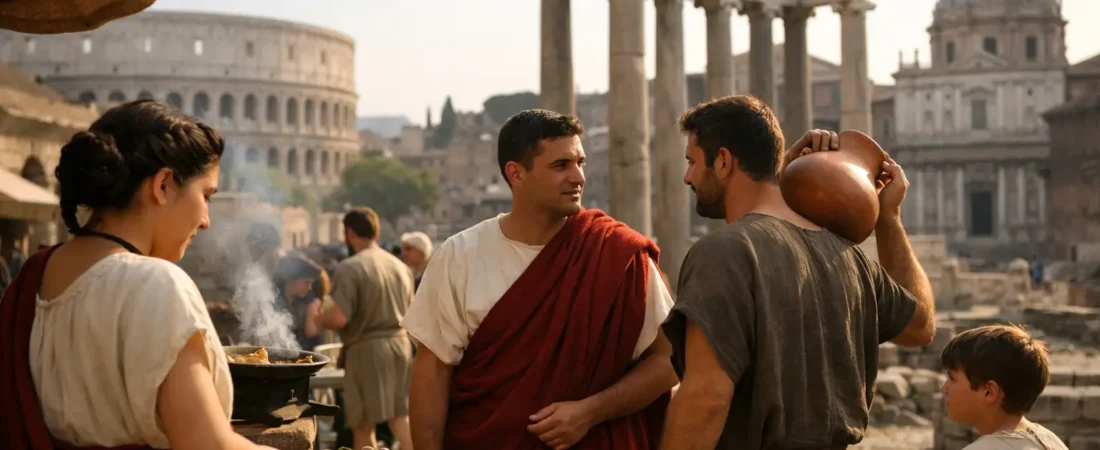
At first light, Rome was already awake. Bakers stoked their ovens before sunrise, mule carts rattled over stone streets, and the first customers pressed into cramped shops beneath apartment blocks. If you want to understand daily life in ancient Rome, it helps to begin not with emperors or generals, but with noise, smoke, bread, sweat, and the steady movement of ordinary people trying to get through the day.
Rome was the capital of an empire, but it was also a city of routines. Millions across the Roman world lived differently depending on region, wealth, legal status, and century. A senator in a grand townhouse on the Palatine Hill experienced Rome in one way, while an enslaved kitchen worker, a shopkeeper in Pompeii, or a soldier stationed on the frontier knew another. Still, certain rhythms tied Roman life together – the household, the street, the market, religion, and the public spaces where private lives spilled into view.
Daily Life in Ancient Rome at Home
The Roman home was more than shelter. It was a center of authority, worship, labor, and reputation. Wealthy families lived in domus houses arranged around an atrium, where visitors might be received beneath painted walls and open roofs designed to catch rainwater. Deeper inside, a garden courtyard offered shade, sculpture, and a carefully staged sense of order.
Most Romans, however, did not live like this. In the city, many rented rooms in insulae, multi-story apartment buildings that could be crowded, dark, and dangerous. Upper floors were cheaper but harder to reach and more vulnerable to fire. Archaeology and ancient writers alike suggest that urban housing could be noisy and unstable, with shared walls, limited privacy, and constant contact with neighbors.
Within the household, rank mattered. The paterfamilias, usually the senior male, held legal authority over the family, though real domestic life could be more complex than Roman law suggests. Women managed households, supervised servants, arranged supplies, and in some cases handled business affairs. Children were expected to learn discipline early, and enslaved people performed much of the labor that kept elite homes functioning.
Religion lived indoors too. Many families kept a household shrine for the Lares and Penates, protective spirits associated with home and provisions. A morning offering, a lamp, or a small prayer connected domestic routine to the sacred. In Rome, faith was not sealed away in temples. It stood in the kitchen, beside the doorway, and at the family table.
Work, Status, and Survival in the Roman City
To walk through Rome was to move through an economy in full motion. Workshops opened onto the street. Taverns served wine and hot food. Barbers, cobblers, metalworkers, scribes, and cloth merchants advertised their skills to anyone passing by. In a world without modern factories, labor was visible and local.
Daily life in ancient Rome was shaped by status as much as occupation. Elite men were expected to pursue public careers, manage estates, and cultivate influence rather than manual work. Beneath them stood a wide range of tradespeople, laborers, freedpeople, and enslaved workers. Freedpeople, formerly enslaved people who had gained legal freedom, could become especially active in commerce. In some towns, inscriptions show them rising to considerable wealth, even if social prejudice never fully disappeared.
Enslavement touched nearly every part of Roman society. Enslaved people cooked, cleaned, taught children, managed accounts, worked in fields, mined stone, and served in bathhouses and workshops. Their experiences varied sharply. Some lived within households and developed close familiarity with those they served. Others endured brutal conditions in agriculture or extraction. Any honest portrait of Rome has to keep this reality in view. The city’s elegance rested, in part, on coerced labor.
For the poor, survival could be uncertain. Employment was often irregular, especially for day laborers. Grain distributions helped some citizens in the capital, and patronage networks mattered. A client might greet a wealthy patron in the morning and receive food, money, or favors in return for loyalty and public support. These relationships were social, political, and economic all at once.
Food and Meals in Daily Life in Ancient Rome
Roman food could be simple or extravagant, depending on who was eating and where. For many people, the daily foundation was bread, porridge, olives, beans, vegetables, and wine watered down for drinking. Fish sauce, especially garum, flavored countless dishes and moved through trade networks on a vast scale. Its smell may not appeal to modern taste, but to Romans it was ordinary, useful, and everywhere.
The richest households displayed status through dining. Guests reclined at formal dinners while courses arrived in sequence, sometimes featuring dormice, shellfish, game, or imported delicacies. Yet even elite meals were about more than appetite. A dinner party announced wealth, education, and connections. It was performance as much as pleasure.
Street food mattered too. Excavations at Pompeii have revealed thermopolia, food counters with embedded jars where customers could buy ready-to-eat dishes. This makes sense in a city where many apartments had limited cooking facilities. Not every Roman family sat down to a private, home-cooked evening meal. Many ate on the move or bought what they could nearby.
Baths, Streets, and the Public World
If the Roman house was one center of life, the bathhouse was another. Public baths were not just places to wash. They were social worlds with changing rooms, warm and hot bathing spaces, exercise areas, and sometimes gardens or libraries. A visit could involve business conversations, gossip, exercise, and relaxation, all in one setting.
For modern readers, Roman bathing habits can seem surprisingly communal. Standards of privacy were different, and cleanliness was tied to social ritual. People scraped oil and dirt from the skin with a strigil, moved through rooms of varying temperature, and ended cleaner, but also more connected to the city’s public pulse.
Outside, the streets were crowded and uneven. Traffic was such a problem in Rome that wheeled vehicles were restricted during parts of the day. Vendors called out. Water flowed from fountains. Graffiti marked walls with jokes, political messages, insults, and advertisements. In Pompeii, these traces remain especially vivid. They remind us that Roman cities were not marble stillness. They were loud, argumentative, and alive.
Education, Family, and Entertainment
Not every Roman child went to school, but education carried prestige. Wealthier families might hire tutors or send children to teachers who trained them in reading, writing, literature, and rhetoric. Boys generally had greater access to advanced education, especially if public careers awaited them. Girls’ education varied by family and status, though many learned literacy and household management.
Family life was marked by both affection and hard realities. Infant mortality was high. Marriage could be a family strategy as much as a personal bond. Children played with dolls, knucklebones, hoops, and pets, and tomb inscriptions reveal deep parental grief when young lives ended early. These fragments of feeling are some of the most moving evidence Rome has left behind.
Entertainment ranged from intimate to enormous. Romans enjoyed board games, poetry recitations, theater, chariot races, and gladiatorial shows. The Circus Maximus could hold vast crowds roaring for their favorite racing factions. Amphitheaters staged spectacles that were thrilling, violent, and politically useful. Emperors and local elites understood that public entertainment helped display power and secure popularity.
Still, it depends which Romans we mean. To an aristocrat, a show might confirm status from a privileged seat. To a vendor, it was a chance to sell goods. To an enslaved person ordered to serve there, it was work. Roman entertainment was shared, but never equally experienced.
Time, Belief, and the Shape of an Ordinary Day
A Roman day was structured by sunlight more than clocks. People rose early, worked through the morning, handled business before midday, and often shifted toward bathing, social calls, or dining in the afternoon and evening. Seasonal change mattered. So did festivals, market days, and religious observances that interrupted normal routines.
Religion was woven through the calendar. Public festivals honored gods, emperors, and civic traditions. Priests oversaw sacrifices, but ordinary people also made vows, wore amulets, visited temples, and watched for signs of divine favor or warning. The boundary between practical life and sacred life was thin. A journey, an illness, a marriage, or a business deal might all call for ritual attention.
What makes Rome feel close across two thousand years is not only its monuments, but its familiarity in fragments. Parents worried about children. Workers complained. Neighbors argued through walls. People hurried to buy food, looked for opportunity, sought comfort, and gathered where the city offered water, heat, news, and spectacle. The empire could be vast and impersonal, but daily existence was lived at human scale.
To picture ancient Rome clearly, imagine less the triumphal arch and more the apartment stair, the bakery queue, the smoky lamp at a household shrine, and the splash of voices in the baths. That is where the past becomes tangible – not in the grand claims Rome made about itself, but in the ordinary hours its people had to fill.