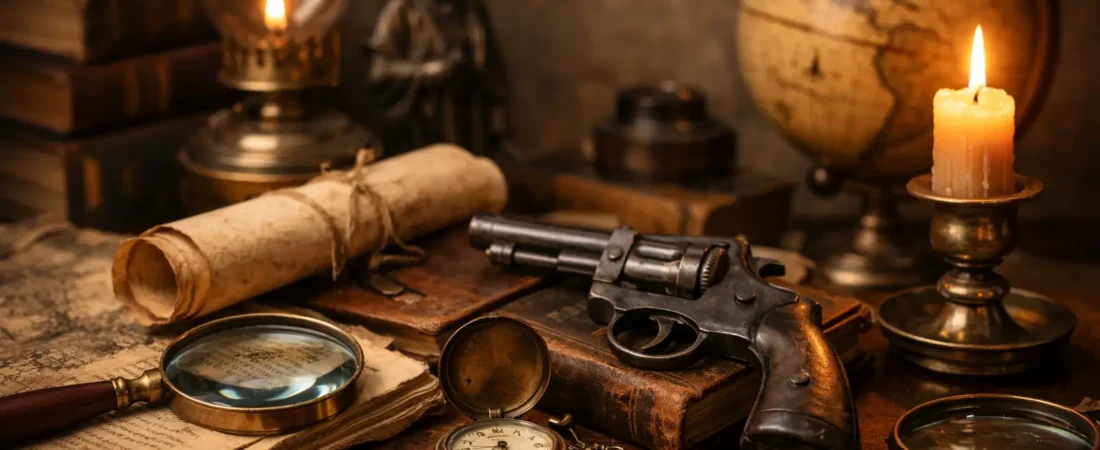
A sealed tomb. A missing colony. A murder file gone cold for a century. Historical mystery stories begin with a gap in the record, but what keeps us reading is not simply the promise of an answer. It is the chance to stand at the edge of what is known and feel the past breathe through fragments – a courtroom transcript, a weathered letter, a broken amulet, a witness who may have lied.
That tension gives the genre its unusual power. It satisfies two appetites at once. We want the pleasure of a mystery, with clues arranged like lanterns in the dark, and we want the texture of another era, with all its vanished rooms, customs, and fears. When those elements are handled well, the result feels less like fiction built on scenery and more like an excavation. We are not just following a plot. We are reconstructing a world.
What makes historical mystery stories different
A modern detective can call a lab, search a database, or watch security footage. In historical mystery stories, certainty is harder to come by. Evidence is fragile, records are incomplete, and even basic facts may be distorted by class, censorship, war, or superstition. That limitation is not a weakness. It is the engine of the form.
Set a mystery in ancient Rome, medieval Baghdad, Victorian London, or Depression-era America, and every clue must pass through the conditions of its time. A footprint matters differently on a muddy village road than on a polished city floor. A missing seal ring can carry legal weight. A rumor can travel faster than proof. The investigator, whether a magistrate, monk, midwife, scholar, or reluctant witness, has to think with the tools of that age.
That is where the genre becomes truly immersive. The puzzle is never floating above history. It is embedded inside trade routes, religious tensions, inheritance law, household labor, colonial ambition, and everyday survival. Solving the mystery means understanding how people in that period lived and what they believed was possible.
The past is not just a backdrop
The best historical mysteries resist costume-drama decoration. They do not place a modern mind in old clothing and call it authenticity. Instead, they allow the setting to shape motive, danger, and silence.
Consider how much could be hidden in a world without universal literacy. A forged document might pass unchecked because only a few can read it. A woman may know the truth of an event yet have no socially accepted way to speak it. A servant might observe everything and still leave almost no trace in the official record. In many eras, power determined whose version of events survived.
This is why old mysteries often feel larger than the crime itself. A disappearance may expose a land dispute. A suspicious death may reveal prejudice in the legal system. A stolen relic may point toward conquest, faith, or the trafficking of sacred objects. The unanswered question pulls at threads that historians themselves often follow.
For readers, that creates a richer kind of suspense. We are not only asking who did it. We are asking what kind of world made this possible.
Historical mystery stories and the thrill of evidence
There is a museum-like pleasure in the way this genre handles objects. A candle stub, a scrap of embroidery, a ship manifest, or a layer of ash can carry narrative weight because it also carries context. In a good historical mystery, artifacts do not merely decorate the scene. They testify.
Archaeology has sharpened this instinct in the public imagination. Modern readers know that a lost shoe in a well or pollen trapped in plaster can change the story of an entire site. That knowledge makes us read historical clues differently. We begin to think like investigators of the past, attentive to what survives by accident.
Real history offers countless examples. The excavation of Pompeii transformed abstract disaster into intimate human evidence – loaves in ovens, tools on benches, graffiti on walls. The deciphering of old letters has reopened royal scandals and wartime betrayals. Cold cases from the nineteenth century have been reexamined through newspapers, coroners’ reports, and family archives, sometimes producing new interpretations even when no final answer emerges.
That last point matters. A satisfying historical mystery does not always end with complete certainty. Sometimes the most honest ending is a narrowed field of possibilities. The past rarely hands over a confession on demand.
Why uncertainty makes the genre stronger
Readers are often told to expect resolution from a mystery, but history is less obedient than fiction. Records burn. Bones vanish. Governments suppress. Witnesses misremember. Entire communities disappear from the archive because no one in power thought their stories worth preserving.
Paradoxically, that uncertainty is one reason the genre feels so alive. Historical mystery stories remind us that evidence is not the same as truth, only our best path toward it. They teach careful attention. They make us ask who created the record, who was excluded from it, and what silence can mean.
This is also where the genre can go wrong. If every gap is filled with wild speculation, the past becomes a stage for fantasy rather than inquiry. The strongest writers leave room for ambiguity without surrendering to vagueness. They know that restraint can be more haunting than certainty.
A vanished expedition, for example, is most compelling when the ice, the logistics, the rationing, and the fragmentary notes are treated with respect. The mystery grows sharper, not weaker, when it remains tied to what can actually be known.
The human scale of old enigmas
Many famous mysteries survive because they touch something deeply personal. We remember lost heirs, unidentified victims, missing ships, and sealed chambers not because they are unusual on paper, but because they preserve human emotion under pressure.
A courtroom mystery from the seventeenth century might carry the fear of public shame. A medieval poisoning case might reveal anxieties about trust at the dinner table. A vanished child in an industrial city can expose how poverty and overcrowding made some lives easier to erase. Even grand imperial puzzles often come down to private grief, ambition, jealousy, or desperation.
That emotional scale is what makes the genre shareable. Readers pass along historical mysteries not just because they contain twists, but because they invite conversation. What would you have believed at the time? Which witness seems credible? Was the official verdict shaped by politics? Could this have happened differently in another century?
These questions pull people into history as participants, not spectators.
How the best historical mystery stories are built
The form works best when storytelling and scholarship keep each other honest. Rich atmosphere matters, but so does method. Dates, geography, clothing, speech, legal customs, and social hierarchy all affect what a character can plausibly do. A single anachronism can break the spell.
Yet accuracy alone is not enough. A stack of correct details does not create immersion. The best writers choose details with narrative purpose. They show the smell of lamp oil because it changes how a room feels. They mention river tides because travel times depend on them. They note the cost of paper because written evidence was never neutral.
This is true in nonfiction as well as fiction. The strongest history writing often borrows the pacing of a mystery because archives naturally create suspense. A letter appears. A name repeats. A witness contradicts an official report. Suddenly a distant century feels startlingly present.
That is one reason audiences return to brands like Time Vault Capsule. The appeal is not only information. It is the sensation of entering an old chamber with a light in hand and recognizing that the people there were no less complex than we are.
Why these stories still matter
Historical mystery stories endure because they train the imagination without asking us to abandon evidence. They offer wonder, but disciplined wonder. They allow readers to feel the romance of the unknown while still respecting the slow craft of history.
They also perform a quiet act of recovery. Every unresolved case, lost settlement, disputed relic, or misread inscription asks us to pay attention to what time has damaged but not erased. Sometimes the mystery centers famous names. Just as often, it restores ordinary people to view – a sailor on a doomed voyage, a girl in a workhouse, a clerk who copied one crucial line, a family whose testimony outlived its moment.
That may be the deepest reason the genre lasts. It turns absence into presence. A missing answer becomes a way of seeing more clearly: the pressures of an era, the fragility of memory, the strange endurance of objects, and the stubborn human wish to know what happened.
The next time a historical mystery catches your attention, pause before rushing to the solution. Look at the room, the archive, the landscape around the question. Very often, the real revelation is not the final answer, but the world that appears while we search for it.