A clay tablet no larger than a paperback book can carry the voice of someone who lived more than 4,000 years ago: a brewer tracking barley, a merchant recording wool, a student copying signs until his hand ached. That human closeness is where a beginner guide to ancient Mesopotamia should begin. This was not one vanished empire with a single people and ruler. It was a long-lived, changing world of cities, languages, temples, farms, armies, and families between two unpredictable rivers.
Where Ancient Mesopotamia Began
Mesopotamia means “the land between the rivers,” a Greek name for the region shaped by the Tigris and Euphrates. Its historical heart lies largely in modern Iraq, though the wider cultural world reached into parts of Syria, southeastern Turkey, Iran, and Kuwait.
The landscape offered extraordinary promise and constant risk. River water, guided through canals, could turn dry ground into fields of barley and date palms. But floods did not arrive with the regularity familiar from ancient Egypt. Canals silted up, river courses shifted, and poor irrigation could leave salt in the soil. Mesopotamian cities were achievements built against the grain of their environment, maintained through communal labor and careful administration.
By about 4000 BCE, settlements in southern Mesopotamia were growing into some of the world’s first true cities. Uruk, near the Euphrates, became vast for its age, with monumental temples, workshops, and neighborhoods of mud-brick homes. Its people did not know they were living at the beginning of “civilization,” a label modern historians use cautiously. They were solving immediate problems: feeding a dense population, organizing labor, honoring their gods, and recording what entered and left the storehouses.
A Beginner Guide to Ancient Mesopotamia’s Peoples
Mesopotamia is often introduced through the Sumerians, and rightly so. In the south, Sumerian-speaking communities developed powerful city-states such as Ur, Uruk, Lagash, Eridu, and Nippur. Each city had its own patron deity, local ruler, agricultural territory, and political ambitions. Their shared culture did not prevent fierce rivalry.
But Sumer was only one chapter. Akkadian speakers lived alongside Sumerian speakers, and the Akkadian language eventually became a major language of government and diplomacy. Around 2340 BCE, Sargon of Akkad forged an empire that joined many Mesopotamian cities under one dynasty. Later came the rulers of Ur’s Third Dynasty, the Old Babylonian kingdoms associated with Hammurabi, the formidable Assyrian empires of the north, and the Neo-Babylonian kings who made Babylon famous once again.
A simple timeline helps place these names in order:
- c. 4000-3100 BCE: Uruk expands; early cities and the first writing emerge.
- c. 2900-2334 BCE: Sumerian city-states compete across southern Mesopotamia.
- c. 2334-2154 BCE: The Akkadian Empire rules much of Mesopotamia.
- c. 2112-2004 BCE: Ur III creates a highly organized southern Mesopotamian kingdom.
- c. 1792-1750 BCE: Hammurabi rules Babylon during the Old Babylonian period.
- c. 911-609 BCE: Assyria becomes the dominant imperial power in the Near East.
- c. 626-539 BCE: Neo-Babylonian rulers, including Nebuchadnezzar II, restore Babylon’s splendor.
These dates are guideposts, not clean dividing lines. Cultures overlapped, old traditions survived, and cities could remain important long after their political independence was gone.
The Invention That Let Voices Survive
Writing began in Mesopotamia not with epic poetry or royal proclamations, but with accounting. Temple and institutional economies needed ways to track grain, livestock, textiles, and labor. Early signs were pressed into wet clay with a reed stylus. Over centuries, the marks became wedge-shaped, giving us the name cuneiform, from the Latin word for wedge.
Cuneiform was a writing system, not a single language. Sumerian, Akkadian, and later other languages could be written with its signs. Reading it is difficult: a sign may stand for a word, a syllable, or an idea depending on context. Modern scholars spent generations piecing it together from inscriptions, bilingual texts, and thousands of excavated tablets.
The results transformed our picture of the ancient world. Tablets preserve contracts, school exercises, prayers, letters, medical recipes, court cases, astronomical observations, and literary works. Among the most celebrated is the Epic of Gilgamesh, whose hero searches for meaning after the death of his friend. Its questions about grief, fame, and mortality still feel startlingly near.
Temples, Kings, and the City
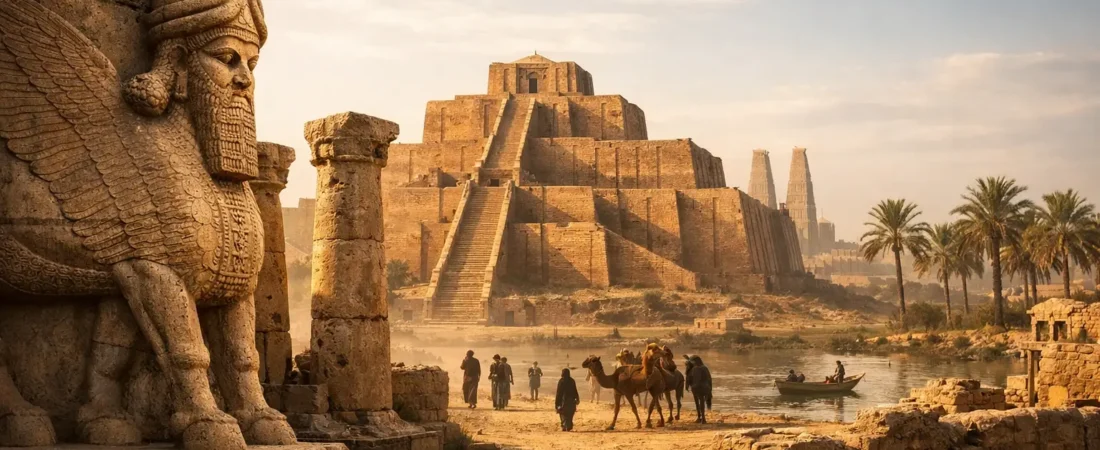
For Mesopotamians, a city belonged first to its god. Temples were religious centers, but they also owned land, employed workers, collected goods, and helped distribute resources. The towering stepped temple platforms known as ziggurats dominated several major cities. They were not pyramids or tombs. A ziggurat elevated a sanctuary, making it a visible meeting point between earthly city and divine realm.
Kings presented themselves as protectors chosen by the gods. Their duties included defending canals, maintaining temples, administering justice, and winning wars. That ideal did not always match reality. Kings could be ruthless, and royal inscriptions were written to glorify victories rather than provide neutral reporting. Archaeologists and historians compare such claims with administrative tablets, enemy records, and the material evidence left in cities.
Hammurabi’s famous law stele is a useful example. It contains nearly 300 legal rulings on property, work, family, injury, and social status. It was not the first law code, nor did every person carry a copy or receive equal treatment. Penalties could differ sharply according to class and gender. Still, the text reveals a society trying to define responsibility in writing, from collapsing houses to unpaid debts.
Everyday Life Beyond the Palace Walls
The grand ruins can make ancient Mesopotamia feel like a place inhabited only by kings and priests. The tablets correct that impression. Most people farmed, herded animals, made pottery and cloth, built homes, transported goods, or worked for temples and palaces. Barley was a staple crop and a common measure of payment. Beer, made from grain, was part of daily life, while dates, onions, fish, bread, and dairy appeared regularly in the diet.
Homes were usually built from sun-dried mud brick, the practical material of a land with limited timber and stone. Such buildings required repair, which is one reason many ancient cities survive as broad mounds, or tells: generations rebuilt on the remains of earlier houses.
Women’s experiences varied by period, location, and social standing. Some managed businesses, owned property, served as priestesses, or wrote letters that survive today. Others lived under strict legal and economic constraints. Slavery existed as well, involving people captured in war, born into enslaved households, or driven into dependency by debt. Ancient Mesopotamia produced remarkable cultural achievements, but it was not a simple golden age.
What Archaeology Can and Cannot Tell Us
The story of Mesopotamia reaches us through fragile evidence. Clay tablets endure fire and time better than papyrus or wood, yet they are unevenly preserved. Royal archives are more likely to survive than a farmer’s passing thoughts. Excavated objects can show what people made and used, but an object without its original context may lose much of its meaning.
That is why museum labels and dramatic reconstructions deserve thoughtful reading. The Ishtar Gate, rebuilt from excavated glazed bricks in Berlin, conveys the visual force of Neo-Babylonian Babylon. Yet its modern display is necessarily incomplete. Likewise, the legendary Hanging Gardens remain uncertain. Ancient writers described them, but archaeologists have not found conclusive evidence for their location or even for Babylon as their setting.
The uncertainty is not a failure of history. It is part of the encounter. Each sealed tablet, buried canal, and broken foundation offers evidence, but rarely a complete answer.
Why Mesopotamia Still Feels Familiar
Ancient Mesopotamia did not invent every feature later associated with civilization, and it should not be reduced to a checklist of “firsts.” Its deeper importance lies in the enduring patterns visible there: cities depending on infrastructure, states collecting information, trade linking distant regions, and ordinary people using writing to manage obligations and relationships.
When you encounter a Mesopotamian artifact, pause over its scale. A king’s inscription may announce an empire, but a tiny tablet may preserve a complaint about a missing shipment or a mother’s concern for her son. Across millennia, the most powerful discovery is not that these people were like us in every way. It is that their world was fully human, complex enough to resist easy labels, and close enough to still speak when we learn how to listen.