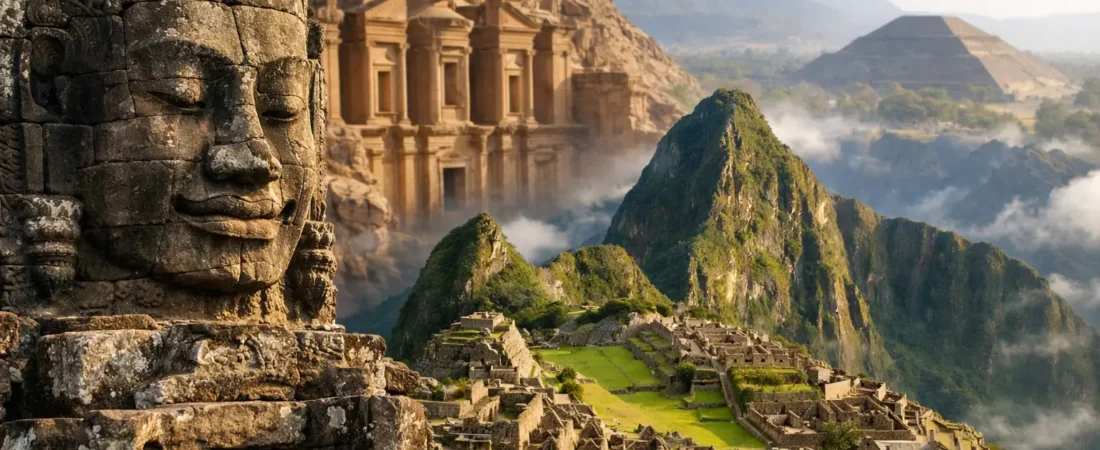
A wind moves through the empty avenues of Petra, catching in the carved façades where Nabataean merchants once watched caravans arrive. Far away, jungle roots clutch the stone terraces of Machu Picchu, while beneath the waters off Egypt’s coast, columns from Thonis-Heracleion lie where ships once anchored. The lost cities of the world are not merely ruins with romantic names. They are archives of human decisions: where to build, what to worship, whom to trade with, and when a place could no longer sustain the people who called it home.
The phrase “lost city” can be misleading. Many were never truly forgotten by local communities, even when outsiders overlooked them for centuries. Others vanished from written records but remained present in oral tradition, ritual landscapes, or the memory embedded in a place name. Their rediscovery is rarely a single dramatic moment. More often, it is a long conversation among archaeology, geography, ancient texts, and the people living nearby.
What Makes a City Lost?
A city can be abandoned after an earthquake, invasion, drought, epidemic, economic decline, or a shift in trade routes. Sometimes the cause is clear. Pompeii was overwhelmed by the eruption of Mount Vesuvius in A.D. 79. In other cases, evidence points in several directions rather than one final catastrophe.
That uncertainty is part of the fascination. Archaeologists do not simply uncover walls and declare a mystery solved. They study pollen, ceramics, skeletal remains, inscriptions, building repairs, soil layers, and the paths of rivers. A collapsed roof may tell us about a quake; an empty reservoir may point toward drought; imported pottery can reveal that a city remained connected long after its political power faded.
The following cities invite us to enter different moments of departure, survival, and rediscovery.
Petra: The Desert Capital Carved in Stone
Petra, in present-day Jordan, was the capital of the Nabataean Kingdom and one of the ancient world’s great crossroads. By the first centuries B.C. and A.D., caravans carrying incense, spices, textiles, and other valuable goods passed through this mountain basin. Its famous rose-colored monuments were carved directly into sandstone cliffs, but Petra’s true achievement was less visible: water management.
The Nabataeans built channels, dams, cisterns, and pipelines to capture rare rainfall and direct it through a dry landscape. Their city could support a large population and welcome traders precisely because its engineers understood the desert’s limits.
Petra declined after Roman trade patterns changed and devastating earthquakes damaged parts of its infrastructure, especially in the fourth and sixth centuries. It was never erased from regional knowledge, but it became little known in Europe until Swiss traveler Johann Ludwig Burckhardt entered it in 1812. Today, its survival brings a difficult balance. Tourism helps support preservation and local livelihoods, yet foot traffic, erosion, and flash floods continue to threaten the very structures visitors come to see.
A city built around water
Petra reminds us that a “lost” city may have been technologically sophisticated in ways its later admirers initially missed. The Treasury is spectacular. The cisterns are the reason it was possible.
Pompeii: A City Preserved in Its Final Hour
On the morning Vesuvius erupted, Pompeii was not an ancient relic. It was a busy Roman town of shops, homes, temples, workshops, taverns, gardens, and public baths. Ash and volcanic debris sealed much of the city, preserving an extraordinary cross-section of daily life.
Excavations have revealed election notices painted on walls, carbonized food, household shrines, wine jars, tools, and graffiti ranging from business messages to jokes and declarations of affection. Pompeii feels immediate because it retains the small traces that grand monuments often lose.
Yet its famous body casts demand care. They are not statues made by the volcano. In the nineteenth century, excavators poured plaster into voids left after bodies decomposed in hardened ash, creating casts that recorded final postures. Modern techniques, including scans and chemical analysis, have added detail while encouraging a more respectful approach to the victims as individuals rather than spectacles.
Pompeii was not lost in the same way as a jungle city. Its location was known, and early digging occurred before systematic archaeology developed. Still, its burial removed it from ordinary life for nearly 1,700 years. It offers an unsettling lesson: history can be interrupted in a day, while its material evidence can outlast empires.
Angkor: The Vast City Hidden by a Forest
For centuries, visitors approaching Angkor Wat in Cambodia encountered one of the largest religious monuments ever built. What was harder to see was the scale of the urban world surrounding it. Angkor was the center of the Khmer Empire, flourishing roughly from the ninth through fifteenth centuries, with temples, reservoirs, roads, canals, rice fields, and neighborhoods spread across a vast landscape.
Recent airborne laser mapping has transformed how scholars understand Angkor. By sending laser pulses through the forest canopy, researchers identified the outlines of roads, embankments, ponds, and settlement areas concealed beneath vegetation. Angkor was not simply a cluster of temples swallowed by jungle. It was a complex, low-density urban system shaped by water.
Its decline was gradual and uneven. Political conflict, changing trade networks, religious change, and repeated climate stress likely all played roles. Studies of regional climate records suggest severe droughts followed by intense monsoon rains may have strained waterworks designed for more predictable conditions. The old capital did not suddenly become empty, but power shifted south toward Phnom Penh.
Angkor’s story cautions against simple collapse narratives. Great cities can weaken over generations, adapting until adaptation is no longer enough.
Great Zimbabwe: Stone, Gold, and Misread History
On a high plateau in southeastern Zimbabwe stand the monumental dry-stone walls of Great Zimbabwe. Built between roughly the eleventh and fifteenth centuries, the site was the center of a powerful Shona society linked to regional cattle wealth, agriculture, and long-distance trade. Gold and ivory moved through trading networks that connected interior southern Africa to the Swahili Coast and the Indian Ocean world.
The Great Enclosure, with its curving walls and conical tower, astonished early European visitors. Some refused to believe African builders could have created it, inventing false connections to biblical figures or Mediterranean civilizations. Archaeological evidence has firmly established that Great Zimbabwe was built by local African ancestors.
Its decline may have involved environmental pressures, changing political centers, and the need to manage a growing population. No single explanation accounts for every detail. What matters is that Great Zimbabwe corrects a long-standing historical distortion. A lost city can be obscured not only by sand or forest, but by the prejudices of those interpreting it.
Thonis-Heracleion: Egypt’s Sunken Gateway
For more than a thousand years, Thonis-Heracleion stood near the mouth of the Nile, where Egypt met the Mediterranean. Egyptian sources knew it as Thonis; Greek writers called it Heracleion. Before Alexandria rose to prominence, it was a major port of entry, a place where goods, travelers, taxes, and religious processions passed between worlds.
The city eventually sank beneath Aboukir Bay. Researchers believe a combination of earthquakes, rising water, soil liquefaction, and coastal subsidence destabilized the land beneath it. Beginning in the early 2000s, underwater archaeologists documented enormous statues, temple remains, anchors, coins, ceramics, and shipwrecks scattered across the seabed.
The discoveries are especially valuable because water protected objects that might otherwise have been disturbed by later construction. They also show that ancient coastlines were never fixed. Ports flourished because of geography, and they could disappear because geography changed.
Machu Picchu: Not a City Lost to Everyone
Machu Picchu is often described as a city “lost” in the Peruvian Andes until Hiram Bingham brought international attention to it in 1911. That description needs revision. Local farmers knew of the site, and Bingham was guided there by residents of the region. The citadel was not unknown to Peruvians; it was unknown to much of the outside world.
Built in the fifteenth century under the Inca ruler Pachacuti, Machu Picchu occupies a spectacular ridge between mountain peaks. Its precisely fitted stonework, agricultural terraces, fountains, and ceremonial spaces reveal careful planning in difficult terrain. It was likely a royal estate or elite retreat, though scholars continue to debate aspects of its purpose and population.
The site was abandoned during the era of Spanish conquest, although there is no evidence that Spanish forces found or destroyed it. Its remote setting, combined with the vegetation that later covered its buildings, helped preserve it. Machu Picchu now faces a familiar modern challenge: how to welcome people into history without allowing popularity to wear history away.
Why These Ruins Still Matter
The lost cities of the world are often presented as riddles, as if their greatest value lies in a final unanswered question. But their deeper power is more human. They show that cities are living systems dependent on water, food, labor, belief, trade, and political stability. When one part changes, every other part feels the strain.
They also teach humility. Petra’s waterworks, Angkor’s engineered landscape, Great Zimbabwe’s trade networks, and Thonis-Heracleion’s submerged harbor all challenge narrow ideas about where innovation happened and who created it. Archaeology is at its best when it replaces fantasy with a richer reality.
When you encounter a ruined wall, a buried street, or a temple emerging from forest, resist the urge to see only silence. Look for the marks of ordinary life: drains, doorways, storage jars, worn steps, repairs made by hands that expected the city to endure. The past does not speak in one dramatic voice. It speaks in fragments, and each fragment asks us to preserve the evidence long enough to listen.