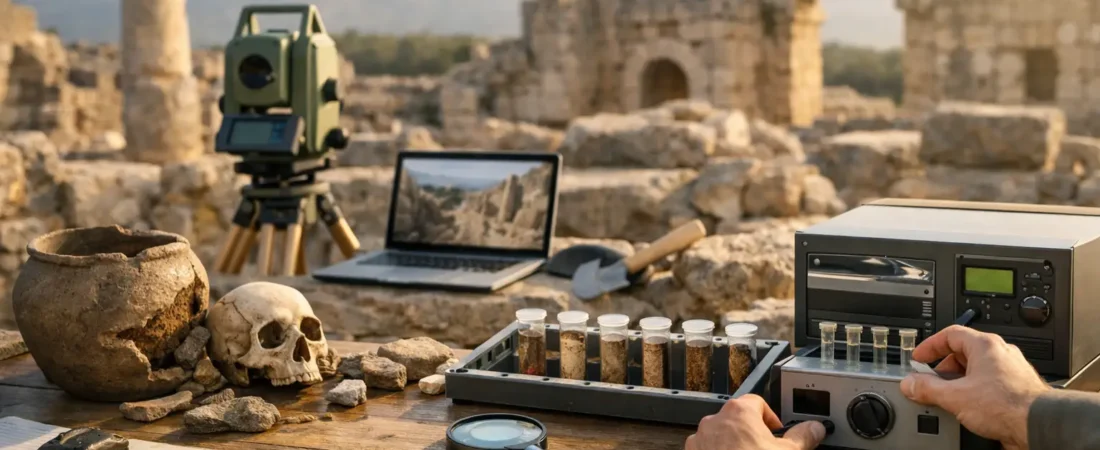
A ruined wall can look timeless at sunset: weathered stones, broken columns, roots pressing through old mortar. Yet archaeologists rarely ask only, “How old is this?” They ask a more precise question: When was each part of this place built, used, repaired, abandoned, and buried? Understanding how archaeologists date ancient ruins means seeing a site not as a frozen moment, but as a layered record of human lives.
A temple may stand on the remains of an earlier shrine. A Roman house may contain a floor laid centuries after its foundation. Even a single coin found in a room can tell a complicated story. It may date the room’s last use, not the day its walls went up. Archaeological dating is therefore less like reading a clock and more like assembling a historical timeline from fragments.
The First Clock Is the Ground Beneath the Ruins
Before an artifact reaches a laboratory, archaeologists study where it was found. This is stratigraphy, the principle that layers of soil usually accumulate over time. In an undisturbed deposit, the deepest layers were laid down first, while later activity appears above them.
Picture an ancient city destroyed by fire. Ash seals the floor of a shop. Over the ash, windblown soil gathers. Centuries later, a new settlement rises on the same hill. If excavators carefully record these layers, they can reconstruct the order of events: shop in use, fire, abandonment, burial, and later rebuilding.
This method provides relative dating. It tells archaeologists whether one object or structure is older or younger than another, even when it cannot yet supply a calendar year. The method is powerful, but it has limits. Graves cut through earlier layers. Pits are dug and refilled. Floods, burrowing animals, looters, and later builders can move material far from its original position. That is why excavation records matter as much as the objects themselves.
Context Can Matter More Than Rarity
A humble pottery sherd found sealed beneath a floor may be more useful than a gold ornament recovered without a recorded location. Archaeologists call the object’s position and relationship to nearby evidence its context. Once context is lost, much of the story disappears with it.
This is also why museums and researchers place such emphasis on documented excavation. An object removed from a ruin without records may be beautiful, but it cannot reliably explain when a room was occupied or how a settlement changed over time.
Dating Ancient Ruins Through Artifacts
People leave behind objects with recognizable histories. Pottery styles shift, coins carry rulers’ names, inscriptions mention officials or events, and architectural fashions change from one generation to the next. By comparing excavated material with well-dated examples, archaeologists can often narrow down a period of activity.
Pottery is especially valuable because it was made in enormous quantities, broke easily, and traveled widely. The shape of a jar handle, the color of a glaze, or a painted pattern may identify a particular region and era. At many sites, pottery is the first practical clue to a layer’s date.
Coins can offer an even tighter range. A coin minted under Emperor Constantine, for instance, could not have entered the ground before his reign. But it does not prove that the building beside it was constructed during his lifetime. Coins may remain in circulation for decades, be collected as curiosities, or fall into older deposits through later disturbance. Archaeologists treat them as evidence with a date range, not magical date stamps.
Inscriptions and building techniques can also speak clearly. A foundation inscription may name a ruler who commissioned a monument. Distinctive bricks, mortar recipes, column styles, or construction methods may point toward a known cultural tradition. Still, builders reused old stone throughout history. A Roman inscription embedded in a medieval wall dates the reused block, not necessarily the wall itself.
How Archaeologists Date Ancient Ruins With Science
When organic material survives, scientific methods can bring the timeline closer to calendar years. The best technique depends on what the site has preserved.
Radiocarbon Dating
Radiocarbon dating measures the gradual decay of carbon-14 in once-living material. Charcoal from a hearth, seeds from a storage jar, bone, wood, woven fibers, and even soot can sometimes be tested. Because living organisms absorb carbon during life, the remaining carbon-14 after death provides an estimate of when that organism stopped exchanging carbon with the environment.
For ruins, the key question is whether the sample truly relates to the event being dated. Charcoal beneath a foundation may help date construction. Charcoal in a later repair trench may date the repair instead. Old wood presents another challenge: a beam cut from a centuries-old tree may produce a date older than the building in which it was used.
Radiocarbon results are also calibrated against long-term records, including tree rings. The final answer is usually a range of probable dates, not one dramatic year. That uncertainty is not a weakness. It is an honest reflection of the evidence.
Tree Rings, Light, and Volcanic Ash
Dendrochronology, or tree-ring dating, can be remarkably precise when timbers retain enough rings and can be matched to established regional sequences. In favorable cases, it can identify the year a tree was felled. If that wood was used promptly in construction, it may closely date a building phase.
Other methods date the moment minerals were last exposed to sunlight or intense heat. Optically stimulated luminescence can estimate when sediments were last exposed to light, making it useful for buried earthworks and sediments. Thermoluminescence may help date ceramics, bricks, and heated stone by measuring energy stored since their last firing.
Volcanic eruptions sometimes provide extraordinary time markers. A layer of ash from a known eruption can seal a settlement or appear within a building sequence. At Pompeii, the eruption of Mount Vesuvius in AD 79 created a catastrophic but invaluable archaeological boundary. Yet even there, archaeologists must distinguish between evidence from the final disaster and material from earlier renovations or later disturbance.
Ruins Are Usually Older Than Their Latest Finds
One of the most common misunderstandings is that a site has one date. In reality, ancient places often have biographies.
A hilltop fortress may begin as an Iron Age enclosure, gain stone walls under Roman rule, become a medieval refuge, and later serve as a shepherds’ shelter. Each phase leaves its own floors, repairs, rubbish deposits, and altered foundations. A careful excavation separates these episodes rather than forcing them into one simplified age.
Archaeologists also distinguish between the date an object was made, the date it was used, and the date it was discarded. A family might keep an heirloom vessel for generations. A stone statue could be moved from a temple into a garden. A collapsed roof beam may preserve the date of a fire rather than the original construction of the house.
This patient attention to sequence is what protects archaeology from easy but misleading answers.
Building a Date From Many Small Clues
The most trustworthy dates come from agreement among different forms of evidence. Stratigraphy may show that a house was rebuilt after a destruction layer. Pottery may place that destruction in the late first century BC. A radiocarbon sample from the burned roof may support the same range. A coin beneath the replacement floor may establish that the rebuilding happened later still.
When evidence conflicts, archaeologists do not simply choose the most appealing result. They investigate. Was the sample contaminated? Was the coin residual material from an older layer? Did a later pit cut through the deposit? Could a style have continued longer in this region than elsewhere? Archaeology advances through such careful challenges.
Modern tools add further precision without replacing the excavator’s eye. Ground-penetrating radar can reveal buried walls before excavation. Geographic information systems map a site’s changing landscape. Micromorphology examines soil in thin sections under a microscope, revealing trampled floors, ash, dung, and tiny construction traces. These methods help archaeologists decide where a sample belongs in the larger story.
The Date Is a Doorway, Not the Destination
Knowing that a ruined room was occupied around AD 200 is only the beginning. A date lets us place people within wider events: a drought, an empire’s expansion, a trading network, a migration, or a local disaster. It can reveal whether a settlement flourished before a war, endured through it, or was rebuilt afterward.
The next time you stand before ancient stones, imagine the ground as a library whose pages have been pressed into earth. The walls are only one chapter. Beneath them lie repairs, meals, fires, footprints, collapsed roofs, and generations of decisions. Archaeologists date ruins not to reduce them to a number, but to return those buried chapters to time – and, with care, to human memory.