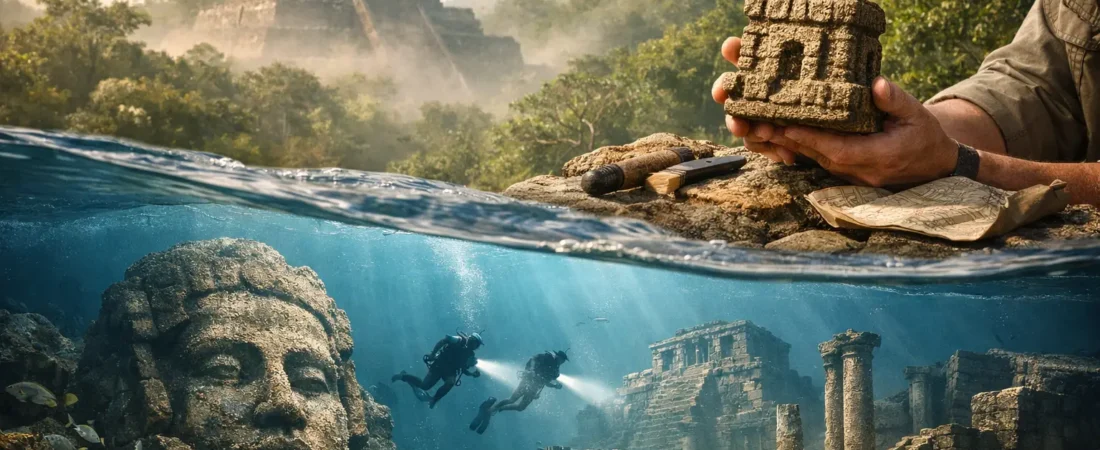
A wall rises from the jungle after rain. A stairway appears where a field had looked empty for centuries. A pattern beneath desert sand resolves into streets, temples, and homes. When we talk about lost civilizations discovered, the phrase can sound dramatic, but the reality is often quieter and more moving. What is found is not fantasy. It is evidence – stone foundations, broken pottery, pollen trapped in soil, inscriptions worn by weather, and the stubborn trace of human life refusing to disappear.
That is what makes these discoveries so powerful. They do not simply add another name to a map of the ancient world. They change scale. They remind us that whole societies can flourish, build, trade, worship, and vanish from public memory while leaving behind enough for patient hands to recover their outlines. To stand at one of these sites is to feel a strange double vision. You are in the present, but the ground insists that countless lives once moved here with purpose.
Why lost civilizations discovered still reshape history
Archaeology rarely works like an adventure film. More often, it advances by fragments. A carved stone suggests a dynasty. A burial pattern reveals social rank. Microscopic remains of crops can tell us whether a city fed itself or depended on distant trade. Yet when enough fragments gather, a lost civilization does not merely reappear. It forces historians to revise old assumptions about power, innovation, and cultural exchange.
For a long time, many ancient societies were underestimated because they left fewer surviving written records, or because their cities were hidden by forest, silt, volcanic ash, or later construction. In some cases, colonial-era scholarship also distorted the picture, treating certain peoples as marginal when the evidence now shows they were sophisticated engineers, traders, and political organizers.
This is one of the central lessons behind lost civilizations discovered in the last two centuries. History is not fixed. It expands when better tools and better questions meet the material record.
Pompeii and the civilization frozen mid-breath
Few places make the past feel more immediate than Pompeii. When Mount Vesuvius erupted in AD 79, ash and volcanic debris sealed parts of the city with terrifying speed. What survived was not an entire civilization in a single site, but a vivid cross-section of Roman urban life – shops, homes, graffiti, shrines, bakeries, baths, and the physical imprint of disaster.
Pompeii matters because it strips away the polished marble image of Rome and gives us texture. We see election slogans on walls, food counters facing the street, garden layouts, and the clutter of ordinary rooms. The city was not preserved perfectly, and early excavations damaged context that modern archaeologists value deeply. That trade-off is part of the story. Pompeii became famous early, but archaeology as a discipline was still immature. What was saved came at the cost of methods we would handle differently now.
Even so, Pompeii transformed our understanding of Roman daily life. It showed that history is not only made of emperors and battles. It is also made of loaves left in ovens and footsteps halted in an instant.
Troy, myth, and the danger of certainty
When the site identified as ancient Troy was excavated in northwestern Turkey, it electrified the world. Here was a place long associated with epic poetry, warrior kings, and the Trojan War. Yet Troy also offers a cautionary lesson. The desire to prove legend can damage history if evidence is forced to fit a romantic narrative.
Nineteenth-century excavator Heinrich Schliemann helped bring Troy to international attention, but his methods were destructive by modern standards. He cut through layers that later archaeologists would have studied far more carefully. What emerged over time was not one Troy, but many. The mound held multiple cities built one atop another across centuries.
That complexity is more valuable than a simple headline. Troy was real as a settlement center, but the relationship between archaeology and Homer remains debated. This is where responsible historical storytelling matters. Sometimes a discovery confirms a place but not the full legend attached to it. That does not make the site less fascinating. It makes it more honest.
The Maya cities the forest tried to keep
In Mesoamerica, Maya cities were never truly lost to local communities, but many monumental centers were swallowed by vegetation and misunderstood by outsiders for generations. Over time, excavations at places such as Tikal, Palenque, Copan, and Calakmul revealed a network of city-states with complex writing, astronomy, dynastic politics, and monumental architecture.
Recent laser mapping, known as LiDAR, has widened that picture dramatically. By stripping away the visual cover of the forest canopy, researchers have identified roads, terraces, fortifications, reservoirs, and dense settlement patterns on a scale that earlier surveys missed. The result has been one of the most important archaeological shifts of recent decades. The Maya world was not a scattering of isolated ceremonial centers surrounded by empty jungle. In many regions, it was heavily managed, engineered, and interconnected.
This matters because it changes how we imagine population, governance, and environmental pressure. It also complicates the old collapse narrative. There was no single simple ending. Different Maya cities declined at different times for different reasons, with drought, warfare, political instability, and changing trade routes all playing roles depending on the place.
Lost civilizations discovered under desert and sand
Some of the most arresting archaeological recoveries come from dry landscapes, where cities can vanish under dunes or survive in harsh silence. Petra in present-day Jordan was known locally and never wholly disappeared, yet to much of the Western world it seemed almost unreal when it entered modern imagination. Carved into rose-colored rock and sustained by advanced water management, Petra reveals the Nabataeans as far more than caravan middlemen. They were strategic planners who built an urban center in a difficult environment and tied it into long-distance trade.
Farther east, sites in Mesopotamia continue to emerge through excavation and remote sensing, reminding us that many ancient settlements still lie under alluvium, modern towns, or unexcavated mounds. In Egypt, buried neighborhoods and newly identified cemeteries repeatedly refine what we know about urban life beyond the pharaohs.
Desert discoveries often look dramatic, but they also come with limits. Preservation can be excellent in one layer and terrible in another. Looting, erosion, and modern development can erase evidence faster than archaeologists can record it. Finding a site is only the beginning. Interpreting it takes years.
Angkor and the lost civilizations discovered by new technology
Angkor in Cambodia was never absent from local memory, but much of its full urban extent remained hidden for centuries beneath forest and sediment. Best known for Angkor Wat, the broader Angkorian landscape has emerged as one of the most striking examples of how technology can redraw historical understanding.
LiDAR surveys revealed a vast low-density urban network of temples, roads, reservoirs, canals, and neighborhoods spread across a scale that surprised even specialists. Angkor was not just a temple complex. It was an enormous engineered environment.
That discovery sharpened a larger truth. Some civilizations do not disappear because they were small or primitive. They disappear from broad public awareness because their remains are hard to read from the ground. New tools – LiDAR, satellite imagery, ground-penetrating radar, isotope analysis, and ancient DNA – have become lanterns in places where spades alone are not enough.
What these discoveries really tell us
The phrase lost civilization can be misleading if used carelessly. Civilizations are not magic acts. They are human communities shaped by climate, conflict, trade, belief, disease, leadership, and adaptation. Many were never truly lost to descendants or local populations. They were lost mainly to wider historical narratives that ignored them, buried them, or failed to understand their scale.
That distinction matters. It keeps wonder grounded in respect. Archaeology is at its best when it recovers voices without pretending certainty where certainty does not exist. A newly mapped city plan can tell us about infrastructure, but not every ritual. A royal tomb can illuminate elite culture, but not every farmer’s life. The evidence is powerful, yet always partial.
Still, there is something deeply human in these recoveries. Every carved lintel and shattered vessel resists oblivion. Every excavated street suggests children running, merchants bargaining, priests preparing offerings, laborers hauling stone, rulers making promises they could not keep. The past returns not as a complete script, but as a stage set with enough detail for us to recognize ourselves.
At Time Vault Capsule, that is the real thrill of archaeology. Not the fantasy of a vanished world suddenly solved, but the patient reassembly of lives once thought silent. The next great find may be under jungle roots, beneath a modern city block, or hidden in plain sight inside museum storerooms waiting for new analysis. History still has unopened chambers. When one of them opens, the most valuable thing we recover is not treasure. It is perspective.