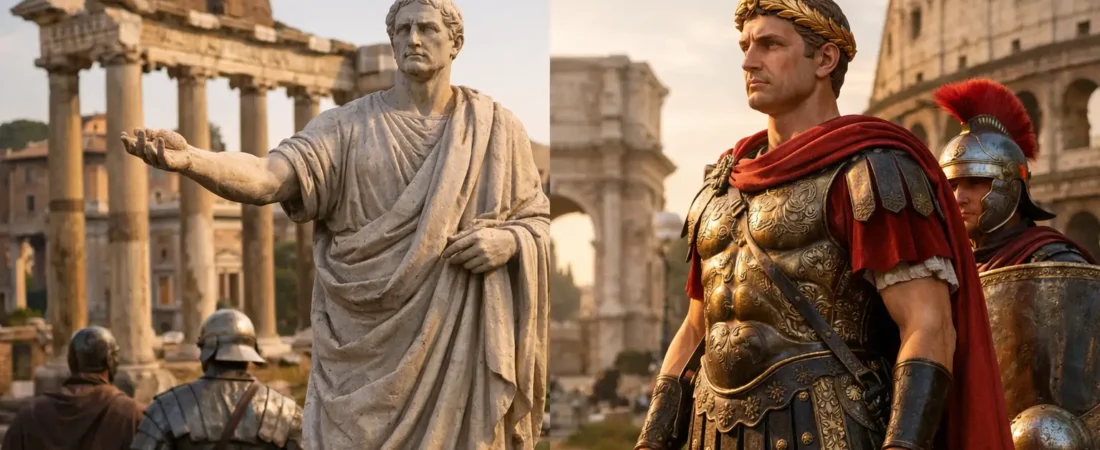
On the Roman Forum, the change did not arrive with one shattered statue or a single proclamation. Senators still wore their broad purple stripes. Elections still took place. Priests still consulted the gods. Yet, by the time Augustus ruled, the old republic had become something very different: a state in which one man held the decisive military, political, and religious power.
The question of Roman Republic vs Empire is therefore more than a contrast between democracy and monarchy. Rome was never a modern democracy, and its empire of overseas territories began long before it had an emperor. The real story is how a fiercely competitive republic, built to prevent kingship, created conditions in which rule by one extraordinary citizen became possible.
Rome Before Emperors: The Republic’s Fragile Balance
Roman tradition dated the founding of the Republic to 509 BCE, after the expulsion of Rome’s last king, Tarquinius Superbus. Whether every detail of that origin story is historical matters less than its political message: Romans believed liberty began when they rejected kings.
The Republic divided authority among elected magistrates, the Senate, and popular assemblies. Two consuls, elected annually, led armies and governed the state. Other offices handled courts, finances, public order, and religious duties. In a crisis, Romans could appoint a dictator, but traditionally only for a limited term of six months.
This system was designed around short terms, shared office, and mutual obstruction. One consul could veto another. Tribunes, officials elected to defend the interests of plebeians, could block actions they considered harmful. No Roman was supposed to become indispensable.
Yet the Republic was not governed equally by all. The Senate, filled largely with wealthy former magistrates, held enormous influence over foreign policy, finance, and provincial administration. Elections mattered, but aristocratic families possessed networks of clients, land, money, and prestige that shaped public life. Rome’s republican ideals were real, but they operated within a deeply unequal society.
The Roman Republic vs Empire: One Word, Two Meanings
A useful distinction prevents a common misunderstanding. In English, “empire” can mean a vast collection of lands ruled by a central power. By that measure, Rome became an empire during the Republic. After defeating Carthage in the Punic Wars, Rome acquired provinces in Sicily, Spain, North Africa, Greece, and Asia Minor. Republican governors and generals oversaw territories far beyond Italy.
But “Empire” with a capital E usually refers to the imperial political system that began with Augustus in 27 BCE. Under this arrangement, Rome retained republican language and institutions while concentrating effective power in the hands of the emperor.
That distinction explains why the transition was gradual rather than sudden. Republican Rome conquered an empire. The Roman Empire later governed it under imperial leadership.
A Republic Built for a City Faces a Mediterranean World
Rome’s victories brought wealth, enslaved people, farmland, tribute, and new trading opportunities. They also brought pressures its older political system struggled to absorb. Senators competed for provincial commands because military success could bring immense riches and public fame. Generals became more visible to their troops than distant civic institutions in Rome.
At the same time, small farmers could lose land while serving in long campaigns. Large estates expanded, often worked by enslaved labor. Crowded urban populations depended increasingly on political patrons and grain distributions. These changes did not automatically destroy the Republic, but they sharpened old divisions between elite factions and between rich and poor citizens.
When Politics Became Personal
In 133 BCE, the tribune Tiberius Gracchus proposed land reforms intended to redistribute public land to poorer citizens. His political opponents resisted him fiercely. He and many supporters were killed in an outbreak of violence near the Capitol, a shocking breach of Roman political custom.
His younger brother, Gaius Gracchus, pursued further reforms and met a similar end. The Gracchi did not cause the Republic’s collapse on their own, but their deaths revealed a dangerous precedent: when compromise failed, Roman leaders increasingly reached for force.
The following generations saw commanders use armies as political instruments. Gaius Marius, a celebrated general, held the consulship an unprecedented seven times. His rival, Lucius Cornelius Sulla, marched his army on Rome itself in 88 BCE, then did so again after civil war. As dictator, Sulla published lists of enemies who could be killed and whose property could be seized. He attempted to restore senatorial control, but his example taught later leaders that an army could decide Rome’s politics.
The final decades of the Republic were marked by alliances that bypassed ordinary constitutional restraint. Julius Caesar, Pompey the Great, and Marcus Licinius Crassus formed an informal partnership often called the First Triumvirate. Each possessed something the others needed: military glory, popular influence, or vast wealth.
When the alliance broke apart, Caesar crossed the Rubicon River in 49 BCE with his army, beginning a civil war against Pompey and the senatorial faction. His victory made him dictator, eventually dictator perpetuo, or dictator in perpetuity. To supporters, he brought order and reform. To opponents, he appeared perilously close to the king Romans had feared for centuries.
On March 15, 44 BCE, Caesar was assassinated in the Senate house. The conspirators claimed they had saved the Republic. Instead, they opened the way to more war.
From Caesar’s Heir to Augustus
After Caesar’s murder, his adopted heir Octavian emerged as a formidable and patient political operator. He joined Mark Antony and Marcus Aemilius Lepidus in the Second Triumvirate, a legally sanctioned three-man dictatorship. Its brutal proscriptions claimed the life of Cicero, among many others.
The triumvirs defeated Caesar’s assassins at Philippi in 42 BCE, but their partnership soon collapsed. Octavian defeated Antony and Cleopatra at the Battle of Actium in 31 BCE. Antony and Cleopatra died the following year, and Octavian stood alone at the center of Roman power.
In 27 BCE, Octavian performed one of history’s most careful political transformations. He publicly presented himself as restoring authority to the Senate and Roman people. The Senate honored him with the name Augustus, meaning “revered one.” He avoided calling himself king. Instead, he accumulated republican offices and powers: command over major provinces and most legions, tribunician authority, religious influence, and unmatched prestige.
Augustus called himself princeps, or “first citizen.” This is why the early imperial system is often called the Principate. The republic’s outward forms remained, but they no longer had equal weight. Senators debated, magistrates served, and assemblies met, while the emperor controlled the military forces that ultimately guaranteed power.
A Short Timeline of the Transition
- 509 BCE: Roman tradition places the beginning of the Republic after the expulsion of the kings.
- 133 BCE: Tiberius Gracchus is killed amid conflict over land reform.
- 82-79 BCE: Sulla rules as dictator after marching on Rome and winning a civil war.
- 49 BCE: Julius Caesar crosses the Rubicon, triggering civil war.
- 44 BCE: Caesar is assassinated on the Ides of March.
- 31 BCE: Octavian defeats Antony and Cleopatra at Actium.
- 27 BCE: Octavian receives the title Augustus, conventionally marking the start of the Roman Empire.
What Actually Changed Under the Empire?
The most dramatic difference was the location of power. In the Republic, authority was dispersed, unstable, and fiercely contested among elite families. Under Augustus and his successors, authority was concentrated in an emperor whose position depended above all on control of the army.
That concentration had trade-offs. The Empire could provide greater continuity after a century of civil conflict. Augustus established a more professional military structure, reorganized provincial administration, and presided over the opening of the Pax Romana, a long period of relative stability across much of the Mediterranean. Roads, aqueducts, monumental buildings, coinage, and commercial networks connected communities from Britain to Syria.
But stability could become dependence on the character of one ruler. A capable emperor could govern with restraint, consult the Senate, and fund public works. A cruel or reckless emperor could endanger the entire state. There was no reliable constitutional mechanism for peaceful succession. When an emperor died without an accepted heir, legions and rival claimants could turn the empire into a battlefield.
For ordinary people, the shift was not always immediately visible. A farmer in Italy, a merchant in Gaul, or a family in Roman Egypt still dealt with taxes, local officials, military recruitment, religion, and the practical rhythms of work. Yet imperial rule increasingly reached into daily life through censuses, law, coinage, military service, and the emperor’s image displayed in public spaces.
Why Rome’s Transformation Still Matters
Rome’s story resists a simple moral. The Republic was not a lost age of universal freedom, nor was the Empire only tyranny in marble. Republican institutions allowed participation and competition, but they also excluded many people and repeatedly failed to restrain powerful men. Imperial rule brought order and administrative reach, but at the cost of political liberty and with the permanent risk of autocracy.
The ruins of the Forum preserve this tension. There stand the spaces where citizens voted, advocates argued, generals celebrated triumphs, and emperors reshaped public memory. Rome did not abandon its past when Augustus rose to power. It carried the language, symbols, and offices of the Republic into a new age, even as their meaning changed.
When you encounter a Roman inscription praising the Senate and People of Rome, look beyond the familiar letters, SPQR. Ask who commanded the legions, who controlled the money, and whose voice could truly alter events. That is where the living difference between republic and empire can still be found.