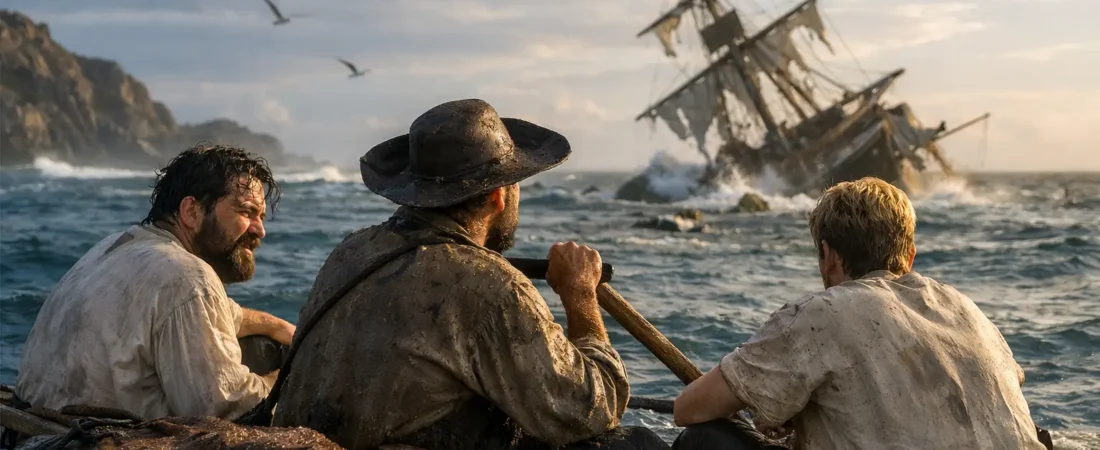
A shipwreck rarely began with one dramatic moment. It began with details: a reef glimpsed too late through rain, a hull groaning under ice pressure, a sail split by a gale, a captain forced to choose between grounding the vessel or letting her founder in deep water. How sailors survived shipwreck disasters depended less on luck alone than on preparation, command, practical knowledge, and the stubborn ability to make decisions while cold, exhausted, and afraid.
For centuries, the sea offered little mercy after a ship went down. There were no radio distress calls, rescue helicopters, or satellite beacons. A survivor might face surf on an unfamiliar coast, an open boat with too little water, or a crowded raft where hunger and panic became as dangerous as the storm. Yet again and again, people endured. Their stories reveal what survival at sea truly required.
The First Minutes Decided Everything
When a vessel struck rock or began taking on water, the greatest enemy was often confusion. Water entering a ship could extinguish lights, scatter passengers, and make decks treacherous within minutes. Sailors who knew the vessel’s layout had an advantage: they could find hatches, pumps, boats, axes, stored provisions, and routes to the open deck even in darkness.
Experienced crews also understood that abandoning ship too early could be fatal. A damaged hull was still shelter, food store, and navigational platform. Small boats, by contrast, could be swamped, separated, or lost in heavy surf. Captains had to judge whether a vessel could be repaired, run aground deliberately, or kept afloat long enough to organize an evacuation.
That judgment was never simple. On April 15, 1912, Titanic’s crew had only a short window to lower lifeboats as the ship settled by the bow. The disaster exposed a terrible mismatch between the ship’s capacity and its lifesaving equipment: Titanic carried boats for about 1,178 people, far fewer than those aboard. Roughly 706 people survived, many because they reached a lifeboat before the final plunge and because the nearby Carpathia received Titanic’s distress signals.
The lesson was stark. In a wreck, equipment matters, but the ability to deploy it matters just as much. A boat hanging uselessly in its davits was no refuge.
How Sailors Survived Shipwreck Disasters at Sea
Once survivors left the ship, their world became very small: a boat, a sail or oar, a ration tin, the horizon. The first objective was usually to stay together. A cluster of boats was easier for rescuers to spot, and groups could share tools, knowledge, and labor. Separation created different risks. One boat might possess a compass, another a water cask, and a third the only person able to navigate by stars.
Water was the central concern. Humans can endure longer without food than without fresh water, especially under a hard sun or in salt spray. Sailors rationed carefully, collected rainwater from sails or clothing, and tried to shield themselves from exposure. Drinking seawater was a desperate mistake. Its salt content worsened dehydration, confusion, and eventually organ failure.
Food still mattered, especially on long voyages in open boats. Hardtack, preserved meat, ship’s biscuit, and whatever could be caught from the sea were divided under close watch. Rations were not merely nutritional. Fair distribution protected order. A crew that trusted its officers, or at least believed the rules were consistent, had a better chance of remaining functional.
Navigation gave survivors a purpose beyond endurance. Mariners read currents, prevailing winds, seabirds, drifting vegetation, cloud formations, and stars. Before modern charts and instruments, many knew the broad geography of trade routes and coasts well enough to make an informed gamble. The choice was rarely between safety and danger. It was between dangers: remain near the wreck in hopes of rescue, or sail toward a shore that might be days away.
Discipline Was a Form of Lifeboat
Accounts of maritime disasters repeatedly show that routine could preserve life. Someone bailed water. Someone tended a wound. Someone watched the horizon. Someone kept count of the rations. These tasks gave frightened people a role and prevented precious energy from disappearing into panic.
Sir Ernest Shackleton’s Endurance expedition is one of the clearest examples. In 1915, Antarctic pack ice crushed the expedition ship Endurance. Shackleton and his 27 companions camped on the ice, then launched their boats when the floes began breaking apart. Their survival did not come from a single heroic gesture. It came from months of hard discipline: protecting supplies, maintaining morale, keeping men moving, and adapting plans as ice and weather changed.
After reaching the bleak shores of Elephant Island, Shackleton and five men sailed the small boat James Caird about 800 miles across the Southern Ocean to seek help. The voyage was extraordinary, but it depended on unglamorous preparation. Frank Worsley’s navigation, improvised boat modifications, ration management, and the group’s shared endurance all played their part. Every member of the expedition ultimately survived.
Leadership could also fail catastrophically. The French frigate Medusa ran aground off West Africa in 1816 after poor navigation and command decisions. With too few boats, 147 people were placed on an improvised raft. Set adrift with inadequate provisions, they suffered thirst, violence, and exposure. Only 15 were alive when rescued 13 days later. The episode is remembered not simply because it was horrific, but because it shows how swiftly poor planning can turn a wreck into a larger disaster.
Shore Was Not Always Safety
Reaching land could feel like deliverance, but many wreck survivors found a new set of hazards waiting. An unfamiliar coast might offer no fresh water, little food, dangerous terrain, or communities with whom communication was difficult. Injuries sustained in the wreck could worsen without treatment. Wet clothing, wind, and exhaustion could kill even after the surf had been crossed.
The Dutch East India Company ship Batavia wrecked on reefs off the coast of Western Australia in 1629. Many survivors reached small islands in the Houtman Abrolhos, but the disaster became infamous for violence among the stranded. While the commander sought help, a faction led by Jeronimus Cornelisz murdered more than 100 people. The wreck reminds us that survival was not always a contest between humans and nature. Scarcity, authority, and fear could expose the darkest divisions within a group.
Other castaways survived because they learned quickly from their surroundings. They looked for water before food, built shade before attempting long journeys, and used wreckage as a resource. Broken spars became shelter frames. Sails became tents, bandages, or rain catchers. Barrels became flotation devices or storage. A ruined ship was often a floating warehouse, and survivors who salvaged methodically before it disappeared gained precious time.
The Skills Hidden Behind the Legends
Popular shipwreck stories often celebrate the final rescue, the dramatic raft, or the lone sailor clinging to wreckage. The quieter skills deserve equal attention. Knots held boats together. Sail handling prevented a small craft from capsizing. First aid limited blood loss and infection. Celestial navigation transformed a blank horizon into a route. Even knowing how to rest in shifts could preserve the strength needed for the next crisis.
Social skill mattered too. In close quarters, survival depended on cooperation among people who may have differed sharply in rank, language, age, and experience. Captains who communicated honestly could build trust, although blunt truth sometimes had to be balanced against the need to sustain hope. Hierarchy could organize labor, but rigid custom could also cost lives when it prevented swift action.
Modern maritime safety grew from many such losses. Better lifeboat rules, emergency drills, radio watches, weather forecasting, life jackets, and international rescue systems were written into practice because earlier sailors had paid dearly for their absence. These improvements do not make the sea predictable. They acknowledge that survival should not rest solely on courage when better preparation is possible.
The wrecks preserved in logbooks, paintings, artifacts, and cold seabeds are not only records of catastrophe. They are evidence of people making choices under impossible pressure: bailing one more bucket, sharing one more mouthful of water, reading a patch of clear sky, or refusing to leave a companion behind. When we stand before the relics of a lost ship, we are looking at more than what the sea took. We are also looking at what human skill, endurance, and solidarity sometimes saved.