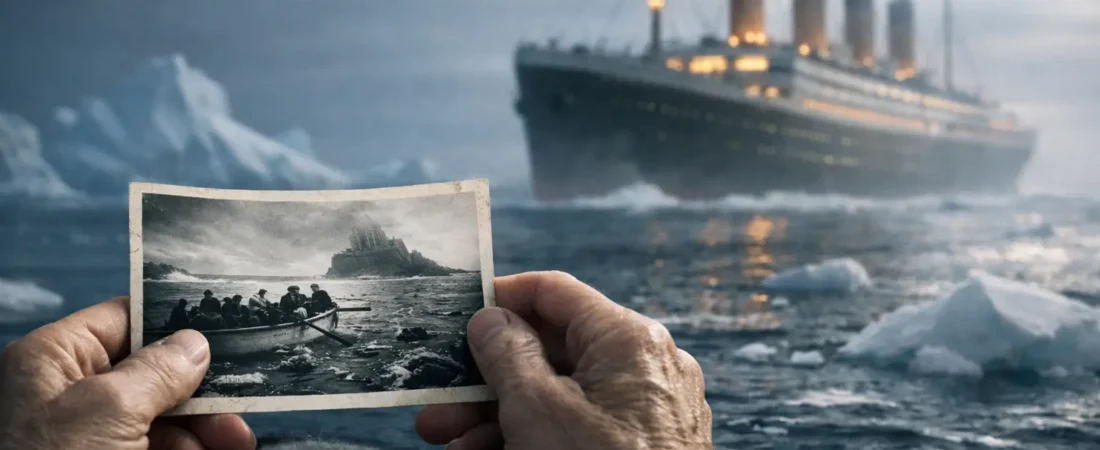
A ship can vanish in two hours and forty minutes. A voice can carry across a century.
That is why witness accounts of Titanic still matter. They do more than confirm the sequence of a famous disaster. They preserve the texture of that night – the brittle cold, the strange calm after impact, the disbelief on deck, the music, the cries in the dark, and the terrible silence that followed. Through survivors, crew members, and those who watched from nearby ships, the sinking of Titanic becomes less like a legend and more like a lived human event.
Why witness accounts of Titanic remain so powerful
Titanic has been told and retold in books, documentaries, films, inquiries, and museum galleries. Yet firsthand testimony remains the most revealing layer of all. The official timeline can tell us when the iceberg struck, when the distress signals were sent, and when the ship slipped beneath the Atlantic. Witnesses tell us something different: how long denial lasted, what people noticed first, and how ordinary habits persisted even as catastrophe unfolded.
That difference matters because disaster is rarely experienced as a neat timeline. It is confusion, hesitation, rumor, and small decisions made under pressure. One passenger remembered a slight jar. Another recalled ice scattered on the forward well deck. A steward focused on waking sleeping travelers. A wireless operator stayed at his set as the power failed. These fragments do not always match perfectly, but that is part of their value. They show how human beings actually perceive crisis.
The first moments after impact
Many survivors later said the collision did not feel like a violent crash. That detail surprises modern readers, but it appears again and again in testimony. Titanic was moving fast, yet the impact was described by some as a shudder, a scraping vibration, or a long, glancing tremor. For passengers deep inside a warm, brightly lit liner, it did not immediately suggest mortal danger.
Second-class passenger Lawrence Beesley, one of the most frequently quoted survivors, wrote of a sudden stoppage followed by an unusual sensation rather than chaos. Others stepped out onto deck and found ice fragments, joking at first about having struck a small patch of frozen sea. This gap between danger and recognition shaped everything that followed. Precious minutes slipped away while many passengers remained inside, dressing carefully, asking questions, or assuming the ship was unsinkable because they had heard exactly that.
Crew testimony adds another layer. Some engineers and officers understood the scale of the damage far sooner than most passengers. Water was entering multiple compartments. Mail clerks worked in flooding spaces. Firemen and engine room staff stayed below in growing peril to keep lights and power running. Their stories are often less famous than those of first-class survivors, yet they reveal the sacrifice that made evacuation possible at all.
Voices from the boats and the decks
If there is one recurring theme in witness accounts of Titanic, it is disbelief. Lifeboats were lowered half full in the early stage of evacuation because many passengers were reluctant to leave a large, illuminated ship for a small open boat in freezing darkness. Some believed the lifeboats were the more dangerous choice.
Here the accounts grow especially vivid. Archibald Gracie, a first-class passenger who survived by reaching an overturned collapsible, later described the final stages with sharp detail and a soldier’s attention to sequence. Margaret Brown remembered the strain inside the lifeboats themselves – the uncertainty, the cold, and disagreements over whether to return for swimmers. Charles Lightoller, the ship’s second officer and the senior surviving officer, left some of the most important recollections from the crew’s side, though his memory, like all memory under trauma, must be read carefully.
One of the most haunting testimonies came from wireless operator Harold Bride. He recalled the routine of distress work turning steadily unreal as the situation worsened. Signals were sent. Replies came back. Nearby ships were discussed in terms of miles and minutes while the ocean around Titanic remained black and indifferent. Bride’s account captures an unsettling truth of modern disaster: technology can connect people instantly and still fail to save them in time.
Then there were the sounds. Survivors repeatedly described the ship’s band playing on deck, though there is disagreement about exactly what was played near the end. Some remembered hymns. Others recalled more general dance music meant to steady nerves. That uncertainty has inspired endless debate, but the larger fact is well supported: music was used to maintain calm while the ship died.
And after the final plunge came what many survivors found hardest to remember – the cries of those left in the water. Lifeboat passengers spoke of hearing a vast chorus of voices in the darkness, then a fading. It is one of the most painful threads in the historical record because it forced survivors to live not only with escape, but with helplessness.
What nearby witnesses saw
Not all witnesses were aboard Titanic. Some of the most debated testimony came from people on nearby vessels, especially the Californian, whose crew saw rockets in the distance but did not respond in time. Their statements became central to the official inquiries held in the United States and Britain.
These accounts are frustrating, contradictory, and historically important. Officers and crew disagreed on what they saw, how large the distant ship appeared, and what the rockets meant. To later generations, the failure seems impossible to explain. To historians, it is a case study in nighttime misjudgment, incomplete communication, hierarchy, and the fatal consequences of uncertainty. Witnesses did not merely recount the sinking. They also revealed how disasters can be worsened by hesitation elsewhere.
When the Carpathia arrived and began taking in survivors, new testimony emerged immediately. Passengers wrapped in blankets described husbands left behind, children separated from parents, and the eerie sight of lifeboats drifting on a glassy sea at dawn. These first interviews, taken before memory had fully settled into narrative, remain especially striking. They are raw, fragmented, and often emotionally direct.
The limits of Titanic survivor testimony
It is tempting to treat firsthand accounts as pure truth. Historians cannot do that. Memory is shaped by trauma, status, shame, pride, publicity, and time. Some survivors testified within days. Others wrote memoirs years later. Details shifted. Timings blurred. Personal reputations also shaped recollections, especially for officers whose decisions were being judged in public.
That does not make the accounts useless. It makes them human. The task is to compare them with one another, with wireless logs, ship plans, inquiry records, oceanographic evidence, and later archaeological findings from the wreck itself. When multiple independent witnesses describe the same feature – the mildness of the initial impact, the shortage of urgency, the angle of the deck, the intense cold – confidence grows. When stories conflict, the conflict becomes part of the history.
This is one reason Titanic continues to hold public attention. It sits at the meeting point of modern technology and ancient vulnerability. We have survivor books, testimony transcripts, newspaper interviews, recovered artifacts, and a wreck site on the ocean floor. Few disasters are documented with such emotional richness.
What the accounts tell us about class, courage, and chance
The most famous witness narratives often came from first-class passengers because they had status, education, and access to publishers. But the fuller record reminds us that Titanic was also a story of immigrants, stokers, stewards, musicians, telegraphers, bakers, children, and domestic workers. Their experiences differed sharply depending on where they were in the ship and how quickly they were directed toward the boat deck.
Class shaped survival in practical ways. Distance from lifeboats mattered. Language barriers mattered. So did familiarity with the ship. Yet witness testimony also complicates any simple moral story. There were acts of discipline and selfishness, bravery and confusion, generosity and denial, spread across all ranks. Some crew members performed with extraordinary resolve. Some passengers helped strangers. Some people froze, argued, or refused to believe what was happening. Real disasters are like that.
Chance appears everywhere in the record. A person lingers in a cabin to fetch a blanket and misses a boat. Another walks to the deck at the right moment and is waved in. One family is divided by a rule. Another survives together by accident. Read enough survivor testimony and the sinking stops looking inevitable in human terms, even if it was physically irreversible. It feels instead like a thousand private crossroads unfolding at once.
Why these testimonies still speak to us
The enduring force of witness accounts of Titanic is not only that they describe death. It is that they preserve behavior under impossible conditions. They show how people cling to routine, search for authority, protect loved ones, misread danger, and create meaning while the world tilts beneath them.
For a history brand like Time Vault Capsule, this is where the past feels closest. Not in the grand image of a famous liner, but in the remembered details: a steward’s knock, ice shining on deck, a band still playing, a lifeboat hesitating in the dark. Those moments resist becoming cliché because they were once immediate, cold, and real.
If you want to understand Titanic, start with the witnesses. Listen for where they agree, where they falter, and where silence enters the story. History often survives in facts. Sometimes it survives even more vividly in the way someone remembered the night air on their face.