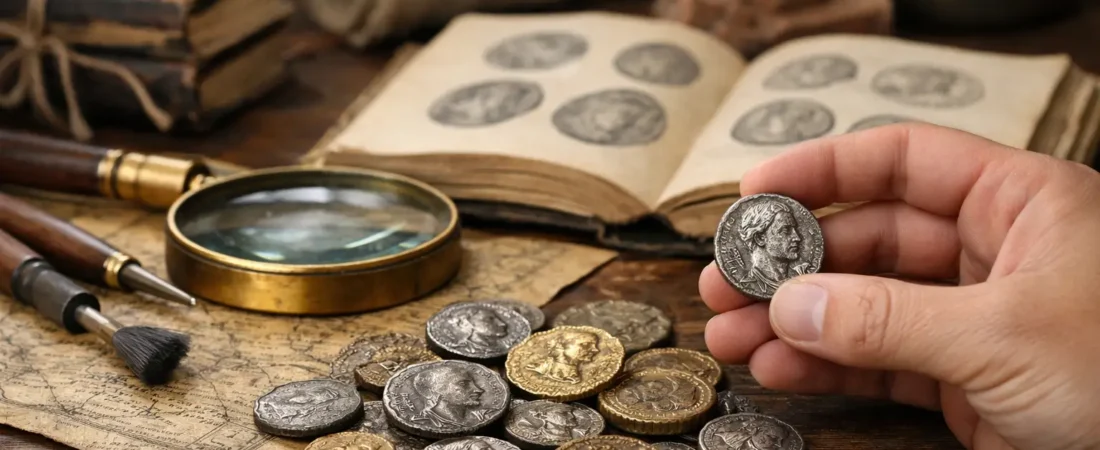
A small bronze coin can hold an emperor’s face, a city’s pride, a military victory, and the fingerprints of the people who spent it. It may have crossed a Roman market stall, paid a soldier near a frontier fort, or been placed in a grave as a final offering. Learning how to interpret ancient coins means treating each piece not simply as an old object, but as a message deliberately made for the hands and eyes of its first users.
Ancient coins were among the most widespread forms of visual communication in the ancient world. Their images traveled farther than statues, inscriptions, and monumental arches. A coin could announce a new ruler in a remote province, celebrate a harvest, honor a local god, or reassure a population during a crisis. Reading one well requires patience, comparison, and a willingness to let small details matter.
Begin With the Coin’s Basic Facts
Before searching for a famous emperor or mythological scene, record what is physically in front of you. Note the coin’s diameter, weight, metal, color, condition, and any visible lettering. If possible, photograph both sides in even light, including the edge. A ruler and a small digital scale are useful, but careful observation is more valuable than expensive equipment.
The metal offers the first clue. Gold and silver usually belonged to higher-value monetary systems and were often tied to state authority, military payments, or large transactions. Bronze and copper-alloy coins formed the everyday currency of markets, workshops, and households. Yet metal alone cannot identify a coin. Roman bronze coins span centuries, Greek cities struck silver in many different standards, and ancient counterfeits could imitate precious metal with a thin plated surface.
Weight and diameter help narrow the field because many ancient states used recognizable denominations. A large Roman bronze sestertius, for example, generally carried more visual space and official messaging than a small late Roman nummus. But ancient coins were hand-struck, worn down through circulation, clipped, corroded, and sometimes imitated. Treat measurements as evidence, not as an absolute verdict.
How to Interpret Ancient Coins From Their Two Sides
Most ancient coins have an obverse and reverse. The obverse is often called the “front,” commonly bearing a portrait, deity, or civic emblem. The reverse usually carries a complementary image: a god, animal, building, personification, trophy, or scene of power. Neither side is decorative filler. Together, they create an argument.
Read the Portrait as Political Theater
A ruler’s portrait is rarely a candid likeness. It is political theater in miniature. Alexander the Great’s successors often placed the deified Alexander or the god Heracles on their coins to claim a connection with conquest and heroic legitimacy. Roman emperors adopted idealized features that suggested youth, military discipline, piety, or dynastic continuity.
Look closely at the headgear and attributes. A laurel wreath may signal victory or imperial authority. A radiate crown, with rays like the sun, often marks a particular Roman denomination or associates the ruler with solar imagery. A helmet can suggest military leadership. A veil may point to religious duty or mourning. Even the direction a portrait faces can matter when compared with other issues from the same ruler.
Not every portrait is a monarch. Greek city-states frequently used gods and local heroes as civic signatures. Athens famously struck the head of Athena, while its reverse showed her owl, a bird linked to wisdom and the city itself. Such a coin told users where it came from and what its community valued.
Let the Reverse Explain the Message
If the obverse introduces the issuer, the reverse often reveals what they wanted remembered. A standing goddess holding a branch may promise peace. A figure carrying a cornucopia may advertise abundance. A ship’s prow can evoke naval power, commerce, or a colony’s maritime identity. A temple may commemorate a sacred site, an imperial building project, or a city’s special religious status.
Roman reverses are particularly rich in personifications. Victory appears with wings and a wreath. Pax represents peace. Annona, associated with the grain supply, may hold ears of wheat. These images were not neutral. When an emperor issued coins showing abundance during a period of food anxiety, or Victory during a difficult war, the message could be aspirational as much as descriptive.
This is where interpretation requires restraint. A coin showing Victory does not prove that a campaign was successful. It proves that the issuer wanted victory to be seen, expected, or celebrated. Coins are evidence of public messaging, not unbiased news reports.
Read the Letters, Even When They Are Incomplete
Inscriptions are among the strongest tools for identifying an ancient coin. Greek legends may name a city, ruler, or deity. Roman inscriptions often give an emperor’s titles, such as Augustus, pontifex maximus, or consul. A few surviving letters can be enough to distinguish one issue from another.
Begin by transcribing exactly what you can see, including uncertain letters. Do not silently fill gaps with what seems likely. Ancient lettering is often abbreviated, and worn surfaces can turn one letter into another. On Roman coins, “IMP” commonly refers to imperator, while “COS” indicates a consulship. Because imperial titles changed over time, they can help date an issue surprisingly closely.
Greek coins can pose a different challenge. Their inscriptions may use unfamiliar letter forms, and a city’s ethnic name may appear in the plural, meaning “of the people of” a particular place. A coin labeled for the people of Syracuse or Corinth was not merely tagged with an address. It announced civic identity in a competitive Mediterranean world.
Pay attention to monograms, tiny clusters of letters often tucked into fields or beneath figures. These may identify magistrates, mint officials, workshops, or regional issues. They can be frustratingly small, but they are often the difference between a broad identification and a precise one.
Place the Coin in Its Historical Landscape
The most rewarding stage begins after you have identified probable date, place, and issuer. Ask what was happening when this coin was struck. Was a new dynasty taking power? Was a city rebuilding after war? Did the ruler need the army’s loyalty, urban support, or divine approval?
Consider a Roman coin of Vespasian, who became emperor after the violent civil wars of 69 CE. His coinage repeatedly emphasized stability, peace, and restored order. Those themes gain force when viewed against the instability that preceded his reign. Similarly, coins of Constantine I often use Christian symbols cautiously and alongside traditional imperial imagery, reflecting a changing empire rather than a sudden, simple break with its past.
Local coins can be just as revealing. Under Roman rule, many eastern Mediterranean cities continued to strike bronze coins featuring local gods, festivals, rivers, and myths. Their designs show that imperial power did not erase local identity. A provincial coin may carry a Roman emperor on one side and a city’s ancient patron deity on the other, holding two worlds in the same palm.
Examine Wear, Damage, and Signs of Use
A coin’s condition is part of its biography. Smooth high points on a portrait, softened lettering, and a dark, stable patina may indicate long circulation. A broken edge or test cut can show that someone checked whether a silver coin was genuine. Countermarks, stamped later onto an older coin, may reveal reuse under a new authority or validation in a different region.
Corrosion complicates the picture. Bronze disease, often visible as powdery pale green spots, can actively damage copper-alloy coins and should be handled carefully. Do not clean a coin aggressively. Scraping, polishing, or chemical treatment can erase surface details and historical evidence. The green or brown patina on an ancient bronze coin is often part of its long archaeological story, not dirt to be removed.
Provenance matters, too. A coin found in a documented excavation offers context that a detached market specimen cannot. Coins from a shipwreck, temple, military camp, or sealed household layer can help date activity at a site and reveal patterns of trade or movement. Without find information, a coin can still be studied, but some of its story has already been separated from it.
Beware of the Temptation to Identify Too Quickly
Ancient coins are frequently misidentified because designs repeat. Eagles, owls, Zeus, Athena, horses, laureate portraits, and Victory figures appear across many regions and centuries. Modern replicas, altered coins, casts, and outright forgeries add another layer of caution.
A sound interpretation should be expressed in degrees of certainty. “Probably a third-century Roman provincial bronze” is often more honest and useful than a confident but unsupported claim. Check whether the style of the portrait, lettering, fabric, weight, and imagery all agree with the proposed identification. If one feature feels wrong, pause. A coin may be a contemporary imitation, a hybrid, or something modern.
The most skilled readers of coins do not rely on a single clue. They build a case from several small observations: the metal, portrait, legend, reverse type, mint marks, and historical setting. Like an archaeologist reconstructing a ruined room from scattered objects, they let the evidence lead.
Hold a Piece of the Ancient Conversation
Ancient coins were made to circulate, and circulation gave them power. A grand imperial proclamation carved on a monument could be seen by those who reached the monument. A coin could enter a baker’s shop, a harbor, a shrine, or a soldier’s pay pouch. Its image became familiar through touch.
When you study one, look beyond the famous face or the catalog label. Ask who commissioned it, who received it, and what reassurance, promise, or claim it carried. Then keep looking closely. In the worn lines of a tiny portrait or the last visible letter of an inscription, the ancient world is still trying to speak.