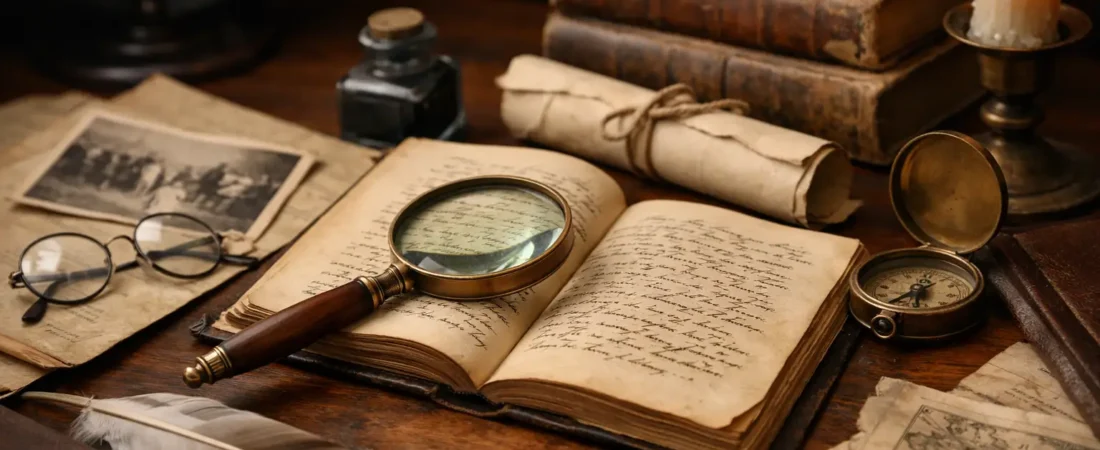
A mud-stained diary, a shipwrecked coin, a wartime photograph, a grocery list preserved in an archive: each can place us startlingly close to another life. But closeness is not the same as certainty. A guide to primary source analysis begins with that essential distinction. Historical evidence is a doorway into the past, yet every doorway has a frame, a keeper, and a view that may be incomplete.
Primary sources let us encounter history in its own surviving traces. They can reveal the texture of an ordinary morning, the fear behind an official order, or the choices made in a moment of crisis. Reading them well means resisting the temptation to treat them as silent witnesses that simply report the facts. They were created by people, institutions, and cultures with purposes of their own.
What Counts as a Primary Source?
A primary source is material created during the period being studied, or by someone with direct involvement in an event, place, or culture. It may be written, spoken, visual, or physical. A Roman inscription, a 19th-century abolitionist’s letter, an oral history recorded by a survivor, and soil samples from an archaeological site can all serve as primary sources.
The category depends on the question. A newspaper published in 1941 is a primary source for understanding what readers were told about World War II at the time. The same newspaper may be less useful as a final authority on what actually happened in a battle, especially if reporting was delayed, censored, or based on rumor.
This is why primary does not mean perfect. It means close to the historical moment or experience under examination. A source can be firsthand and still mistaken, selective, self-serving, or deliberately deceptive.
Begin With the Object in Front of You
Before interpreting a source, pause over its physical or digital form. Imagine an archaeologist lifting a clay tablet from the earth. The marks matter, but so do the tablet’s size, damage, location, and neighboring finds. Context begins before translation.
Ask four grounding questions:
- Who created this source, and what do we know about that person’s position, beliefs, or access to events?
- When and where was it made?
- Who was meant to see, hear, or use it?
- What purpose did it serve at the time?
A private letter and a public speech may describe the same event in radically different tones because they were made for different audiences. A royal inscription might celebrate military victory while omitting defeat, famine, or rebellion. A census form can appear impersonal, yet its categories reveal how a government chose to define households, race, occupation, and citizenship.
Even a photograph demands these questions. Who stood behind the camera? Was the scene posed? What lies beyond the frame? Early photographs were sometimes staged, cropped, retouched, or captioned in ways that shaped public memory. The image is evidence, but it is not an open window.
Read for Voice, Silence, and Purpose
Once a source is situated, read or examine it closely. Notice its language, repeated ideas, emotional tone, and details that seem oddly specific. A merchant’s account book may look dry until it records a sudden rise in grain prices. A soldier’s diary might spend more lines on wet boots and bad food than on the battle later remembered in textbooks. Such details often restore the human scale of history.
Just as revealing are the silences. Whose perspective is absent? Enslaved people, women, children, Indigenous communities, laborers, and the poor were often documented by officials, employers, missionaries, or colonizers rather than in records of their own making. That does not make those records useless. It means they must be read carefully, with attention to the power relationships behind them.
Consider a plantation ledger. It may preserve names, work assignments, purchases, punishments, and births. Yet its language can reduce human beings to property or labor units. The historian’s task is not to repeat that framing. It is to recognize the ledger’s purpose while searching for the lives that press against its impersonal columns.
Provenance: The Source’s Chain of Custody
In museums and archives, provenance refers to a source’s documented history of ownership, discovery, and collection. It is one of the most practical tools in primary source analysis. If an artifact has no recorded excavation location or has passed through undocumented hands, crucial information may be lost.
A ceramic vessel found in a controlled archaeological excavation can tell researchers about its layer, nearby structures, food practices, trade networks, and date. The same vessel removed without records becomes far harder to interpret. Its beauty remains, but much of its historical voice has been stripped away.
Provenance also helps guard against forgery and looting. The antiquities market has produced convincing fake inscriptions, coins, manuscripts, and paintings. An object that appears ancient is not automatically authentic, and an exciting claim deserves especially careful verification. Respect for evidence includes respect for the places and communities from which evidence comes.
Corroborate Without Expecting a Perfect Match
One source is rarely the whole story. Strong historical interpretation compares different kinds of evidence: letters against court records, oral traditions alongside maps, archaeological remains beside tax rolls, photographs with newspaper accounts.
Corroboration does not mean every source must agree word for word. In fact, disagreement can be historically valuable. Two witnesses may remember the same protest differently because they stood on opposite sides of the street, belonged to different social groups, or faced different risks in telling the story. Their conflict may reveal how an event was experienced, not merely whether it occurred.
A useful habit is to separate three levels of claim. First, identify what the source directly says or shows. Next, explain what it may suggest. Finally, distinguish broader conclusions that require support from additional evidence. This prevents a single vivid quotation or artifact from carrying more weight than it can bear.
A Practical Guide to Primary Source Analysis
When you encounter a source, move through it in stages rather than rushing toward an interpretation. First, describe it plainly. Record what is visible or stated without adding assumptions. Then place it in context by identifying its creator, date, setting, audience, and purpose.
Next, interrogate its perspective. What interests, pressures, prejudices, or limitations might shape it? A government report may seek to justify policy. A memoir written decades later may blend memory with later understanding. An oral testimony may preserve emotional truth and lived experience while becoming uncertain about exact dates or sequences.
Finally, compare it with other evidence and state your conclusion with appropriate care. Phrases such as “this suggests,” “the record indicates,” or “the evidence is consistent with” are not weak language. They are signs that an interpreter understands the difference between evidence and certainty.
This approach also applies to digital sources. A scanned manuscript may be incomplete. Metadata can contain cataloging errors. Social media posts, videos, and digital photographs may be copied, altered, or detached from their original date and location. Preserve screenshots, check original accounts when possible, and pay attention to when a file first appeared rather than only when it was reposted.
Let Evidence Complicate the Story
The most rewarding sources do not always confirm what we expect. In 1925, archaeologists examining the tomb of Tutankhamun found not only spectacular gold but humble objects of daily life: linen garments, sandals, food vessels, games, and tools. These items help transform an ancient king from a museum icon into a person who dressed, ate, traveled, and prepared for an imagined afterlife.
Yet even this famous discovery requires caution. The tomb had been disturbed in antiquity, its objects were interpreted through early 20th-century archaeological practices, and public fascination often favored treasure over context. The lesson is not to distrust the collection. It is to ask better questions of it.
Primary sources reward patience because they make the past less tidy. They show that people held contradictory beliefs, made choices under pressure, and left records unevenly. A carefully analyzed source does more than provide a fact for a timeline. It lets us see how history was lived, remembered, controlled, and contested.
The next time you stand before a faded letter, an old map, or an artifact behind glass, linger a little longer. Ask who made it, why it survived, and what it cannot tell you on its own. That quiet act of attention is where the past begins to speak.