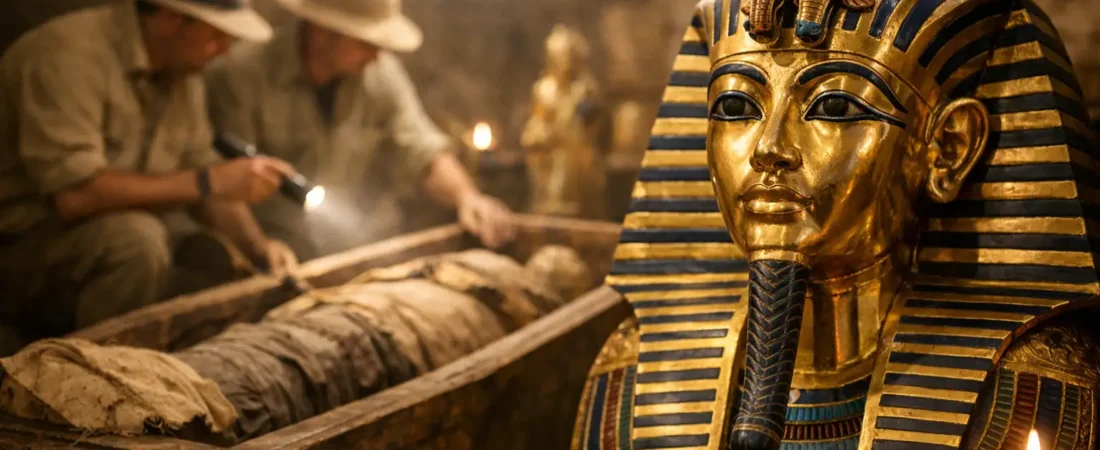
On November 4, 1922, a workman’s pick struck a buried stone step in Egypt’s Valley of the Kings. Within weeks, Howard Carter was peering through a small opening into a chamber crowded with gilded furniture, dismantled chariots, strange animal-headed couches, and sealed doors. The Tutankhamun excavation evidence did more than reveal a famous gold mask. It gave archaeologists an unusually complete record of what an Egyptian king was prepared to carry into eternity.
That record is not perfect. Tomb robbers had entered the burial complex in antiquity, and the excavation methods of the 1920s fall short of modern standards. Yet Carter’s painstaking notes, photographs, object cards, plans, and the surviving artifacts form one of archaeology’s richest archives. Together, they let us step into a royal funeral arranged more than 3,300 years ago.
The Evidence Began Beneath a Worker’s Hut
Tutankhamun’s tomb, designated KV62, lay in a modest location beneath the remains of huts built for workers on the nearby tomb of Ramesses VI. This accidental camouflage probably helped it escape the scale of looting suffered by larger royal tombs.
Carter had searched the valley for years with the financial backing of George Herbert, the fifth Earl of Carnarvon. By 1922, Carnarvon was ready to end the costly project. Carter asked for one final season. The decision proved historic when the first step emerged from the rubble.
A sealed doorway at the bottom of the staircase carried impressions from the royal necropolis seal. Some of the plaster had been broken and resealed, an early warning that the tomb had been disturbed. Beyond the entrance passage, excavators found a second sealed door. This one bore the name of Tutankhamun.
The discovery unfolded slowly rather than in a single dramatic moment. Carter first entered the outer chamber on November 26, 1922. The burial chamber was not opened until February 1923, and the final removal and conservation of the tomb’s contents took nearly a decade.
A brief timeline of the find
- November 4, 1922: The first stone step leading to KV62 is uncovered.
- November 26, 1922: Carter makes a small opening and sees the crowded outer chamber.
- February 16, 1923: The burial chamber is officially opened.
- October 1925: The gold mask is revealed during the unwrapping of the mummy.
- November 1932: Work on the tomb is completed after almost ten years of documentation and conservation.
What the Tomb’s Layout Tells Us
KV62 is surprisingly small for a pharaoh’s tomb. It consisted of an entrance corridor, an antechamber, a side room called the annex, a burial chamber, and a treasury. Unlike the long, carefully decorated tombs made for earlier New Kingdom rulers, Tutankhamun’s burial place seems adapted from a smaller tomb, perhaps because his death came unexpectedly around age 19.
That interpretation has limits. A compact tomb does not prove chaos or a rushed funeral by itself. Egyptian burial practice was highly organized, and workers still managed to prepare an extraordinary assemblage. But the cramped rooms, the improvised placement of objects, and the unusual arrangement of the burial equipment suggest that time may have been short.
The burial chamber held four nested gilded wooden shrines, filling much of the room. Inside them stood a quartzite sarcophagus. Within the sarcophagus rested three anthropoid coffins, the innermost made of solid gold. At the center lay the mummy of Tutankhamun, covered by the now-iconic gold mask.
This sequence matters because it shows that the king’s body was protected through layers of material, ritual, and text. The shrines bore inscriptions intended to guide and defend him in the afterlife. The outermost barriers were not simply displays of wealth. They were part of a sacred machine built to transform a dead ruler into an eternal, divine being.
Tutankhamun Excavation Evidence Beyond the Gold Mask
The gold mask became the public symbol of the discovery, but the quieter objects often provide the sharper historical clues. More than 5,000 cataloged items were recovered from KV62. They ranged from monumental ritual equipment to sandals, linen garments, writing materials, food, wine jars, and a child’s toy-like board game.
A throne from the antechamber preserves a vivid scene of Tutankhamun and his queen, Ankhesenamun. Sunlight pours from the Aten disk above them, while the king’s name honors Amun. This combination is evidence of a kingdom still emerging from the religious upheaval associated with Tutankhamun’s predecessor, Akhenaten. Under Akhenaten, the traditional gods had been pushed aside in favor of the Aten. Under Tutankhamun, the cult of Amun and older religious institutions were being restored.
Other objects reveal the practical side of royal burial. The tomb contained chariots, bows, shields, walking sticks, and hunting equipment. Some may have been ceremonial, while others show wear consistent with use. The large number of canes has encouraged discussion of the king’s health and mobility, especially alongside evidence from his mummy of a clubfoot and bone disease. Still, the objects cannot diagnose every aspect of his life on their own. A king’s tomb was designed to provide abundance in the next world, not to serve as a medical chart.
The food offerings are equally revealing. Jars once held wine, oils, and provisions. Meat cuts, bread, fruits, and other supplies were placed nearby so the king would not lack nourishment. Labels on wine jars recorded details such as year, estate, and chief vintner, offering rare evidence for how elite goods were managed in the late Eighteenth Dynasty.
The Mummy and the Story It Can, and Cannot, Tell
Tutankhamun’s mummy has been studied repeatedly since Carter’s team unwrapped it in 1925. That early examination caused damage, partly because resins used in the burial had hardened and adhered the body to the coffin. Modern imaging has allowed researchers to examine the remains with far less disturbance.
The evidence indicates that Tutankhamun died young, likely around 19. He had a cleft palate, a clubfoot, and signs of disease. DNA studies have also suggested that malaria may have contributed to his death. But the familiar claims of murder, a lethal blow to the head, or a chariot crash are not settled facts. A damaged skull and broken bones can result from embalming, ancient handling, or the difficult work of removing the mummy from its resin-bound coffin.
This is one of the essential lessons of the tomb: evidence becomes stronger when several independent sources agree. A dramatic theory is not the same thing as a demonstrated conclusion.
Carter’s Archive Is Part of the Discovery
The artifacts alone are only part of the case. Carter’s excavation records are why the tomb remains so informative. He assigned numbers to objects, described their locations, made plans of each chamber, and worked with photographer Harry Burton to create an extraordinary visual record.
Burton’s photographs show objects before removal, after cleaning, and during conservation. In an era when many excavations stripped sites of context, this documentation preserved relationships that would otherwise have vanished. A necklace found on a mummy, a chest positioned beside a wall, or a basket tucked beneath a couch can carry meaning because its original setting was recorded.
Carter’s work also illustrates archaeology’s changing ethics. Egyptian workers, conservators, guards, and officials were vital to the excavation, though popular retellings have often centered only Carter and Carnarvon. The tomb’s contents were ultimately kept in Egypt, where they belong to the wider story of Egyptian cultural heritage. Today, conservation must balance public access with the fragility of wood, linen, pigments, and gold leaf that survived millennia in a sealed chamber.
Why This Tomb Still Changes the Past
Tutankhamun was not among Egypt’s most powerful kings. His short reign left a smaller political footprint than those of Hatshepsut, Ramesses II, or Akhenaten. Yet the survival of his tomb changed how the world sees ancient Egypt because it preserved the texture of royal life and death at an almost unimaginable level of detail.
The evidence does not hand us a single, flawless biography. It offers something better: a carefully documented collection of clues. A repaired doorway tells of ancient thieves. A throne records religious transition. A walking stick hints at bodily vulnerability. A wine label catches the machinery of a royal estate in a few strokes of ink.
When we look past the gold, KV62 becomes more than a treasure chamber. It becomes a reminder that history is built from context, patience, and the fragile survival of ordinary details. The next time Tutankhamun’s mask appears before you, imagine the quieter evidence around it: the labels, footprints, seals, baskets, photographs, and notes that still allow a young king’s lost world to speak.