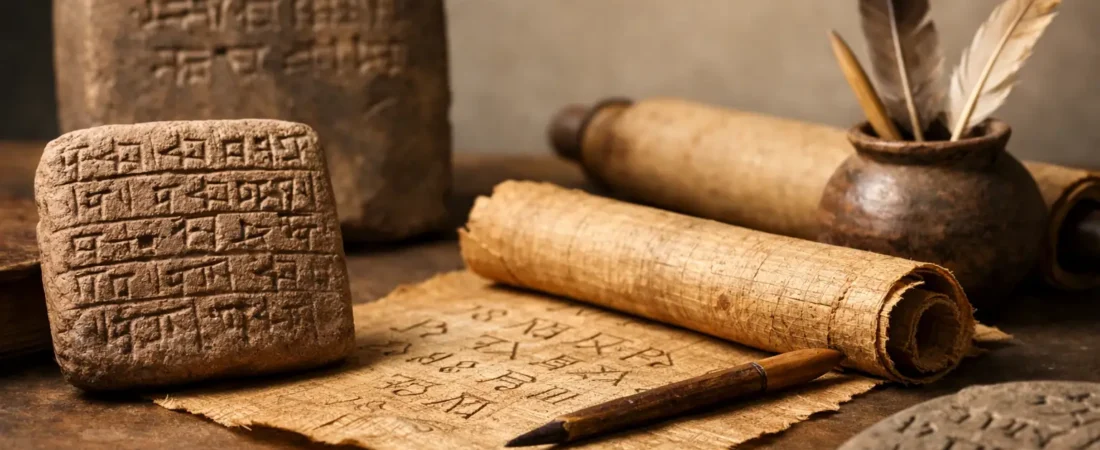
A clay tablet no larger than a hand lay buried for more than 5,000 years in the ruins of southern Iraq. Its marks were not poetry, law, or a king’s proclamation. They were a practical record: goods, labor, and quantities. Yet within these small impressions rests one of humanity’s great turning points. When did writing first appear? The best evidence leads us to Mesopotamia around 3400-3200 BCE, when accounting marks began to develop into a system capable of recording language.
That answer comes with an essential museum-label caveat: writing was not invented in one clean moment. It emerged gradually, across generations, as people found that memory, speech, and simple symbols could not fully manage the growing complexity of their communities. The first written marks were tools of administration. Only later did writing become a vehicle for stories, letters, prayers, and history.
When Did Writing First Appear in Mesopotamia?
The earliest broadly accepted writing comes from the city of Uruk, in present-day southern Iraq. By the late fourth millennium BCE, Uruk had become a vast urban center, with temples, workshops, fields, herds, merchants, and thousands of people whose work needed to be organized. Grain entered storerooms, beer was issued to workers, sheep changed hands, and textiles moved through temple economies.
At first, administrators used small clay tokens to represent commodities and amounts. A cone might stand for a small measure of grain; another shape could represent an animal or a jar of oil. Some tokens were sealed inside hollow clay envelopes called bullae. Before long, people began pressing the tokens into the wet clay surface instead. The image on the outside made the token inside unnecessary.
Around 3400-3200 BCE, scribes at Uruk took the next decisive step: they made marks directly on clay tablets. These earliest tablets are known as proto-cuneiform, meaning “before cuneiform.” Their signs were mostly pictorial and numerical. A drawing of a vessel might refer to a vessel, while repeated marks specified how many were counted.
They are not easy reading. Many signs remain uncertain, and the tablets often record only the essentials: an item, a number, perhaps an institution or person. Still, they show a durable system of visual signs used repeatedly by trained administrators. That is why scholars usually identify Uruk as the birthplace of writing.
From pictures to sounds
The crucial change was not simply drawing pictures. Humans had made images on cave walls, pottery, seals, and stone for tens of thousands of years. Writing begins when signs can reliably represent spoken language, including names, actions, ideas, and grammatical relationships.
Mesopotamian scribes gradually pushed their signs in that direction. A sign originally representing an object could also be used for the sound of that object’s spoken name. This rebus-like principle allowed a limited set of images to record far more than visible things. A sign could help spell a personal name, identify a place, or express an abstract idea.
By roughly 3000 BCE, the script was increasingly being used to write Sumerian, a language spoken in southern Mesopotamia. The signs also changed shape. Rather than drawing curved pictures, scribes pressed a cut reed stylus into clay, creating angular wedge marks. This is cuneiform, from the Latin word for “wedge-shaped.” Over the next three millennia, cuneiform would carry epics, contracts, astronomical observations, royal inscriptions, school exercises, and private complaints.
Egypt’s Earliest Writing: A Near-Contemporary Beginning
Ancient Egypt developed writing at almost the same time. The earliest Egyptian hieroglyphic inscriptions date to about 3250-3200 BCE, appearing on labels, pottery vessels, sealings, and small ivory tags found in elite tombs at Abydos. These compact inscriptions could identify goods, places, and perhaps royal events.
Egyptian hieroglyphs were visually vivid: birds, reeds, hands, water lines, animals, and tools. But they were not merely decorative pictures. Like cuneiform, hieroglyphs could represent sounds as well as objects and ideas. A trained reader could use them to write the Egyptian language.
For years, historians debated whether Egypt borrowed the idea of writing from Mesopotamia. The two regions were connected indirectly through trade and shared artistic influences, and Mesopotamian writing is slightly earlier in the archaeological record. But the evidence does not support a simple story of copying. Egyptian writing formed a distinct system with its own signs, structure, and visual logic. The most careful conclusion is that both societies developed writing during an age of increasing complexity, while the exact degree of contact and influence remains open to discussion.
The Line Between Symbols and Writing
The question becomes more complicated when we look beyond Mesopotamia and Egypt. A symbol is not automatically writing. A stop sign conveys meaning, but it does not record English. A family emblem may identify a household, yet it cannot necessarily preserve a sentence spoken aloud.
Archaeologists therefore ask several questions when examining ancient marks. Do the signs occur in a consistent system? Are they used in repeated combinations? Can they record names or language sounds? Do they communicate a wide enough range of ideas to preserve speech beyond the immediate setting?
This distinction matters because many cultures created sophisticated symbolic traditions long before writing. The painted animals of Ice Age caves, the signs of the Indus Valley, the knotted cords called quipu used in the Andes, and the symbols on Neolithic European artifacts all preserve evidence of human thought and organization. Some may encode information in ways we do not yet understand. But without clear proof that a system records a spoken language, scholars are cautious about calling it writing.
The Indus script is a particularly compelling case. Between about 2600 and 1900 BCE, the cities of the Indus Valley used short inscriptions on seals, tablets, and pottery. The signs are standardized and widespread, but the language behind them remains undeciphered, and most texts are extremely brief. It may be writing, or it may be a different kind of information system. The uncertainty is part of the story, not a failure of archaeology.
Writing Did Not Begin With Literature
It is tempting to imagine the first writer composing a sacred hymn or recording a heroic king. The surviving evidence points somewhere more ordinary: inventories, rations, taxes, fields, animals, and workers. The first tablets preserve the pulse of institutions trying to keep track of resources.
That mundane beginning is precisely what makes them powerful. Writing did not arrive as a luxury. It answered a practical problem created by cities: too many transactions, too many people, and too much time between an action and the need to verify it. Clay became an external memory that could outlast the official who made the count.
Once that memory existed, its uses expanded. In Mesopotamia, scribal schools trained specialists to copy sign lists and exercises. Writing helped rulers govern, merchants trade, and temples manage estates. It also preserved the voices of people who wanted a receipt, a legal decision, or proof that a debt had been paid. Centuries later, the same technology could preserve the Epic of Gilgamesh, one of the world’s earliest surviving works of literature.
A Short Timeline of the First Scripts
- Before 3400 BCE: Clay tokens, seal impressions, and other accounting tools are used in Mesopotamia.
- About 3400-3200 BCE: Proto-cuneiform tablets appear at Uruk in southern Mesopotamia.
- About 3250-3200 BCE: The earliest Egyptian hieroglyphic inscriptions appear, especially at Abydos.
- About 3000 BCE: Mesopotamian signs increasingly record the Sumerian language and evolve toward cuneiform.
- About 2600 BCE: The still-undeciphered Indus script appears in South Asia.
- About 1200 BCE: Alphabetic writing becomes increasingly influential in the eastern Mediterranean, making written signs more compact and adaptable.
Why the First Tablets Still Matter
The invention of writing did not replace oral tradition. For most people in antiquity, stories, laws, family knowledge, and religious practice continued to travel by voice. Literacy was often limited to scribes, priests, officials, and elites. A tablet from Uruk represents not a sudden transformation of every life, but the beginning of a powerful new partnership between human memory and material record.
It also reminds us how fragile the past can be. We know early writing largely because clay tablets were baked hard by accident in fires or preserved in dry soil. Countless texts written on wood, wax, leather, papyrus, bark, and cloth have vanished. What survives is not the whole ancient world, but a remarkable fragment of it.
The next time you see a wedge pressed into clay or a tiny hieroglyph on ivory, imagine the hand behind it: a scribe leaning over a tablet, pausing to count, then leaving a mark meant to make something temporary endure. In that quiet act, the human past began to speak directly to the future.