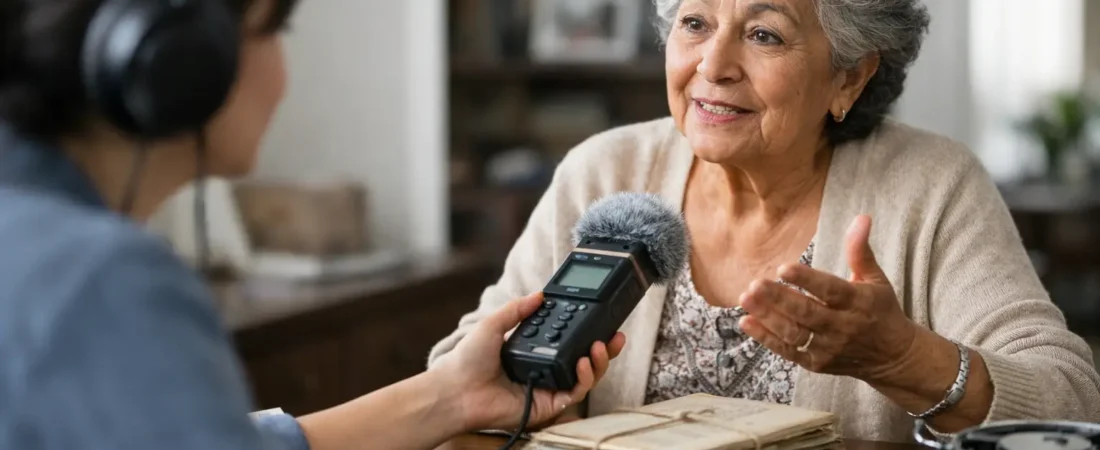
A courthouse ledger may record a marriage, a military roll may list a name, and a newspaper may announce a factory closing. Yet none can fully capture the sound of a mother describing the day her family left home, a veteran remembering a battlefield at dawn, or a worker recalling the rhythm of a vanished mill. Oral histories bring those human dimensions into the historical record.
They are not simply conversations about old times. At their best, oral histories are carefully prepared interviews in which people recount experiences, traditions, observations, and memories. A recorded voice can carry hesitation, humor, grief, pride, and the particular words a person chooses to explain a life. For historians, those details are evidence. They reveal not only what happened, but how events were understood by the people who lived through them.
What Oral Histories Preserve That Documents Cannot
History often survives through institutions. Governments create censuses, courts produce case files, businesses keep account books, and newspapers decide which events deserve print. These sources are invaluable, but they are selective by nature. They tend to preserve the viewpoint of people with authority, literacy, wealth, or access to official systems.
Oral histories can widen the frame. They have preserved the memories of immigrants crossing borders, formerly enslaved people describing daily life under slavery, Indigenous elders maintaining cultural knowledge, civilians enduring war, and neighborhood residents watching their communities change block by block. They also record the lives of people who may never have expected their stories to enter an archive.
Consider a city neighborhood transformed by highway construction. Planning documents can identify the route, budget, and date of completion. An oral history may reveal the barber shop that disappeared, the friendships broken when residents were relocated, and the routes children once walked to school. Neither kind of source replaces the other. Together, they create a fuller and more honest picture.
That is the great strength of spoken testimony: it restores scale to history. National events become personal. A recession becomes a kitchen-table calculation. Migration becomes a suitcase, a train platform, and a remembered farewell.
Memory Is Evidence, Not a Perfect Recording
A common misunderstanding is that an interview is valuable only when every date and detail is exact. Human memory does not work that way. It reshapes experience over time, combining moments, emphasizing what mattered most, and sometimes getting chronology wrong. That does not make oral testimony useless. It tells historians something important about how people make meaning from the past.
A veteran may misremember the exact day of an engagement while describing, with striking clarity, the fear of waiting for orders. A survivor may merge two similar events into one account but accurately convey the social conditions that made both possible. The task is not to treat memory as a flawless transcript. It is to understand what kind of evidence it offers.
Historians test oral accounts against other sources when possible: letters, maps, photographs, newspapers, payrolls, diaries, government files, and additional interviews. They compare timelines, identify contradictions, and distinguish between firsthand observation and stories passed down through a family or community.
This process is not a trap designed to catch a narrator in error. It is historical method. Every source has limitations. A newspaper may carry political bias. A military report may omit civilian losses. A photograph can be staged. An interview, too, must be read with care. Its value lies partly in facts that can be corroborated and partly in the perspective only the narrator can provide.
Why contradictions can matter
When two people remember the same strike, flood, or civil rights march differently, the disagreement may be historically revealing. One person may recall courage and solidarity; another may remember danger and division. Their accounts can show how class, age, race, gender, location, or personal loss shaped the event.
The goal is not always to choose a single winner. Sometimes the historical truth is that an event was experienced in several conflicting ways.
How Historians Build an Oral History Archive
A meaningful interview begins long before the recorder is switched on. Researchers study the historical setting, learn the narrator’s background when appropriate, and prepare open-ended questions. “What was it like when you arrived?” often yields more than “Did you arrive in 1952?” Dates still matter, but a good interview allows the narrator room to lead the listener into unexpected territory.
The most effective oral history interviews feel less like interrogations than guided acts of remembrance. An interviewer may ask about sounds, objects, work routines, local expressions, family meals, or the view from a childhood window. Such questions can open doors that broad questions leave closed.
A typical process includes four essential stages:
- preparing questions and historical context before the interview;
- recording clear audio or video, with the narrator’s informed consent;
- creating a transcript that makes the account searchable and usable;
- preserving the recording, transcript, permissions, and descriptive information for future researchers.
Consent is central, not ceremonial. Narrators should understand where their testimony may appear, whether it will be public, and whether any sections need restrictions. A person speaking about family trauma, discrimination, violence, or migration status may face real risks if an archive releases material carelessly.
Preservation also presents a quieter challenge. A story saved on an obsolete cassette or a forgotten computer drive is not truly secure. Archives migrate digital files, maintain backup copies, label recordings carefully, and preserve contextual details: who conducted the interview, when it took place, what language was used, and whether a transcript was edited. Without that information, a powerful voice can become difficult to interpret.
The Ethics of Listening
Oral history asks for trust. That makes it especially important when interviewing communities whose voices have been extracted, misrepresented, or ignored by institutions in the past.
Ethical practice means allowing narrators meaningful control over their stories. It means being clear about how material will be used and respecting requests to pause, remove, embargo, or correct part of an interview. It also means recognizing that an interviewer is never invisible. Their questions, identity, assumptions, and relationship with the narrator shape the resulting account.
This is particularly relevant in Indigenous oral traditions. In many communities, knowledge is held collectively and may be governed by cultural protocols that do not fit neatly into an ordinary public archive. A responsible researcher does not assume every story is available for publication simply because it has been shared in conversation. Respect for community authority must come before the desire to collect.
The same principle applies to painful testimony. A dramatic account may attract attention, but historical storytelling should never turn suffering into spectacle. Context, dignity, and accuracy matter more than emotional impact alone.
A Voice Can Rebuild a Lost Place
Some of the most moving oral history projects begin after physical evidence has nearly vanished. A neighborhood has been demolished. A language is endangered. A workplace has closed. The witnesses are aging, and their memories may be the last map of a world that no longer appears on modern streets.
Through interviews, historians have reconstructed the social geography of places that maps barely acknowledge: where families gathered, which stores extended credit, how people marked celebrations, and which boundaries felt dangerous after dark. These details may seem small, but they are the texture of lived history.
Oral histories also challenge the assumption that ordinary people stand outside major events. A famous speech, battle, invention, or disaster becomes more complete when viewed from kitchens, classrooms, hospitals, farms, ships, and shop floors. The past was not lived only by leaders whose names fill textbooks. It was carried forward by millions of people whose names may survive only because someone asked them to remember.
Listening as a Historical Skill
For students, family historians, and curious readers, oral history offers a practical lesson: ask better questions while there is still time. If a relative or community elder is willing to talk, begin with a specific memory rather than a demand for a life story. Ask what their home smelled like, how they got to work, what music came through the radio, or what changed after a major local event.
Listen without rushing to correct, and record only with permission. Afterward, write down names, places, approximate dates, and the stories behind photographs or heirlooms. A single remembered name can lead to records that would otherwise remain invisible. Just as importantly, a family story can preserve feeling and context that no official document was designed to hold.
The next time an old voice begins with, “I remember,” treat those words as the opening of a historical doorway. Behind it may be a detail no archive has kept, a perspective no textbook has made room for, or a world waiting to be heard before it falls silent.