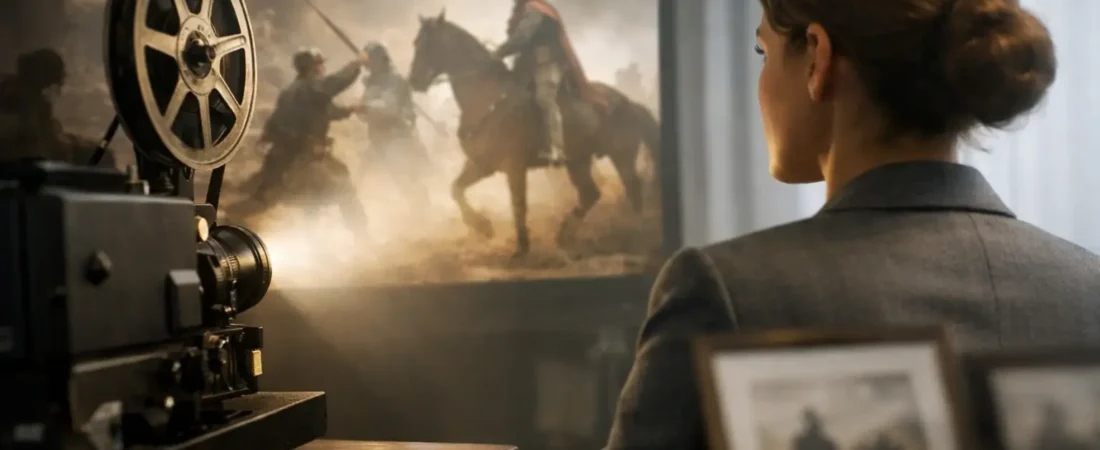
A Roman general walks through a torchlit arena. A young factory worker stares at the gates of Auschwitz. A monarch pauses before signing a document that may change a nation. Historical films place us in rooms we cannot enter and beside people who have been gone for centuries. At their best, they do more than recreate costumes, battles, and old streets. They give the past a human scale.
That power also makes them worth watching carefully. A film can preserve the emotional truth of an event while reshaping its timeline, combining real people into one character, or inventing conversations no record can recover. For history lovers, that tension is not a flaw to dismiss. It is the central question: when does a cinematic story help us understand the past, and when does it begin to replace it?
Why Historical Films Matter
History is often encountered as a map, a date, or a name in a textbook. Cinema restores the weather, the noise, and the uncertainty. It can show that people in the past did not know what would happen next. They made decisions with partial information, private fears, and immediate pressures, just as people do now.
Consider Steven Spielberg’s Lincoln. The film narrows its focus to the political struggle surrounding the Thirteenth Amendment in early 1865. It cannot contain the full history of slavery, the Civil War, emancipation, and Reconstruction. Yet its tightly framed story reveals something essential about political change: legislation is shaped by ideals, moral courage, compromise, calculation, and the voices excluded from the room.
Other films carry audiences into histories that have too often been reduced to statistics. Schindler’s List follows the transformation of Oskar Schindler, a German industrialist who used his factories to protect more than a thousand Jewish people during the Holocaust. The film’s black-and-white imagery does not make the tragedy easier to bear. It asks viewers to recognize individual lives amid a catastrophe whose scale can otherwise feel unbearable.
This is where historical cinema becomes a form of public memory. A memorable scene may remain with viewers long after a date has faded. That can awaken further curiosity, encourage visits to museums and historic sites, and lead audiences toward memoirs, archives, and scholarship. But memory is selective, and movies are selective by design.
Historical Films Are Interpretations, Not Time Machines
No camera recorded ancient Rome, the court of Henry VIII, or the first hours of the French Revolution. Even films about modern events must choose where to point the lens. A two-hour feature cannot include every witness, cause, consequence, and contradiction. It builds an argument through casting, dialogue, editing, music, and what it leaves outside the frame.
The most useful way to approach historical films is not to ask whether every detail is perfectly accurate. Almost none are. Instead, ask several sharper questions. What period does the film claim to depict? Whose experience sits at the center? Which details are grounded in surviving evidence? What has been compressed or invented to create a coherent story?
A composite character, for example, is not automatically misleading. In Chernobyl, a television miniseries rather than a feature film, the scientist Ulana Khomyuk represents the work of many Soviet nuclear scientists who investigated the 1986 disaster. The device simplifies a crowded history, but it can also clarify the institutional resistance those experts faced. The trouble begins when viewers are not encouraged to recognize the distinction between a dramatic representative and a documented individual.
Likewise, a battle scene may capture fear, confusion, and exhaustion even when troop movements are simplified. Ridley Scott’s Gladiator gives its audience a vivid imperial Rome, but its plot takes sweeping liberties with Commodus, Marcus Aurelius, and Roman political life. The film is valuable as a reflection on power, spectacle, and modern ideas about Rome. It is not a reliable biography of the emperor or a guide to how the Roman Empire actually changed hands.
The Details That Build a Convincing Past
Authenticity often lives in the margins. A letter folded correctly, a crowded tenement with worn stair treads, a meal served in period-appropriate bowls, or a character using the social language of their time can make a world feel inhabited rather than staged.
Production designers, costume specialists, dialect coaches, armorers, and historical consultants do much of this work. Their research may draw on paintings, excavation reports, surviving buildings, diaries, probate inventories, military manuals, newspapers, and photographs. For eras with fewer written records, archaeologists and material culture specialists become especially important. A single excavated shoe, cooking pot, or household shrine may reveal more about daily life than the grand monuments that dominate popular imagination.
Still, visual accuracy has limits. Ancient clothing may need brighter colors than audiences expect because surviving statues have lost their paint. Medieval interiors were often more colorful than the gray stone palette favored by many films. Realistic armor can appear unfamiliar to viewers raised on fantasy imagery. Filmmakers sometimes compromise because audiences need to read a character quickly or because a historically precise choice might look strangely modern.
That does not mean the details are trivial. They signal whether a film has tried to meet the past on its own terms. When a production treats another era as a costume box full of stereotypes, it usually loses something deeper: the sense that people lived in a complex world with beliefs and customs that made sense to them.
Accuracy Includes Perspective
A film can reproduce uniforms and architecture with extraordinary care while still presenting a narrow view of history. Who gets to speak matters as much as whether the buttons are correct.
The 1966 film The Battle of Algiers remains striking because it depicts the Algerian struggle for independence from French colonial rule through the texture of a city under surveillance, violence, and repression. Its documentary-like style places viewers amid competing strategies and devastating consequences. Yet even an admired film is a constructed work, shaped by its creators, its moment, and its political purpose.
Newer historical films have increasingly asked whose stories were omitted by older traditions. Hidden Figures brought mathematicians Katherine Johnson, Dorothy Vaughan, and Mary Jackson into the center of the American space program story. The film changes and condenses some events, but its larger correction is meaningful: it challenges the familiar image of space exploration as the work of a small, exclusively white and male cast of heroes.
A thoughtful viewer can hold both ideas at once. The film may not be a final authority. It may also direct needed attention toward people, records, and questions that deserve to be remembered.
How to Watch Historical Films With a Historian’s Eye
Start by letting the story work. Films are made to be felt, and there is no prize for treating every scene like a courtroom cross-examination. Then, after the credits, take a second look.
Notice the film’s boundaries. Does it cover one day, one campaign, or an entire lifetime? A story with a narrow frame may be more revealing than one that races through decades. Ask what happened immediately before and after the depicted events. This is often where a film’s most consequential omissions become visible.
Pay attention to certainty. When characters deliver polished speeches or make perfectly symbolic choices, ask whether the words survive in a primary source or were created for the screenplay. Invented dialogue is often necessary, but it should not be mistaken for a transcript. The same applies to private meetings, romances, and rivalries that historians can only partially reconstruct.
Finally, seek more than one account. A museum exhibition, a historian’s book, a translated diary, or a documentary can complicate the version on screen. For students and educators, pairing a film scene with a contemporary letter or newspaper report is especially revealing. The difference between the two does not merely expose errors. It shows how evidence becomes narrative.
The Best Films Leave Room for Discovery
Some historical films try to settle the past into a neat moral lesson. The more enduring ones preserve its difficulty. They allow a leader to be courageous and compromised, a victory to carry grief, and an ordinary person to matter without becoming implausibly heroic.
This is why the finest historical cinema does not make research unnecessary. It makes research irresistible. After watching The Passion of Joan of Arc, viewers may seek out the surviving records of Joan’s trial. After Master and Commander, they may become curious about naval discipline, global trade, and the Napoleonic Wars. The screen becomes a doorway rather than a destination.
When the lights rise, keep one question in hand: what part of this past have I not yet seen? That question turns a powerful film into the beginning of a longer journey through the archive, the gallery, the archaeological site, and the lives history nearly forgot.