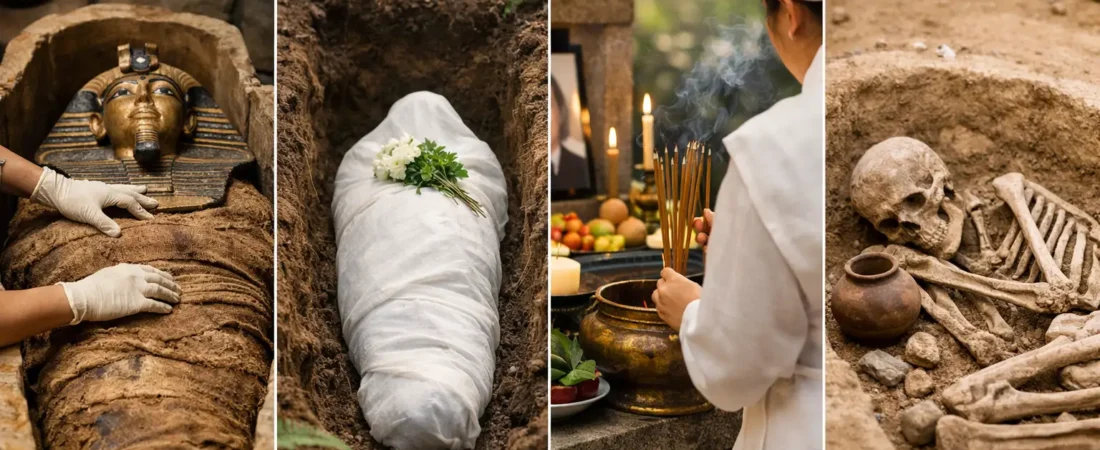
A sealed tomb, a shallow grave, a jar of ashes, a body left on a windswept tower: ancient burial practices explained in their full variety reveal far more than methods of disposing of the dead. They reveal what communities feared, loved, remembered, and hoped might lie beyond the final breath. Archaeologists often begin with the grave because it is one of the few places where private grief, public status, religious belief, and material culture survive together.
A burial is not a simple snapshot of the person who died. It is a carefully arranged message created by the living. The message may honor an ancestor, protect a community from a dangerous spirit, display a family’s wealth, or prepare a soul for a journey. Sometimes, it does all of these at once.
Ancient burial practices explained: what a grave can tell us
The first question is rarely just, How did this person die? Archaeologists ask why a body was placed in a particular position, why certain objects were included, and why others were absent. A burial facing the rising sun may suggest a sacred direction. Red ocher sprinkled around a skeleton may evoke blood, renewal, or ritual transformation. A finely made weapon can signal rank, but it may also be an offering with symbolic meaning rather than proof that the dead person was a warrior.
This caution matters. Graves are evidence, not scripts. Looting, erosion, later construction, and ancient disturbances can alter what remains. Nor did every society bury every person in the same manner. Age, gender, status, cause of death, and local custom could shape the final rite. The poorest people are often hardest to see in the archaeological record, while monumental tombs can make elite customs seem more universal than they were.
Yet even modest graves can be remarkably eloquent. A child buried with a bead, a farmer laid to rest with a simple pot, or a carefully folded shroud can preserve traces of affection that no royal inscription records.
From earth to fire: the major choices
Across the ancient world, communities commonly buried bodies in the ground, placed them in tombs, cremated them, exposed them to the elements, or moved bones after the flesh had decayed. These were not primitive stages along a single path. They were deliberate traditions, each shaped by landscape, religion, and social life.
Inhumation: placing the body in the earth
Earth burial is among the oldest and most widespread practices. At sites such as Qafzeh Cave in present-day Israel, early modern humans were buried roughly 100,000 years ago, sometimes with ocher and animal remains. Such discoveries suggest that intentional care for the dead has exceptionally deep roots.
Bodies might be laid flat, curled on their sides, seated, or placed in stone-lined chambers. In Neolithic Europe, collective tombs known as long barrows and passage graves received generations of dead, turning burial places into ancestral landmarks. The tomb was not only a destination for an individual. It was a meeting place between the living community and its remembered forebears.
Cremation: fire, ash, and transformation
Cremation became especially prominent in parts of Bronze Age and Iron Age Europe, including the Urnfield culture, whose name comes from cemeteries filled with vessels containing cremated remains. In ancient Greece and Rome, both cremation and burial were practiced, with customs changing by region, period, wealth, and family preference.
For Romans, a funeral procession might carry the dead through city streets to a pyre outside the settlement. After the fire cooled, relatives gathered bone fragments, washed them with wine or water, and placed them in an urn. This was not an impersonal process. The handling of remains was a final act of kinship, and funerary monuments preserved a person’s name within public memory.
Exposure and excarnation
Some communities avoided placing an intact corpse in the ground because death could be seen as ritually polluting. In the Zoroastrian tradition of ancient Iran, bodies were placed in structures often called Towers of Silence, where scavenging birds and natural forces removed the flesh. The cleaned bones could then be collected without contaminating sacred earth, fire, or water.
Elsewhere, people practiced secondary burial. A body might first be left to decompose, then its bones gathered and reburied in an ossuary or family tomb. This second ceremony could mark the dead person’s passage from recent loss to ancestor. It also explains why archaeologists sometimes find carefully arranged skulls or bones rather than complete skeletons.
Egypt’s tombs were machines for eternity
No civilization is more closely associated with ancient burial than Egypt, but pyramids are only one part of a vast and evolving funerary tradition. Egyptians believed that survival after death depended on preserving the body and sustaining several aspects of the person, including the ka, often understood as a vital spiritual force, and the ba, an aspect able to move between worlds.
Mummification helped maintain the body as a recognizable home. The process varied enormously by wealth. Royal and elite mummies could receive elaborate treatment, while many ordinary Egyptians had simpler preparations. The famous removal of internal organs, placement in canopic containers, linen wrapping, and protective amulets represent the most elaborate end of that spectrum, not every Egyptian funeral.
Tombs were furnished with practical and magical provisions: food, furniture, cosmetics, tools, model servants, and texts. The Book of the Dead was not a single standardized book but a collection of spells, selected and adapted for particular burials. Its images show the deceased approaching judgment, navigating hazards, and seeking a renewed life among the gods.
One remarkable detail is the shabti, a small human-shaped figurine placed in many Egyptian tombs. If the dead were called upon to perform agricultural labor in the afterlife, the shabti could answer in their place. Even eternity, it seems, required contingency planning.
Burials could declare power as well as grief
Some graves were designed to be seen. The burial mound of a Scythian leader, the chamber tomb of a Mycenaean elite, or the immense mausoleum built for China’s first emperor projected authority long after a ruler’s death.
At Xi’an, the Terracotta Army stands in ranks near the mausoleum of Qin Shi Huang, who died in 210 BCE. The thousands of clay soldiers, horses, officials, and acrobats were not simply artworks. They formed a protective and administrative world intended to serve the emperor beyond death. Archaeologists continue to investigate the larger mausoleum complex carefully, recognizing that excavation can destroy fragile pigments, organic materials, and context.
The famous ship burial at Sutton Hoo in England offers another kind of statement. Buried around the early seventh century CE, the ship contained rich equipment associated with an Anglo-Saxon ruler or high-ranking leader. Its objects connected local kingship to far-reaching trade, warfare, feasting, and belief. A grave can turn a funeral into political theater, especially when the mourners are meant to remember who held power.
The living remained part of the ritual
Ancient funerals did not always end when the grave was closed. Romans visited tombs and offered food and drink to the dead during commemorative festivals. In Greece, families made libations and tended grave markers. In parts of Mesoamerica, ancestors remained embedded in household and community life, sometimes literally, through burials beneath floors or near homes.
These practices challenge the modern assumption that death creates a clean separation. For many ancient societies, the dead continued to require nourishment, remembrance, protection, or conversation. Neglecting them could be dangerous. Honoring them could strengthen family identity and claim a community’s connection to a place.
This is also why grave goods must be interpreted carefully. A cup might be a final meal, a ritual offering, a symbol of status, or an object used in memorial ceremonies. Its meaning depends on context: its placement, wear, contents, neighboring burials, and the customs of the wider site.
What archaeology can, and cannot, recover
Modern science has expanded the evidence preserved in graves. DNA can sometimes reveal biological relationships and population movement. Isotope analysis may indicate where a person spent childhood or what they ate. Pollen, textile fragments, residue inside vessels, and microscopic traces of wood can reconstruct a funeral’s vanished details.
But scientific results do not erase the need for interpretation. Genetic kinship is not the same as family in a cultural sense. A lavish burial does not automatically identify a ruler. And ancestral remains are not merely research material. Many descendant communities have clear views about excavation, display, and repatriation. Respectful archaeology balances the value of knowledge with the dignity owed to the dead.
The next time you stand before a burial mask, an urn, or a weathered mound, look beyond the object’s beauty. Somewhere behind it were mourners making difficult choices with the materials and beliefs available to them. Their rituals were efforts to give death meaning, preserve belonging, and carry a person across the threshold of memory. That impulse remains one of the most human traces the past has left behind.