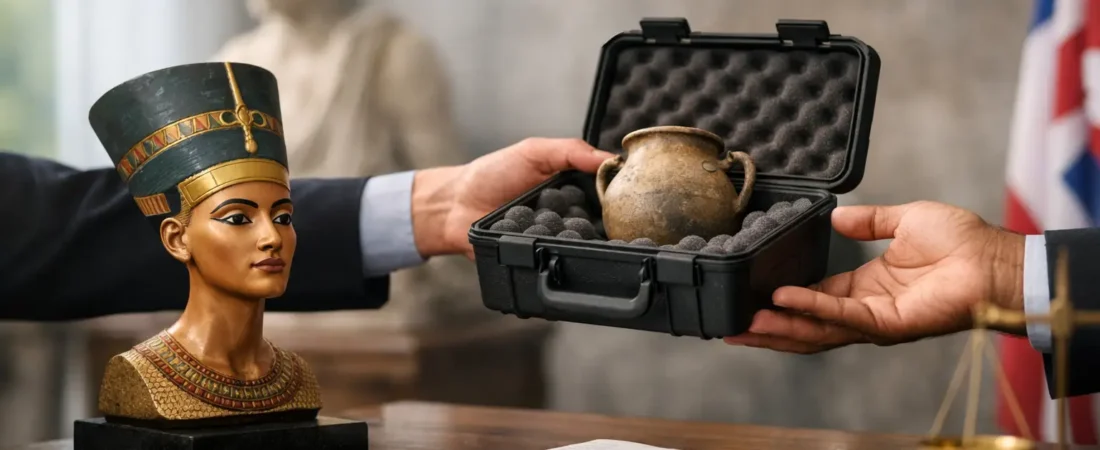
A bronze plaque hangs in a climate-controlled gallery thousands of miles from Benin City. A sacred mask rests behind glass, its songs and ceremonies absent from the label. A burial object, excavated long ago and cataloged as a specimen, still carries the presence of the person it was made to accompany.
Artifact repatriation begins with a deceptively simple question: when an object has been removed from its community, under what circumstances should it return? The answer is rarely simple. It sits at the meeting point of archaeology, law, colonial history, religious practice, museum stewardship, and the enduring human need to tell our own stories.
For visitors, the issue can feel distant – a debate conducted in boardrooms and museum storerooms. Yet every disputed object represents a journey. To understand repatriation, we have to follow those journeys backward, through excavations, invasions, salesrooms, private collections, and sometimes the quiet work of descendants seeking what was taken.
What Artifact Repatriation Actually Means
Repatriation is the return of cultural objects, human remains, or sacred materials to a nation, people, or descendant community. It is related to restitution, but the words can carry different emphasis. Restitution often focuses on correcting a wrongful taking. Repatriation emphasizes return to a homeland or cultural community.
The objects involved are not all alike. Some were stolen during war. Others were removed under colonial rule, purchased in transactions shaped by extreme inequality, or excavated under permits that would not meet modern ethical standards. Some have clear ownership records; others passed through generations of dealers with gaps in their paperwork.
That difference matters. A museum cannot responsibly treat every foreign-made object as stolen, nor can it assume that a decades-old acquisition is beyond question. Each case depends on evidence: provenance records, excavation reports, military archives, oral histories, legal agreements, photographs, and the knowledge held by communities themselves.
The Long Road From Taking to Return
One of the most visible chapters in artifact repatriation concerns the Benin Bronzes. In 1897, British forces attacked and looted the Kingdom of Benin, in what is now southern Nigeria. Thousands of brass plaques, sculptures, ivories, and ceremonial objects were carried away. Many entered European and American museums through sales that followed the expedition.
For more than a century, these works introduced global audiences to the remarkable artistry of Benin’s court. But their presence abroad also reflected an act of violent seizure. In recent years, museums and governments in Germany, the United Kingdom, the United States, and elsewhere have begun returning or transferring ownership of many pieces to Nigeria. The process has not been identical everywhere, and questions about custody within Nigeria have sometimes complicated public discussion. Still, the central fact remains: the bronzes were not simply collected. They were taken amid a military assault.
Another story unfolds in the United States. For decades, museums, universities, and federal agencies held Native American human remains and funerary objects gathered through excavation, collecting, and grave disturbance. The Native American Graves Protection and Repatriation Act, passed in 1990, created a legal framework for federally funded institutions to inventory certain holdings and consult with tribes. Its purpose was not merely administrative. It recognized that ancestral remains are not museum property in the ordinary sense.
A few milestones show how recently this conversation has shifted:
- In 1897, British troops looted the royal treasures of Benin during the punitive expedition.
- In 1970, UNESCO adopted a convention aimed at preventing the illicit import, export, and transfer of cultural property.
- In 1990, the United States enacted the Native American Graves Protection and Repatriation Act.
- In 2021, France returned 26 works looted from the Kingdom of Dahomey to the Republic of Benin.
These dates do not mark the beginning or end of the issue. Communities had demanded returns long before governments created formal procedures. But they reveal a change in public understanding: possession is not always the same as rightful stewardship.
Why Museums Do Not All Give the Same Answer
Museums have genuine responsibilities. They preserve fragile materials, fund conservation, document objects, and make them available to researchers and audiences who might otherwise never encounter them. A museum may argue that an artifact is safer in its care, especially when the country of origin faces conflict, economic hardship, or inadequate storage facilities.
Those concerns deserve consideration, but they can also conceal an old assumption: that only wealthy Western institutions can protect the past. Many source countries have skilled curators, conservators, archaeologists, and ambitious new museums. More fundamentally, preservation is not only about temperature, humidity, and security. It is also about cultural meaning. A sacred object may be physically safe in a distant museum while being spiritually and socially separated from the people who understand its purpose.
There is also no single model for return. An object may be fully transferred to a national museum, returned to a tribal community for reburial or ceremonial care, loaned for a long period, or jointly stewarded by institutions in two countries. Digital imaging and shared research can widen access, but a high-resolution scan is not the same as the original object. For communities seeking the return of ancestors or ceremonial belongings, digital access is often beside the point.
Artifact Repatriation Is a Test of Provenance
Behind many return cases lies a word that can sound dry but changes everything: provenance. Provenance is the documented history of an object’s ownership and movement. Ideally, it traces an artifact from its discovery or creation through every sale, collection, export, and museum acquisition.
In reality, records can be incomplete, misleading, or deliberately vague. Phrases such as “from an old European collection” have sometimes masked a recent illicit excavation. The missing years are often the most revealing. Did an object leave its country after strict cultural-property laws were introduced? Was it sold soon after a conflict? Did a dealer provide no export documentation?
Careful provenance research is slow work. Curators compare accession files with customs records and auction catalogs. Archaeologists examine soil traces, tool marks, and excavation histories. Descendant communities contribute names, ceremonial knowledge, and oral traditions that institutional files never recorded. This is history at its most investigative: a scattered archive brought into focus one clue at a time.
What Is Lost When an Object Is Removed
An artifact is rarely only an artifact. Removed from its original setting, it can lose the relationships that explain it. A statue without its temple, a painted vessel without its burial context, or a bead without the larger regalia it adorned may remain beautiful, but it becomes harder to interpret.
Archaeology calls this lost setting context. Looting destroys context at an extraordinary cost. When objects are pulled from graves, shrines, or ancient buildings for sale, researchers lose evidence about dates, trade networks, diet, ritual, and everyday life. The market may preserve an object, but it often erases the story around it.
Repatriation can help repair some of that damage, though it cannot restore every missing detail. It can bring an object into dialogue with surviving traditions, languages, landscapes, and communities. It can also force institutions to tell a fuller story about how their collections were built.
A More Honest Museum of the Future
The strongest case for repatriation is not that museums should empty their galleries or hide difficult history. It is that museums should be honest about what they hold, how it arrived, and whose voice has been missing from its interpretation.
Some returns will be legally required. Others will be ethically persuasive even when legal ownership is contested. Some objects may remain abroad through transparent agreements that source communities support. The work is case by case, and certainty is not always available. But uncertainty is not an excuse for silence.
When an artifact returns, the past does not vanish from public view. It gains another witness. The next time you stand before an ancient carving, ceremonial garment, or bronze plaque, look beyond its age and artistry. Ask what road brought it there, what records remain, and who may still be waiting to welcome it home.