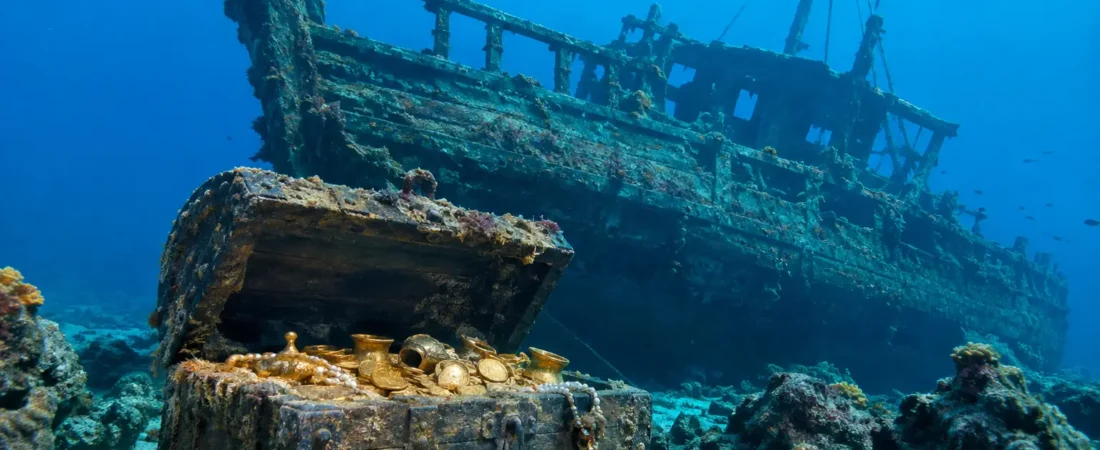
A storm closes over a ship, its sailors vanish from the historical record, and the sea settles into silence. Centuries later, a diver’s lamp catches the edge of an amphora, a bronze statue, or a coin lying where it fell. Forgotten shipwrecks with treasures hold this rare power: they preserve a single interrupted moment of human life, often more vividly than any palace, battlefield, or written chronicle.
The treasure is not always gold. A cargo of broken-looking pottery, stacked metal ingots, food jars, or personal belongings can reveal how ancient worlds traded, traveled, worshiped, and imagined one another. To archaeologists, a wreck is not a chest waiting to be opened. It is a time capsule whose meaning depends on keeping its objects, location, and story together.
When the Seabed Becomes an Archive
A shipwreck is an accident frozen in place. On land, generations reuse buildings, plow fields, and carry away valuables. Beneath water, especially where oxygen is scarce or sediment quickly buries a site, fragile connections can survive. A cooking pot may remain near the galley. Merchant goods may still be grouped in the hold. A sailor’s cup can rest beside tools used to repair the vessel.
That context changes an object’s value. One gold coin can tell us where a ruler minted money. Hundreds of coins, recorded in their original positions alongside cannons, ceramics, and navigational instruments, can reconstruct the route, ownership, purpose, and final hours of an entire voyage.
The sea does not preserve everything equally. Saltwater corrodes iron, wood can be eaten by shipworms, and currents scatter light objects across wide areas. Yet the sea can also protect. Mud seals artifacts away from oxygen. Cold, deep water slows decay. And a wreck’s very inaccessibility can shelter it from souvenir hunters for centuries.
The Uluburun Wreck and a Bronze Age World
Off the coast of southern Turkey, a sponge diver named Mehmed Çakir spotted unusual shapes on the seabed in 1982. They belonged to a merchant vessel that had sunk in the late 14th century BCE, during the Late Bronze Age. Known as the Uluburun wreck, it remains one of the most revealing shipwreck discoveries ever excavated.
Its cargo was extraordinary not because it contained a king’s ransom, but because it mapped a connected Mediterranean world. Archaeologists found roughly ten tons of copper ingots shaped like oxhides, along with about a ton of tin. Combined, these metals could be made into bronze. The ship also carried Canaanite jars, glass ingots in brilliant blue and turquoise hues, ivory, ebony, ostrich eggshells, jewelry, and luxury goods.
These objects came from many regions. The wreck suggests that merchants, craftspeople, and rulers across the eastern Mediterranean depended on far-reaching exchange networks long before classical Greece or Rome. The ship’s cargo was a moving marketplace, carrying raw materials and prestige goods between cultures that modern borders would separate.
Uluburun also offers a useful corrective to the popular image of treasure. Its greatest riches are the clues that reveal systems: where materials originated, how they were packed, and what distant communities valued enough to risk transporting across dangerous water.
Antikythera’s Treasures Were Also Ideas
In 1900, sponge divers working near the Greek island of Antikythera encountered a Roman-era wreck lying deep below the surface. Their finds included marble and bronze statues, fine glassware, coins, and jewelry. The ship had sunk around the first century BCE, probably while carrying Greek artworks and elite goods westward.
One corroded bronze fragment initially looked unremarkable. Over time, researchers recognized it as part of what is now called the Antikythera mechanism, a complex device with interlocking gears used to track astronomical cycles. It demonstrated a level of mechanical sophistication that few people expected from the ancient Mediterranean.
The mechanism is often described as an ancient analog computer, though that phrase can obscure its cultural setting. It was not a mysterious artifact outside history. It emerged from Greek traditions of mathematics, astronomy, craftsmanship, and instrument making. Found beside sculptures and luxury items, it reminds us that knowledge itself could travel as precious cargo.
The Antikythera wreck’s legacy is not a single dramatic revelation. It is the patience of reconstruction. Corroded fragments required decades of conservation, imaging, and interpretation before their significance became clear. Some shipwreck treasures announce themselves in gold. Others wait quietly inside layers of mineralized bronze.
The Belitung Shipwreck and a Global Marketplace
Near Indonesia’s Belitung Island, fishermen found the remains of an Arab dhow in 1998. The vessel had sunk around 826 CE while traveling through Southeast Asian waters, likely on a route linking China with markets farther west. Its cargo included more than 60,000 Tang-dynasty ceramic pieces, ranging from everyday bowls to carefully made ewers and storage vessels.
Among the ceramics were gold and silver objects of remarkable refinement. Yet the mass of pottery may be the more revealing treasure. It shows that Chinese ceramics were being produced and shipped at a scale suited not only to courts but also to expansive commercial networks. The ship’s construction and cargo testify to a maritime world connecting China, Southeast Asia, South Asia, and the Middle East.
The Belitung discovery also raises difficult questions. Commercial recovery brought many artifacts to light quickly, but it also sparked debate about whether excavation and conservation met archaeological standards. That tension matters. Recovering objects without fully documenting their setting can save material from immediate loss while permanently diminishing what scholars can learn from it.
A short timeline beneath the waves
- Around 1300 BCE: The Uluburun vessel sinks with metals, luxury goods, and raw materials from across the eastern Mediterranean.
- Around 60 BCE: The Antikythera ship sinks off Greece, carrying sculpture, coins, and the mechanism that would transform the history of ancient technology.
- Around 826 CE: The Belitung dhow goes down in Southeast Asia with a vast cargo of Tang ceramics and precious metalwork.
- 1708: The Spanish galleon San José sinks near Cartagena during a battle with British warships, taking a cargo of coins and colonial goods to the seabed.
The San José and the Limits of Treasure Hunting
The San José is among the most famous wrecks associated with bullion. The Spanish galleon sank in 1708 near Cartagena, in present-day Colombia, during the War of the Spanish Succession. It was carrying gold, silver, and other cargo from Spain’s American empire when it went down in combat.
Colombia announced the identification of a wreck believed to be the San José in 2015. Its precise location has been closely guarded, partly because the site is vulnerable and partly because questions of ownership, sovereignty, and commercial claims surround it. Remote vehicles have documented cannons, coins, and other objects on the seabed, but the wreck remains a contested historical site rather than a prize ready for display.
This is the central ethical lesson of forgotten shipwrecks with treasures: possession is not the same as understanding. A wreck may involve the descendants of crew members, Indigenous and colonized communities connected to its cargo, national governments, and private salvors. The laws governing underwater heritage vary, and some wrecks are also war graves. Responsible archaeology begins with preservation, meticulous documentation, and public benefit rather than a rush to sell what the sea has protected.
What These Wrecks Ask Us to Remember
The most meaningful shipwreck discoveries do not turn the past into a fantasy of pirate chests and glittering coins. They return scale and humanity to it. A bronze ingot speaks of miners and metalworkers. A ceramic bowl points to a kiln, a buyer, and a meal that may never have happened. A navigational device carries the accumulated observations of generations looking up at the same sky.
When museums display artifacts from wrecks, the strongest exhibits do more than spotlight beautiful objects. They recreate the voyage: the route chosen, the risks accepted, the hands that packed the hold, and the instant when a living ship became an archaeological site. That approach asks visitors to see treasure as evidence, not merely wealth.
The next time a shipwreck appears in the news, look beyond the rumored value of its cargo. Ask what remained in place, who is studying it, and whose stories the objects carry. Beneath the waterline, history is still waiting – not to be claimed, but to be carefully heard.