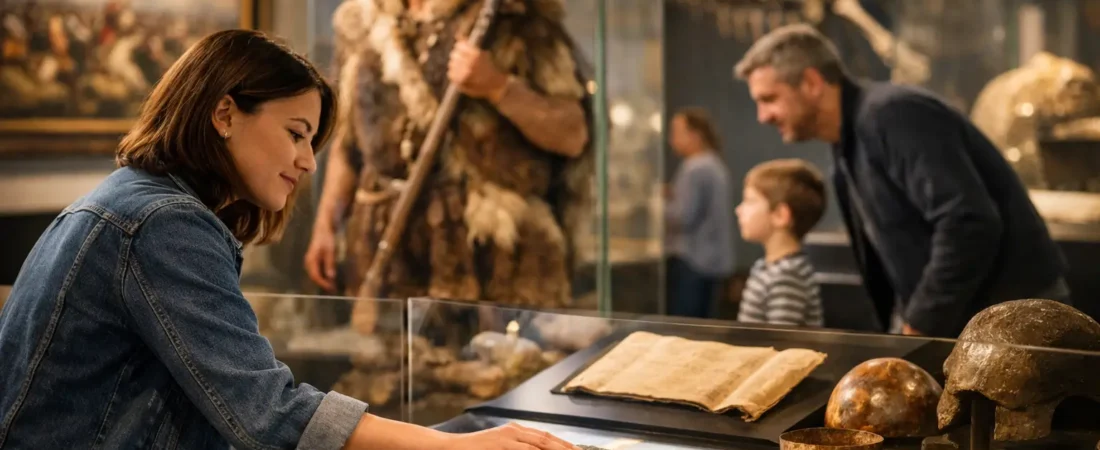
A museum gallery can hold a Roman coin no larger than a thumbnail, a child’s worn shoe, or a shattered piece of pottery lifted from a shipwreck. Alone, each object is quiet. Museum exhibits give it a setting, a date, a human connection, and a reason to be seen. At their best, they do not merely tell us that history happened. They allow us to stand close enough to feel its weight.
That transformation is more difficult than it appears. Every display case represents decisions: what survives, what can be safely shown, whose voice has been preserved in the record, and what a visitor needs to understand in a few precious minutes. An exhibit is not the past itself. It is an evidence-based encounter with the past, carefully built from fragments.
Why Museum Exhibits Matter
History often reaches us as a list of rulers, wars, inventions, and dates. Objects restore scale and consequence. A medieval sword may explain warfare, but the repaired handle tells another story: someone used it long enough to mend it rather than replace it. A ration book from World War II can reveal more about daily sacrifice than a statistic about food shortages. Material evidence carries the marks of hands, weather, work, grief, and survival.
This is why museums remain powerful even when archives, documentaries, and digital collections place vast knowledge within reach. The experience of sharing a room with an original object changes the pace of attention. Visitors notice a crack in a clay tablet, the faded ink in a letter, or the painstaking stitches in a uniform. The artifact becomes proof that another life unfolded in the same physical world we inhabit.
Yet authenticity is not limited to famous treasures. A crown may draw a crowd, but a worker’s lunch pail, a household ledger, or a hand-painted protest sign can make an era feel more immediate. Museums increasingly recognize that history is not only shaped by emperors and generals. It is also built by farmers, sailors, children, craftspeople, migrants, patients, and families whose names may never have appeared in official records.
From Artifact to Historical Encounter
An exhibit begins long before a case is installed. Curators, conservators, registrars, designers, educators, and community advisors may all contribute to its creation. Their task is not simply to arrange attractive objects. It is to make an argument supported by evidence.
A strong exhibition usually starts with a question. How did an ancient city feed tens of thousands of people? What did migration look like through one family’s belongings? How did a disaster reshape a community? The question provides a path through material that might otherwise feel overwhelming. Rather than presenting every object in a collection, the museum selects objects that reveal different parts of the answer.
Context is what turns a relic into history. Consider a simple ceramic bowl excavated at Pompeii. Placed beside a label with only its date and dimensions, it remains an attractive ancient vessel. Set within a room that explains the eruption of Mount Vesuvius in AD 79, the routines of Roman domestic life, and the archaeological work that recovered it, the bowl becomes part of an interrupted meal, a vanished household, and a catastrophe preserved in ash.
The label matters, but it should not carry the entire burden. Light, color, maps, reconstructed spaces, recorded testimony, photographs, and sound can help visitors orient themselves. These choices must serve the evidence rather than overpower it. A dramatic soundscape may be fitting in an exhibit about a naval battle or industrial machinery; it may be intrusive beside funerary objects or human remains. Good exhibition design knows when to create atmosphere and when to leave room for silence.
The Power of the Ordinary Object
The most memorable artifact is not always the rarest one. In 1991, hikers in the Ötztal Alps discovered the naturally mummified body now known as Ötzi the Iceman. His remarkable preservation offered researchers an extraordinary view of Copper Age clothing, tools, diet, and injury. But some of the most revealing evidence came from ordinary possessions: a grass cloak, a birch-bark container, a copper axe, and a small kit for making fire.
Such objects narrow the distance between visitor and subject. They remind us that people in the distant past also dressed for weather, carried supplies, repaired equipment, prepared food, and worried about the next journey. The past becomes less like a painted backdrop and more like a lived environment.
What Makes an Exhibit Trustworthy
Immersion should never mean invention. Museums have an obligation to distinguish clearly between what is known, what is likely, and what remains uncertain. Archaeology often works from incomplete evidence: a foundation without its roof, a burial without a name, a damaged inscription missing crucial words. Honest interpretation does not weaken a story. It lets visitors see how historical knowledge is made.
This is especially important when exhibits address conflict, colonial collecting, enslavement, religious belief, genocide, or ancestral remains. No display can be neutral simply because it uses a calm voice. Choices about language, ownership, and perspective carry ethical consequences. The strongest museums confront those choices directly, consult descendant and source communities, and explain when records are incomplete or contested.
Provenance, the documented history of an object’s ownership and movement, is central to that work. An artifact with unclear origins may have been looted, illegally excavated, or removed under unequal conditions. Museums are increasingly reexamining collections acquired during imperial expansion and returning objects when evidence and ethical responsibility demand it. This can complicate an exhibition schedule, but it strengthens the institution’s credibility. Preservation is not possession at any cost.
There is another trade-off as well: access versus protection. Light can fade textiles, paper, and pigments. Changes in humidity can damage wood, ivory, and metal. Some objects must rest in storage between periods of display, while others can only be shown under low light. A dim gallery or an empty case may seem disappointing, but these measures help ensure that future visitors can encounter the same evidence.
The Visitor’s Role in Reading a Gallery
Museum exhibits are not lectures delivered to passive audiences. Visitors bring their own memories, questions, and cultural knowledge into the room. A person whose grandparents lived through the Great Depression may pause at a patched coat for reasons a student cannot yet imagine. A young visitor may recognize a familiar tool in an ancient farming display and suddenly understand continuity across centuries.
To get more from an exhibit, begin with the object before reading the label. Look closely. What materials were used? Is it polished, broken, repaired, decorated, or worn smooth? Then ask what the museum can prove and what it is asking you to infer. A date tells you when an object was made, but not necessarily when it was used. A portrait tells you how someone wished to be seen, not always how they lived.
It also helps to notice what is absent. Whose labor made the objects on display? Which people appear only in the background of official accounts? Why might certain voices be difficult to recover? These questions do not diminish the museum experience. They turn it into a more active and humane form of historical investigation.
When Technology Helps, and When It Distracts
Digital reconstructions, touchscreens, audio guides, and augmented reality can reveal details impossible to place in a gallery. A virtual model can restore the original colors of an ancient temple. A magnified image can show brushwork invisible to the naked eye. Interactive maps can make the movement of people, trade goods, or armies easier to grasp.
But technology works best when it deepens attention rather than competes for it. A screen should not become more memorable than the centuries-old artifact beside it. In some galleries, a well-written label and a carefully placed bench are more valuable than an elaborate projection. The right choice depends on the story, the audience, and the object’s condition.
The future of museum interpretation will likely be both physical and digital. Online access can bring collections to students, researchers, and distant audiences who may never enter the building. Still, the original object retains a singular force. It has endured. It has traveled through time by chance, care, or rescue. It asks us to meet it with patience.
The next time you enter a gallery, resist the urge to race toward the most famous piece. Stop before the object that has no crowd around it. Read its evidence closely, imagine the hands that made or used it, and leave space for what cannot be fully known. That small act of attention is where history begins to feel alive.