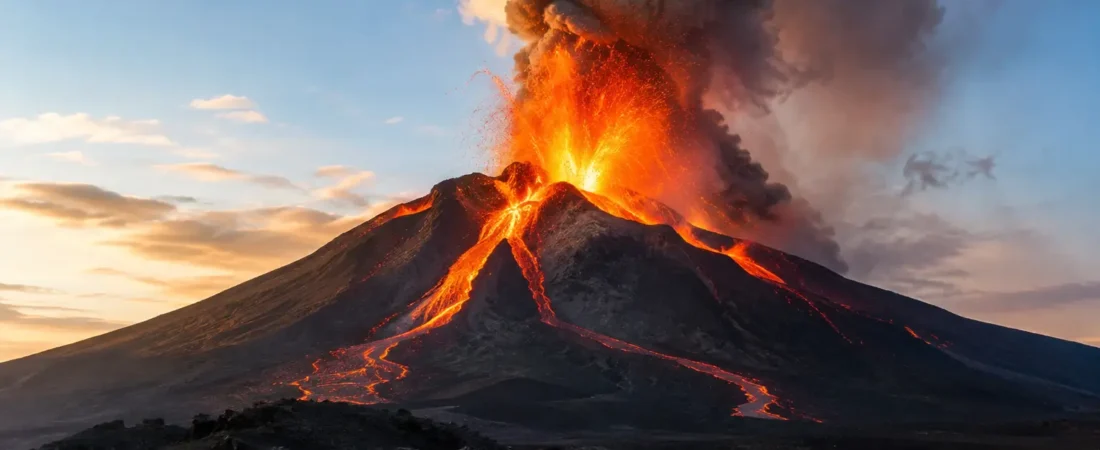
At dawn on April 10, 1815, the Indonesian island of Sumbawa shook beneath Mount Tambora. By evening, the mountain had produced one of the most devastating volcanic eruptions ever witnessed by human beings. Its blast was heard hundreds of miles away. Ash turned day into a strange darkness, villages disappeared beneath scorching debris, and the catastrophe reached far beyond the island. In the following year, weather patterns faltered across the Northern Hemisphere, harvests failed, and communities faced hunger in a summer remembered for frost and snow.
Volcanic disasters are not measured by spectacle alone. A towering ash column or enormous crater may reveal an eruption’s physical force, but its human cost depends on where it occurred, how much warning people received, and whether famine, disease, tsunamis, or social upheaval followed. The deadliest eruptions often became disasters because people were living, farming, trading, and building their futures in the shadow of a mountain.
What Makes an Eruption Devastating?
Scientists classify eruptions partly by the Volcanic Explosivity Index, or VEI, which considers the volume of material blasted into the atmosphere. Yet a high VEI does not automatically mean high mortality. A remote eruption can be immense and kill few people. A smaller event near a crowded city can be catastrophic.
For historians, the most meaningful measure is broader: immediate deaths, displaced communities, destroyed landscapes, and long aftereffects on food, climate, migration, and memory. Death tolls from older disasters are estimates, sometimes based on incomplete records. The figures below should be treated as carefully reconstructed historical evidence rather than perfect totals.
The Most Devastating Volcanic Eruptions
Mount Tambora, Indonesia, 1815
Tambora remains the benchmark for global volcanic catastrophe. Its climactic explosion was among the largest eruptions of the last several thousand years, ejecting vast quantities of ash and sulfur gases into the atmosphere. Pyroclastic flows and ashfall devastated Sumbawa and nearby Lombok. Crops failed, drinking water was contaminated, and famine and disease followed.
Modern estimates commonly place the death toll at more than 60,000, with some historical reconstructions reaching higher. Tambora’s wider legacy was the “Year Without a Summer” in 1816. Parts of North America and Europe suffered cold, wet weather, failed harvests, food shortages, and soaring grain prices. The eruption did not create every hardship of that troubled year, but it intensified a world already strained by war, poverty, and poor harvests.
Tambora’s missing summit tells part of the story. Before 1815, the mountain rose far higher than it does today. The explosion emptied part of its magma chamber, and the peak collapsed into a vast caldera. Archaeologists have also found traces of settlements buried by the eruption, a reminder that the disaster erased entire local worlds.
Krakatoa, Indonesia, 1883
On August 27, 1883, Krakatoa erupted in a series of explosions so violent that the sound was heard thousands of miles away. The island volcano, located in the Sunda Strait between Java and Sumatra, largely destroyed itself. But the blast was not the principal killer.
The sea was. Collapse and explosions generated colossal tsunamis that struck surrounding coasts with little chance of escape. Entire settlements were swept away. More than 36,000 people are generally believed to have died, though the true number may never be known. Ships were carried inland, while ash and darkness added to the terror.
Krakatoa became one of the first truly global media disasters. Telegraph networks carried reports across continents, and people around the world observed unusually vivid sunsets caused by volcanic particles high in the atmosphere. Its story also carries a practical lesson: coastal communities near island volcanoes must prepare not only for ash and lava, but for water displaced with devastating speed.
Mount Pelée, Martinique, 1902
The city of Saint-Pierre was called the Paris of the Caribbean, a busy port of elegant homes, theaters, shops, and sugar trade. On May 8, 1902, Mount Pelée transformed it into ruins within minutes.
A blazing pyroclastic flow, a ground-hugging avalanche of superheated gas, ash, and rock fragments, surged down the mountain and through the city. An estimated 28,000 to 30,000 people died. The destruction was so swift that many residents had little opportunity to flee, despite warning signs that included ashfall, earthquakes, and destructive mudflows.
One of the best-known survivors was Louis-Auguste Cyparis, a prisoner held in a thick-walled cell. He suffered severe burns but lived, later becoming a public symbol of the disaster. His survival was extraordinary, not evidence that confinement was safe. Mount Pelée demonstrated why pyroclastic flows are among the deadliest volcanic hazards: they move rapidly, burn intensely, and can overwhelm communities beyond the reach of lava flows.
Nevado del Ruiz, Colombia, 1985
Nevado del Ruiz had awakened before November 1985, and scientists warned that an eruption could melt the volcano’s snow and ice, creating lahars. These dense volcanic mudflows can race along river valleys, carrying boulders, trees, and collapsed buildings like fragments in wet concrete.
When the volcano erupted on November 13, relatively modest heat and ash melted enough ice to unleash lahars down the mountain. The town of Armero, built on an old mudflow plain, was buried during the night. About 23,000 people died there and in nearby communities.
The Armero tragedy is painful because warning signs existed. Hazard maps had identified the danger, but communication failures, uncertainty, delayed decisions, and the difficulty of ordering a large evacuation proved fatal. The disaster changed volcanic risk management worldwide. Monitoring matters, but warnings must also be understood, trusted, and acted upon in time.
Mount Vesuvius, Italy, AD 79
Vesuvius is perhaps history’s most famous eruption because it preserved the Roman world even as it destroyed it. In AD 79, an enormous column of ash and pumice rose over the Bay of Naples. Pompeii was gradually buried beneath falling debris; Herculaneum was overwhelmed by scorching pyroclastic surges and flows.
The number of dead remains uncertain. Archaeological discoveries have recovered the remains of more than a thousand victims, but many people escaped, and many bodies were never found. Estimates of total deaths often reach into the thousands rather than the tens of thousands.
Its devastation has another dimension. Ash sealed homes, bakeries, workshops, gardens, wall paintings, and graffiti beneath layers of volcanic material. Pompeii and Herculaneum offer an unusually intimate record of ordinary Roman life, but they should never be treated as a frozen curiosity. They are cities of interrupted lives, preserved by the same catastrophe that ended them.
Laki, Iceland, 1783-1784
Laki did not erupt from a single familiar cone. A long fissure opened across southern Iceland, pouring out lava and releasing enormous amounts of sulfur-rich gas. The immediate landscape became a harsh volcanic wasteland, but the more widespread danger came from a poisonous haze that damaged pasture, sickened livestock, and contributed to famine.
In Iceland, the resulting crisis killed a major share of the population, with estimates often around 9,000 deaths. The haze also spread over Europe, where observers described dim skies, respiratory distress, and an unsettling dry fog. Linking every European hardship directly to Laki would oversimplify a complicated period of weather, disease, and poverty. Still, the eruption shows that volcanic damage can travel across borders without a single ember falling there.
Beyond the Death Toll: A Mountain’s Long Shadow
Other eruptions deserve mention even when their death counts are harder to establish. Huaynaputina’s 1600 eruption in present-day Peru likely contributed to cold conditions and crop failures as far away as Russia. The Bronze Age eruption of Thera, or Santorini, sent tsunamis and ash across the Aegean, though claims that it single-handedly destroyed Minoan civilization go beyond the evidence. In the Pacific Northwest, Mount St. Helens killed 57 people in 1980, a far smaller toll than Tambora or Krakatoa, but its landslide and lateral blast reshaped how scientists communicate danger around active volcanoes.
These comparisons reveal why a simple ranking can mislead. The deadliest eruption is not always the largest. The most culturally important is not always the one with the widest climatic effect. A volcano becomes a historical force through its meeting with human choices: where towns are built, how warnings travel, whether officials listen, and how survivors rebuild.
Volcanoes create fertile soils, geothermal energy, dramatic landscapes, and places that draw people generation after generation. Living near them has never been a simple story of recklessness. It is often a story of livelihood, ancestry, and limited choices. When we remember the most devastating volcanic eruptions, we are not only looking at nature’s power. We are entering the final hours of cities, farms, families, and communities whose experiences still shape how the world prepares for the next rumble beneath the ground.