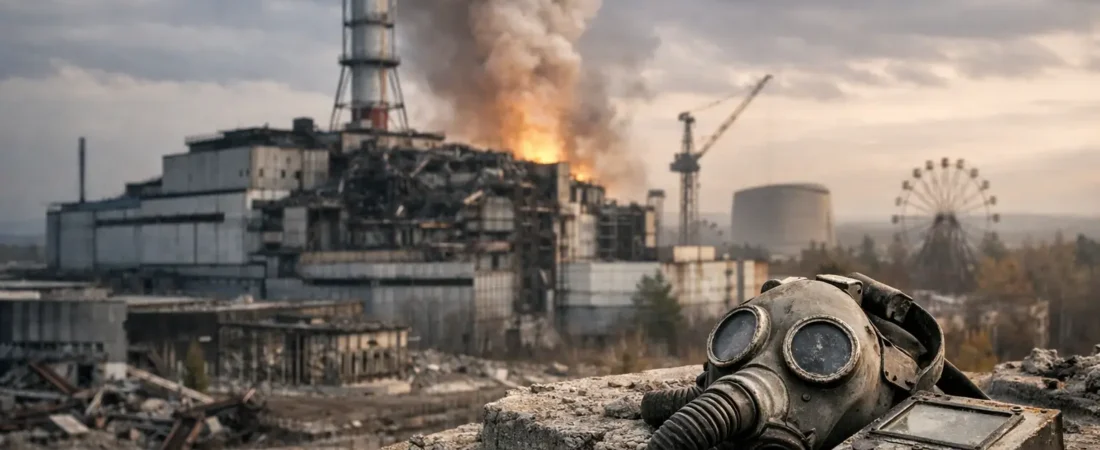
At 1:23 a.m. on April 26, 1986, the night shift at Reactor No. 4 of the Chernobyl Nuclear Power Plant lost control of a routine safety test. Within seconds, two explosions tore apart the reactor building. The Chernobyl disaster timeline begins in that violent instant, but its consequences unfolded over days, decades, and across much of Europe.
The plant stood near the new Soviet city of Pripyat, in northern Ukraine, then part of the Soviet Union. Nearly 50,000 people lived there, many of them young families whose lives were tied to the power station. By sunrise, they could see a fire burning where a reactor had stood. Few were told what they were witnessing.
Chernobyl Disaster Timeline: April 25-26, 1986
The crisis began before the explosion. Plant operators had planned a test to determine whether a turbine, slowing after a power loss, could briefly supply electricity to essential safety equipment. The test had been delayed, leaving the night crew to conduct it under difficult conditions.
In the early hours of April 26, operators reduced Reactor No. 4’s power too far. The RBMK reactor design could become unstable at low power, and a series of decisions made the condition worse. At 1:23:40 a.m., the crew pressed the emergency shutdown button, known as AZ-5. Instead of immediately stopping the reaction, a design flaw caused a sudden surge of power.
Two explosions followed. The reactor’s core was destroyed, its roof blown away, and radioactive material was hurled into the atmosphere. Unlike the containment structures used around many Western reactor designs, Chernobyl’s reactor had no full containment building capable of trapping the release.
Firefighters arrived within minutes, unaware that parts of the debris around them were intensely radioactive. They fought blazes on the roof and around the wrecked building through the night. Several men later recalled seeing an eerie blue glow in the darkness, a phenomenon associated with intense ionizing radiation. Many received lethal doses while preventing the fire from spreading to neighboring reactors.
The first official response
At first, officials at the plant and in Moscow struggled to understand the scale of the accident. Some believed the reactor remained intact. Others saw pieces of graphite from its core scattered outside – evidence of a catastrophe that seemed almost impossible.
By morning, radiation monitors in and around the plant were overwhelmed or unavailable. Yet Pripyat’s residents went about a bright spring Saturday: children played outdoors, weddings took place, and people watched emergency vehicles race toward the station. The invisible danger was already moving on the wind.
April 27: Pripyat Is Evacuated
About 36 hours after the explosion, buses began arriving in Pripyat. Residents were told to pack documents, essential belongings, and enough supplies for three days. They were assured they would soon return.
They did not return home.
Beginning at 2 p.m. on April 27, roughly 49,000 people were evacuated from Pripyat. The hurried departure preserved a city frozen in time: apartments with family photographs on the walls, classrooms with notebooks left behind, and the famous Ferris wheel in the abandoned amusement park. The wheel was scheduled to open for May Day celebrations, but it became instead one of the most recognizable images of the disaster.
Evacuation was necessary, but the delay mattered. Residents had spent more than a day exposed to radioactive iodine and other contaminants, mainly through the air and food. Children were especially vulnerable to radioactive iodine, which can collect in the thyroid gland.
April 28-May 6: Europe Learns What Happened
The Soviet Union did not publicly announce the accident immediately. The first clear alarm came from abroad. On April 28, workers at Sweden’s Forsmark Nuclear Power Plant detected radioactive contamination on their clothing and vehicles. Initial concern focused on a possible accident in Sweden, but meteorological evidence pointed east toward the Soviet Union.
That evening, Soviet television acknowledged that an accident had occurred at the Chernobyl plant. The announcement was brief and gave little detail. By then, radioactive material had already traveled across Belarus, Ukraine, Russia, Scandinavia, and other parts of Europe.
The following days became a battle to reduce a release that no one could simply switch off. Helicopters dropped sand, boron, clay, lead, and other materials into the shattered reactor. The work was dangerous and imperfect, but it reflected the urgency of the moment. Boron was intended to absorb neutrons and help suppress the nuclear reaction, while other materials aimed to smother the burning core.
On May 5 and 6, the most intense releases began to decline. But the emergency had not ended. The reactor remained a vast source of contamination, and the ground beneath it posed another fear: molten nuclear fuel could potentially reach water reservoirs below. Miners were brought in to dig beneath the reactor, working in extreme heat to prepare a cooling system. The feared worst-case scenario did not occur, but their labor became part of Chernobyl’s immense human effort.
May-December 1986: The Liquidators Enter the Zone
In the months after the explosion, hundreds of thousands of workers, soldiers, engineers, doctors, drivers, and cleaners took part in the response. They became known as liquidators, a Soviet term for those assigned to eliminate the consequences of the accident.
Their tasks varied. Some washed roads and buildings. Some removed contaminated topsoil from villages. Others cleared radioactive debris from the reactor roof, where human workers could remain only briefly. Robots were tried, but many failed under the intense radiation. Men were then sent in for seconds at a time, often called “bio-robots,” to shovel fragments of highly radioactive graphite and fuel into the ruins below.
In May, authorities expanded the evacuation area into a 30-kilometer exclusion zone. Ultimately, more than 100,000 people were relocated in 1986, followed by further resettlements in later years. Entire villages were emptied. Some were buried or demolished to limit the spread of contamination.
By November, workers completed the first concrete-and-steel shelter over the destroyed reactor. Known as the sarcophagus, it was built at remarkable speed under hazardous conditions. It was never meant to be permanent. It was an emergency monument to containment, built while the Soviet Union was still trying to control the story of what had happened.
The Human Cost and the Long Aftermath
Chernobyl’s immediate death toll and its long-term health effects require care and precision. Two plant workers died from traumatic injuries on the night of the accident. Twenty-eight firefighters and plant personnel died within months from acute radiation syndrome. Additional workers later died from radiation-related illness, though attributing individual deaths can be medically and statistically complex.
The broader impact is measured differently. The United Nations and other scientific bodies have linked the accident most clearly to thousands of cases of thyroid cancer, particularly among people exposed as children or adolescents in Belarus, Ukraine, and Russia. Many cases were treatable, but the increase was real and devastating for families who had been told little about the risk.
Chernobyl also carried psychological, social, and economic wounds. Displaced people lost homes, work, communities, and trust in public institutions. The label of being “contaminated” followed some evacuees for years. For others, the disaster became a source of misinformation and fear, making clear communication as vital as radiation monitoring.
1991-2016: From Failed Shelter to New Confinement
The original sarcophagus deteriorated over time. Rainwater entered through gaps, and the unstable remains of Reactor No. 4 still contained radioactive fuel-bearing materials. Engineers faced an unusual preservation challenge: how do you safely enclose a ruined nuclear reactor without disturbing the radioactive material inside it?
The answer was the New Safe Confinement, a vast steel arch assembled nearby and slid into place over the old structure in 2016. It spans the reactor like a protective hangar and is designed to limit radioactive releases while allowing future dismantling work. Its arrival did not erase Chernobyl, but it changed the site from an open emergency into a long-term engineering project.
Pripyat and the surrounding exclusion zone remain places of absence and endurance. Forests have grown through abandoned streets. Wolves, elk, birds, and other wildlife inhabit landscapes where human settlement sharply receded. This does not mean radiation is harmless or that the zone has become an untouched paradise. Contamination varies greatly by location, and ecological recovery exists alongside lasting radioactive hazards.
What the Chernobyl Timeline Still Teaches
Chernobyl was not caused by one mistake alone. It emerged from a dangerous reactor design, inadequate safety culture, procedural failures, and a system that discouraged people from openly confronting bad news. That combination is why the timeline matters. It shows how disaster can gather quietly before it becomes visible.
To stand in Pripyat today, even through photographs or testimony, is to encounter history at its most unsettling: a modern city interrupted in the middle of ordinary life. The enduring lesson is not simply that nuclear technology carries risk. It is that honesty, preparation, and respect for evidence matter most when the stakes are highest.