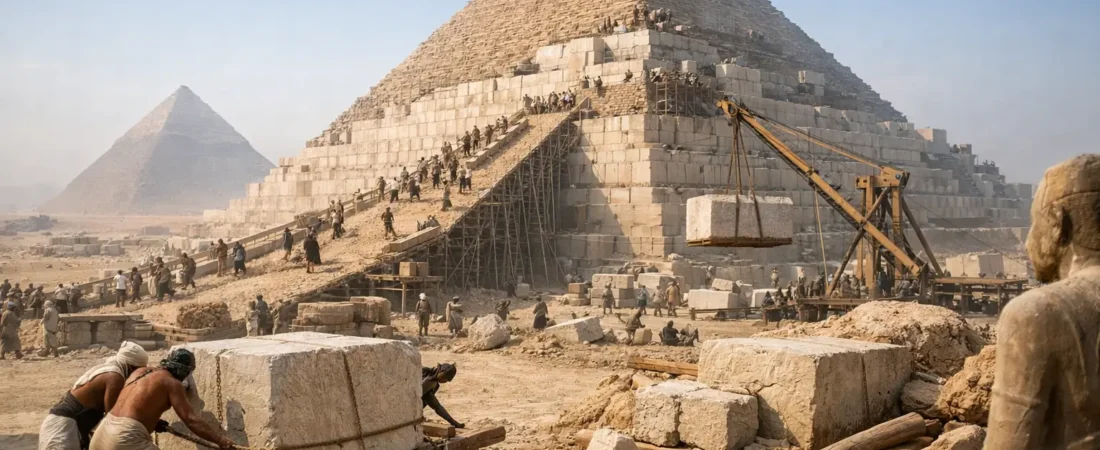
At dawn on the Giza Plateau, the Great Pyramid can seem less like a building than a fact of nature: a mountain with edges too precise to be accidental. Yet every limestone block was cut, moved, lifted, and set by people. Egyptian pyramids construction theory is not one settled answer, but a careful reconstruction built from quarry marks, worker settlements, ancient papyri, engineering experiments, and the physical limits of stone.
The mystery remains compelling because the monument is so large. Completed for Pharaoh Khufu around 2600 BCE, the Great Pyramid originally stood about 481 feet high. It contains an estimated 2.3 million blocks, most weighing several tons. Those figures invite fantasies of secret machines or lost technologies. The archaeological record points somewhere more impressive: to a highly organized Old Kingdom state, skilled laborers, seasonal work crews, water transport, and practical engineering refined over generations.
Egyptian Pyramids Construction Theory Begins at the Quarry
The pyramid did not begin at Giza. It began in the limestone beds surrounding the plateau, where most of the core blocks could be quarried close to the construction site. Workers cut channels around a desired block with copper tools and stone pounders, then freed it using wooden levers. Harder stone required different methods. Granite used in the King’s Chamber and its massive relieving chambers came from Aswan, roughly 500 miles south along the Nile.
The finest white casing limestone came from Tura, across the river. When newly placed, these polished outer stones would have made Khufu’s pyramid gleam in the sun. Much of that casing was later removed for building projects in medieval Cairo, but a few stones remain at the base, preserving a glimpse of the original surface.
Ancient Egyptians did not need to carry every block across desert sand by hand. The Nile was their great construction highway. A major breakthrough came with the discovery of the diary of Merer, an official who recorded the transport of Tura limestone to the Giza area during Khufu’s reign. Found at Wadi al-Jarf on the Red Sea coast, the papyri describe crews moving stone by boat through canals and branches of the Nile. They do not explain the entire pyramid, but they offer rare firsthand evidence that waterborne logistics were central to the project.
Sledges, Sand, and Human Muscle
Once blocks reached land, they were likely hauled on wooden sledges. Tomb imagery from ancient Egypt shows laborers pulling a large statue on such a sledge while another worker pours liquid in front of it. For years, the scene was interpreted as a ritual gesture. Experiments have shown a practical reason: dampening sand can reduce friction, making a heavy load easier to drag.
That does not mean wet sand solved every problem. The amount of moisture mattered. Too little had limited effect; too much could create mud. Nor does the image prove that pyramid crews used the exact same technique for every block. Still, it matches a wider pattern of evidence. Egyptian builders understood how to use simple materials, coordinated labor, and carefully prepared surfaces to move astonishing weights.
The work was demanding, but the old image of vast slave gangs is misleading. Excavations at Giza have revealed bakeries, storage areas, workshops, and burial grounds for workers. Their remains suggest a workforce that included permanent skilled specialists and rotating labor crews, probably drawn from farming communities during the Nile inundation, when fields were underwater. These people were fed, housed, treated for injuries, and buried near the royal project. Their lives were hard, but their presence beside the pyramid speaks of status and participation in a state enterprise, not an anonymous mass of chained captives.
The Ramp Question
Getting stone to the base of a pyramid is one challenge. Raising it level by level is the question that has produced the most competing theories.
Most scholars agree that ramps played some role. The disagreement concerns their shape, position, and scale. A straight ramp leading from the ground to the rising face is easy to picture, but it creates a serious problem. As the pyramid grew taller, a ramp shallow enough for hauling would need to become extraordinarily long and contain an enormous volume of material. Building and removing such a ramp could itself have rivaled the pyramid in scale.
A zigzag or switchback ramp, climbing one face in angled sections, would require less material. But it might obstruct the corners, where surveyors needed clear sightlines to preserve the monument’s exact geometry. Spiral-ramp proposals solve some space problems by winding around the outer faces, yet they raise another: a ramp on the exterior could conceal the corners and make precision harder to monitor.
Some researchers have proposed an internal ramp, built within the pyramid’s outer shell. This idea has captured public imagination because it offers a route that would not dominate the exterior. It remains unproven. The Great Pyramid’s interior is complex, and scans have revealed intriguing voids, including the large passage-like structure identified above the Grand Gallery in 2017. But no known void can yet be confidently identified as an internal hauling ramp.
The most credible answer may be less dramatic and more realistic: builders probably used different methods at different stages. A broad approach ramp could have served the lower courses, while shorter ramps, levers, and carefully planned work platforms handled higher levels. Ancient construction was not a single elegant trick. It was a changing sequence of solutions adapted to a monument that changed shape every year.
Lifting the Highest Stones
The upper levels required the greatest care, not necessarily the largest blocks. Workers could use levers to raise a stone in small increments, placing packing beneath it after each lift until it reached the next course. This method is slow, but pyramids were not built in a weekend. Khufu’s project likely unfolded over decades, supported by administrators, boat crews, quarry teams, surveyors, toolmakers, food producers, and thousands of laborers working in rotation.
The massive granite beams above the King’s Chamber show what this system could achieve. Some weigh dozens of tons. Their placement was a feat of planning as much as strength. A failed lift or damaged beam would have cost valuable time and labor, so each stage demanded dependable routes, disciplined crews, and constant measurement.
Precision Was Part of the Construction
The Great Pyramid is not merely huge. Its sides are aligned closely with the cardinal directions, and its base was leveled with remarkable accuracy. Egyptian surveyors likely established orientation by observing stars, possibly using circumpolar stars that never set. For leveling, they may have used water-filled trenches or channels, allowing builders to mark a consistent horizontal reference across the site.
This precision matters when evaluating any egyptian pyramids construction theory. A proposal must explain more than how a block could be moved. It must also account for how builders maintained straight courses, stable internal chambers, smooth casing lines, and a near-square footprint while the work zone was crowded with ramps, sledges, tools, and people.
It also explains why archaeology favors organization over mystery. Khufu’s pyramid belongs to a long architectural story. Earlier rulers had already built stepped pyramids and true pyramids, including the Bent Pyramid and Red Pyramid of Khufu’s father, Sneferu. Those monuments were laboratories on a monumental scale. By the time Khufu’s architects planned Giza, they inherited generations of hard-won experience.
What We Know, and What We Still Cannot See
No ancient Egyptian instruction manual has survived telling us exactly how the Great Pyramid was raised from its first course to its capstone. That absence leaves room for debate. Models, experiments, and digital reconstructions can test possibilities, but none should be mistaken for final proof simply because it looks convincing.
What the evidence does establish is powerful enough. Stone came through linked quarry and river systems. Workers lived in a purpose-built community. Crews used sledges, boats, ropes, levers, and ramps. Royal administration supplied food, labor, and planning on a vast scale. The pyramid was the result of technology available to ancient Egyptians, applied with exceptional patience and intelligence.
The next time you picture the Great Pyramid, do not imagine a single secret hidden behind its stones. Picture a boat entering a canal with white limestone aboard, a quarry crew striking rock in the desert heat, surveyors watching the night sky, and laborers pulling together on a rope. That human landscape is the true wonder waiting inside the pyramid’s construction story.