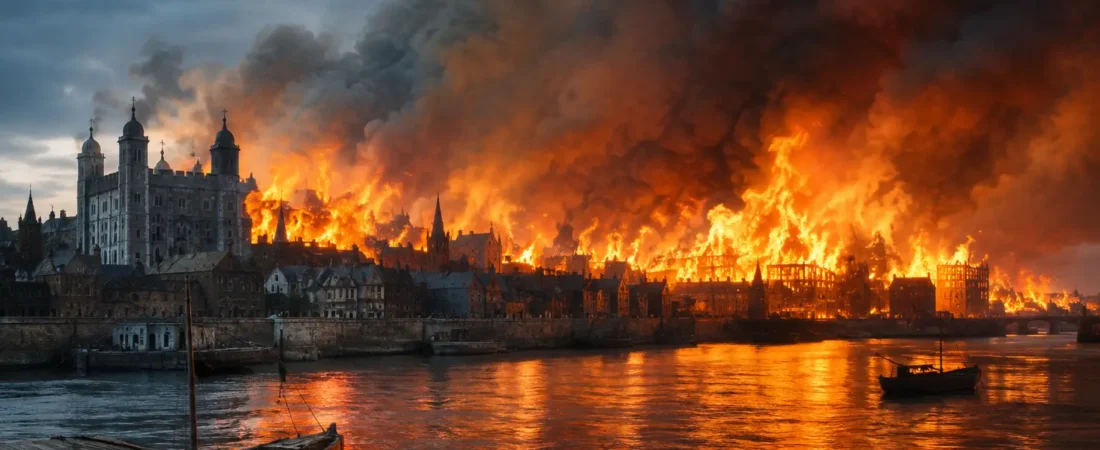
At about 1 a.m. on Sunday, September 2, 1666, a fire began in a baker’s house on Pudding Lane. By dawn, sparks were racing over London’s timber roofs in a strong east wind. The most revealing Great Fire of London facts are not simply about what burned. They show a city built for medieval life meeting a disaster it could no longer contain – and emerging with a different shape, skyline, and sense of public safety.
For four days, Londoners watched familiar parish churches, markets, workshops, homes, and civic buildings disappear behind a wall of flame. Yet the Great Fire was neither the total destruction of London nor the clean beginning of a new city often suggested by paintings of blazing streets. Its real story is messier, more human, and more remarkable.
A City Ready to Burn
London in 1666 was crowded, prosperous, and dangerously combustible. Within the old Roman walls, narrow lanes twisted between multistory houses. Many buildings had timber frames, plaster walls, wooden staircases, and roofs that allowed flames to jump quickly from one property to the next. Warehouses held oil, tar, coal, spirits, cloth, and other trade goods that fed a fire once it reached the riverside districts.
The city had also endured a difficult recent past. The Great Plague of 1665 had killed tens of thousands of people, and London’s population was beginning to recover. Its streets were busy again, but its infrastructure had not been remade. Firefighting depended largely on local parish efforts: leather buckets, hand pumps, hooks, ladders, and, most importantly, the creation of firebreaks by pulling down buildings ahead of the flames.
That last measure was slow to begin. The Lord Mayor, Sir Thomas Bludworth, initially underestimated the danger. As the fire spread, property owners naturally resisted the destruction of their own houses, even when demolition might save an entire neighborhood. By the time decisive action came, wind and fire had taken control.
Great Fire of London Facts: Four Days That Changed the City
A brief timeline helps place the catastrophe inside the lived experience of 1666.
Sunday, September 2
The fire began at the bakery of Thomas Farriner, also spelled Farynor, the king’s baker. The family escaped, but the blaze spread through nearby houses. Strong winds carried burning fragments across lanes and rooftops. Samuel Pepys, the naval administrator and diarist, climbed the Tower of London and saw what he called an “arch of fire” stretching across the city.
Monday, September 3
The fire became an urban inferno. It crossed key commercial areas, including warehouses near the Thames. King Charles II and his brother James, Duke of York, personally helped direct emergency measures and urged the demolition of buildings to halt the advance. Many residents fled by boat, cart, or on foot, carrying whatever they could save.
Tuesday, September 4
Flames reached some of London’s most important landmarks. Old St. Paul’s Cathedral, already covered in wooden scaffolding for repairs, burned spectacularly. The heat was so intense that stone and metal fractured, while molten lead reportedly ran down the streets.
Wednesday, September 5
As winds eased and wider firebreaks finally held, the main blaze was brought under control. Smaller fires continued, but the immediate threat to the western parts of London had passed.
The Numbers Tell Only Part of the Story
The scale remains difficult to picture. The fire destroyed roughly 13,200 houses, 87 parish churches, St. Paul’s Cathedral, the Royal Exchange, Guildhall, prisons, markets, and many public offices. It consumed about 373 acres within the City of London and a far larger area when surrounding districts are considered.
One of the strangest Great Fire of London facts is the official death toll: only a handful of deaths were recorded, commonly given as six or fewer. Historians treat that figure cautiously. Poor residents, servants, laborers, and people without family connections were less likely to be formally identified. Some victims may have been cremated by the heat or died later from injuries and exposure. The documented toll was low compared with the immense destruction, but it is unlikely to record every life lost.
Neither did the fire erase all of London. The Tower of London survived. Westminster, where the royal court and Parliament were located, lay west of the main fire zone and escaped. Southwark, across the Thames, was not consumed. The disaster destroyed the old commercial heart of the city, not every neighborhood that Londoners knew as home.
Rumor, Fear, and the Search for Blame
The fire unfolded during wartime. England was fighting the Dutch in the Second Anglo-Dutch War, and Londoners feared invasion, sabotage, and foreign agents. Rumors spread quickly that the fire had been deliberately set by French or Dutch Catholics. Mobs attacked suspected foreigners, and authorities struggled to restore order alongside fighting the flames.
No credible evidence has shown that the fire was a coordinated enemy attack. The most likely origin remains accidental: an oven fire at Farriner’s bakery that was not fully extinguished. But disasters create a painful demand for explanation. In 1666, existing religious and political tensions gave that demand dangerous targets.
One man, a French watchmaker named Robert Hubert, falsely confessed to starting the blaze. His story changed repeatedly and contained clear contradictions, including evidence that he was not even in London when the fire began. He was nevertheless convicted and executed. His fate is a sobering reminder that historical disasters do not only destroy buildings. They can expose fear, prejudice, and failures of justice.
Rebuilding London Without Starting from Scratch
After the ash cooled, architects and planners imagined bold alternatives. Christopher Wren, John Evelyn, and others proposed broad boulevards, grand squares, and orderly street plans inspired by continental European cities. None of these complete redesigns was adopted.
The reason was practical. Land ownership in London was complicated, businesses needed to reopen, and thousands of people required homes. A perfectly planned capital might have taken decades and triggered endless disputes over boundaries and compensation. Instead, the rebuilt City broadly followed the old street pattern, though with significant improvements.
New building regulations favored brick and stone over timber. Streets were widened in selected places, overhanging upper stories were restricted, and construction standards became more controlled. Wren went on to design the new St. Paul’s Cathedral, completed in 1710, along with dozens of City churches. The familiar dome that now defines London’s skyline is therefore one of the fire’s most enduring architectural legacies.
The Monument, built near Pudding Lane between 1671 and 1677, still marks the event. Its height, 202 feet, matches its distance from the site traditionally identified as the bakery where the fire began. It was designed by Wren and Robert Hooke, a scientist, architect, and surveyor who helped measure and rebuild the damaged city.
What the Fire Did Not Do
A persistent legend claims the Great Fire ended the plague by burning out rats and infected areas. It is an appealing idea, but the evidence does not support such a simple conclusion. The fire affected only part of London, while plague deaths had already declined sharply before September 1666. Disease patterns are shaped by many forces, including immunity, movement, weather, living conditions, and the ecology of rats and fleas.
The fire also did not instantly make London safe. Rebuilding took years, housing remained scarce, and poorer residents bore immense losses. Still, it accelerated changes in construction, urban regulation, insurance, surveying, and fire prevention. London learned, at terrible cost, that a dense city needed shared rules as much as individual enterprise.
For visitors standing near Pudding Lane or beneath St. Paul’s dome, the most useful way to remember 1666 is to look beyond the flames. The Great Fire reveals how ordinary materials, delayed decisions, weather, commerce, fear, and human resilience can reshape a city. History survives not only in monuments, but in the choices a community makes after the smoke clears.