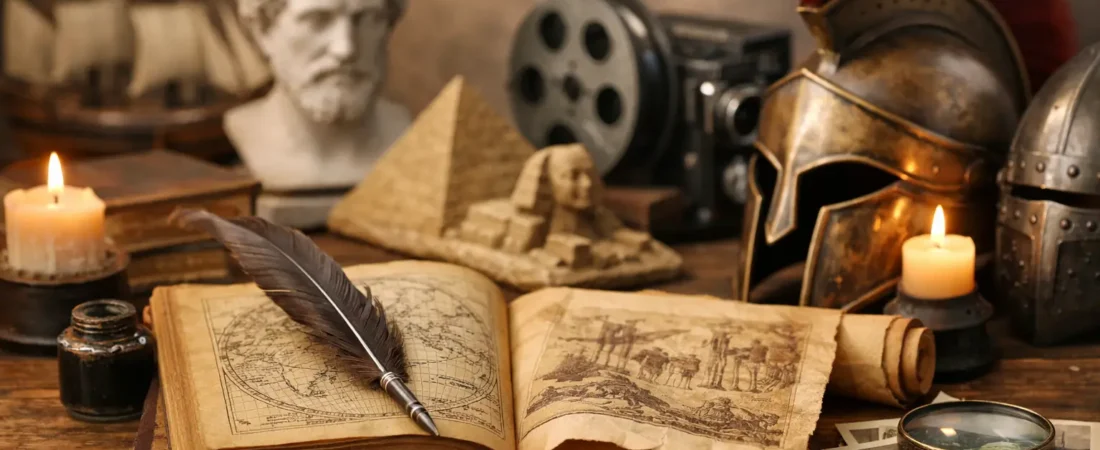
A Roman general stands before his troops and writes about his own campaigns as if he were an observer. A Greek historian reconstructs speeches he never heard. A West African griot carries centuries of memory without a single page. These historical storytelling examples remind us that history has never been only a record of facts. It has also been a craft – a way of arranging memory so that people can understand power, loss, courage, and change.
The best historical storytelling does something rare. It preserves evidence while also creating presence. We do not simply learn what happened. We feel the weight of a city under siege, the tension of a royal court, or the silence after a ship disappears beneath the water. For a history audience, that distinction matters. Facts tell us what occurred. Storytelling helps us grasp why it mattered to the people who lived through it.
Why historical storytelling examples matter
If you walk through a museum gallery, the most memorable objects are rarely the ones with the longest labels. They are the ones placed within a human scene: a child’s shoe from a migration route, a cracked helmet from a battlefield, a letter written the night before an execution. The object gains force because it is anchored in narrative.
That is exactly what strong historical storytelling examples show us. They reveal how different cultures and eras turned raw events into meaning. Sometimes the goal was accuracy as we would define it today. Sometimes it was moral instruction, political persuasion, religious memory, or cultural survival. The trade-off is crucial. A source may be vivid and influential without being fully reliable in every detail.
For readers, students, and creators, this is where the subject becomes most useful. Studying historical storytelling is not just about admiring old texts. It is about learning how evidence, emotion, and perspective shape our view of the past.
Historical storytelling examples from the ancient world
Herodotus and the birth of narrative history
Herodotus, writing in the 5th century BCE, is often called the Father of History. He is also one of history’s earliest great storytellers. In his account of the Persian Wars, battles share space with customs, rumors, geography, royal ambitions, and strange anecdotes gathered from travelers and witnesses.
That mixture is precisely why he still matters. Herodotus understood that events do not happen in a vacuum. A war is not only troop movement. It is belief, fear, pride, and misunderstanding. His weakness, of course, is that not every tale he preserved can be verified. Yet his method opened a path historians still follow: gather voices, compare accounts, and place human motives at the center of the story.
Thucydides and the drama of evidence
If Herodotus gives us breadth, Thucydides gives us discipline. His history of the Peloponnesian War is sharper, colder, and more analytical. He is deeply interested in cause and effect, political calculation, and the mechanics of conflict.
But Thucydides is not dry. He includes speeches that reveal the moral atmosphere of war, including the famous Melian Dialogue. He admitted that these speeches were reconstructed to reflect what was appropriate to the moment. By modern standards, that creates tension. Yet it also shows an early historian wrestling with a problem we still face: how do you convey truth when the exact words are gone? His answer was to preserve the essence of the argument and the stakes of the moment.
Julius Caesar and the power of controlled perspective
Caesar’s Commentaries on the Gallic War remain some of the most influential political narratives ever written. He describes his campaigns in the third person, creating a tone of distance and authority even as he shapes his own image.
This is historical storytelling as strategy. Caesar gives readers action, geography, character, and military tension, but he also justifies conquest and presents himself as rational and necessary. It is a valuable reminder that some of the most compelling historical narratives are also acts of self-fashioning. The story is not false simply because it is interested, but it must be read with clear eyes.
Storytelling beyond the written page
Oral tradition and the memory keepers
Not all history began in manuscripts. Many societies preserved the past through spoken performance, ritual, poetry, and song. Among the most powerful examples are the griots of West Africa, who carried genealogies, political memory, and cultural identity across generations.
Oral historical storytelling works differently from written chronicles. It is living rather than fixed. Details may shift in performance, but continuity is maintained through trained memory, communal correction, and ceremonial repetition. For modern readers, this can be difficult at first because we are used to treating the written word as more trustworthy. Yet oral tradition often preserves what official archives ignore: family lines, local trauma, heroic resistance, and the emotional truth of a people.
Indigenous memory and place
Across many Indigenous cultures, landscape itself becomes an archive. A river bend, a mountain path, or a sacred site can carry story, law, ancestry, and warning. In these traditions, historical storytelling is not separate from geography. It is embedded in movement, season, and community knowledge.
This matters because it broadens our understanding of what counts as historical evidence. A colonial administrator’s report may survive in paper form, while an Indigenous account survives in oral teaching and place-based memory. Neither should be dismissed out of hand. Good historical practice asks how these forms can be read together, and where they challenge one another.
Medieval and early modern historical storytelling examples
The Anglo-Saxon Chronicle and the feeling of time passing
The Anglo-Saxon Chronicle is not a single polished narrative. It is a record compiled and continued over time, with entries that range from brief notices to fuller accounts. That layered quality gives it unusual power.
Reading it can feel like watching the Middle Ages think in real time. Famines, raids, royal deaths, omens, and battles appear with uneven detail, which tells us something important. What a society chooses to record, and how much space it gives each event, reveals its anxieties and values. Historical storytelling here is cumulative. It creates atmosphere through sequence rather than dramatic flourish.
Froissart and the theater of chivalry
Jean Froissart’s chronicles of the Hundred Years’ War offer another model entirely. His work is colorful, courtly, and highly attentive to noble conduct, ceremony, and battle scenes. He helped shape how later generations imagined medieval warfare.
Yet Froissart also shows the limits of elegant storytelling. His interest in chivalric spectacle can soften the brutality of war and push common people to the margins. That does not diminish the value of his writing. It clarifies what it is best used for. He is indispensable not only for events but for understanding how elites wanted those events remembered.
Modern forms that changed historical narrative
Diaries, letters, and the first-person witness
When history narrows from kingdoms to a single voice, the effect can be devastating. Diaries and letters bring us close to lived experience in ways grand chronicles rarely can. The diary of Samuel Pepys captures Restoration London with extraordinary immediacy. Anne Frank’s diary records not only persecution but the inner life that persecution could not erase.
These sources are often fragmentary, and that is part of their strength. They do not pretend to see the whole field. They preserve weather, routine, fear, boredom, affection, and interruption – the texture of life as it was actually lived. For immersive history writing, they are among the finest teachers available.
Microhistory and the overlooked life
Modern historians have become increasingly skilled at telling large stories through small subjects. A village trial, a shipwreck, a burial site, or a single household ledger can illuminate an entire era. This approach, often called microhistory, works because scale can sharpen meaning.
A well-known example is the use of inquisitorial records, court archives, or excavation evidence to reconstruct ordinary lives otherwise absent from major political narratives. The benefit is intimacy. The risk is overreach. A single case can reveal a great deal, but it cannot automatically stand for everyone. The best microhistories keep that balance in view.
What these examples teach us about telling the past well
Across these historical storytelling examples, one lesson keeps returning: the strongest narratives do not merely decorate facts. They organize evidence around human experience. They know when to widen the lens and when to move close. They respect uncertainty instead of covering it up.
They also remind us that every historical account has a position. Some are imperial. Some are communal. Some speak from power, while others survive from the edges of it. Reading history well means noticing both what a source tells us and what it cannot or will not say.
That is why great history writing still feels almost archaeological. We brush away assumption, compare fragments, and try to restore a vanished world without pretending we can make it fully whole. At Time Vault Capsule, that is the real fascination of the craft. Not just to retell the past, but to let readers stand near it long enough to hear its true scale.
The next time a historical narrative grips you, pause for a moment and ask how it was built. Was it shaped by memory, politics, performance, or witness? Somewhere inside that answer is the difference between a date on a page and a past that breathes.