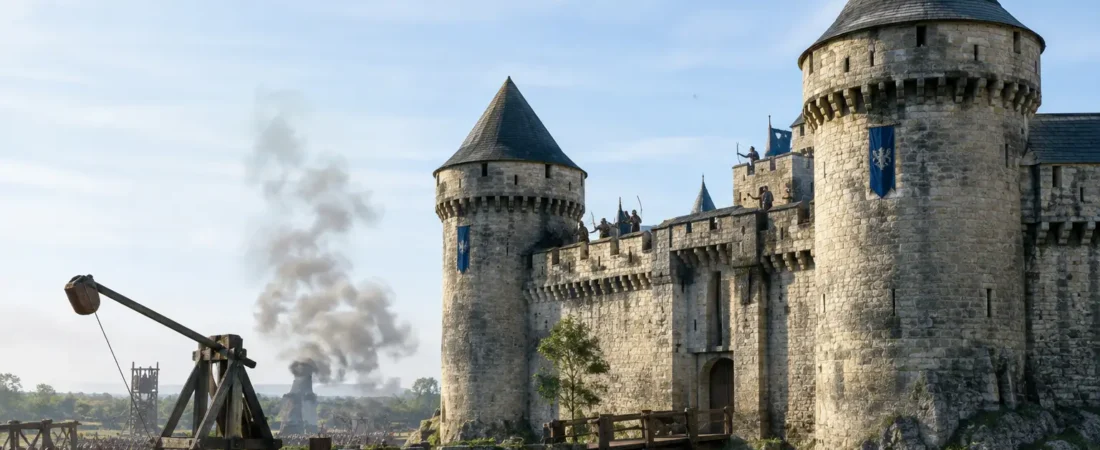
A siege began long before the first stone struck a wall. From a castle rampart, defenders could watch smoke rise from farms beyond the gates, see roads close under enemy patrols, and measure their remaining grain by the day. Understanding how castles defended against sieges means looking beyond thick walls. A castle was a fortified community, designed to delay, frustrate, and outlast an army that often hoped hunger would succeed where weapons failed.
For medieval lords, a castle was never invincible. Its strength depended on its location, garrison, water supply, stores, and the political reality outside its walls. Yet at their best, castles made siege warfare painfully expensive. They forced attackers to fight uphill, expose themselves in narrow approaches, and sustain an army in hostile territory for weeks, months, or even years.
How Castles Defended Against Sieges
The first line of defense was usually the landscape itself. Many castles stood on steep hills, rocky outcrops, river bends, or artificial mounds. Approaching soldiers had to climb while carrying ladders, shields, and siege equipment. Horses struggled on muddy slopes. Heavy engines such as trebuchets needed level ground and time to assemble.
At Dover Castle in England, high chalk cliffs protected one side so completely that an enemy could not realistically attack from it. Other strongholds used water as their ally. Moats did more than create a dramatic obstacle: they kept siege towers and battering rams away from the walls, made mining difficult, and narrowed the places where attackers could concentrate.
A moat did not always contain water. A dry ditch, particularly one cut into rock, could be equally formidable. An attacking force had to fill it, bridge it, or descend into it under arrows and stones from above. Every additional minute at the base of a wall was dangerous.
Walls Built to Absorb Attack
Early medieval castles often relied on timber palisades and earthworks, especially the familiar motte-and-bailey design introduced widely in England after 1066. Timber could be raised quickly, but it burned. Over time, many major castles replaced wood with stone, creating stronger curtain walls and towers that could resist fire, arrows, and many forms of impact.
Stone walls were not merely tall. Their shape mattered. Towers projected outward from the curtain wall, allowing defenders to fire along its face. This was called flanking fire. An attacker pressed against the wall might be protected from arrows shot directly downward, but not from missiles launched sideways from a nearby tower.
By the 13th century, some castles adopted concentric defenses: an outer wall enclosing an inner, taller wall. If attackers captured the first line, they entered a killing ground overlooked by defenders on the inner circuit. Harlech Castle in Wales is a celebrated example of this principle, though its defenses also relied on strong towers, a commanding site, and access to the sea during certain periods.
Walls also evolved in response to artillery. When gunpowder cannon became more effective in the late medieval period, high, thin walls became vulnerable. Fortifications gradually shifted toward lower, thicker earth-and-stone defenses. The age of the classic medieval castle was giving way to a new architecture of war.
Gates Were the Castle’s Most Dangerous Weakness
A castle needed an entrance for people, livestock, supplies, and messengers. That necessity made the gate the place attackers most wanted to break. Defenders responded by turning it into a layered trap.
A visitor might pass over a drawbridge, through a barbican or outer gateway, beneath a portcullis, and into a passage guarded by heavy doors. Above, defenders could fire through openings or drop missiles. Popular imagination often calls every opening in a gatehouse a “murder hole,” but medieval designs varied greatly, and the term is modern. What mattered was the same: the gateway exposed attackers while giving defenders protected firing positions.
The strongest gatehouses were small fortresses within the fortress. Their rooms housed guards, mechanisms for raising portcullises, and stores of weapons. If a battering ram reached the door, defenders could reinforce it with beams, hurl stones, or launch a sudden sortie through another entrance.
Defenders Fought From Above and Beyond the Walls
The classic image of boiling oil poured from battlements is far less certain than films suggest. Oil was expensive, useful for cooking, and not always available in the necessary quantities. Defenders more commonly used arrows, crossbow bolts, stones, lime, hot water, and burning materials. A stone dropped from height could be devastating, especially against men crowded beneath a ladder or ram.
Castle walls were not passive barriers. Wooden hoardings, built out from the top of walls, allowed defenders to shoot and drop objects directly downward while remaining sheltered. Later stone machicolations served a similar purpose. Archers and crossbowmen targeted engineers, standard-bearers, and officers, whose loss could disrupt an assault at a critical moment.
Defenders also made surprise attacks. A small group might leave through a concealed postern gate at dawn or during bad weather, attempting to burn siege engines, kill laborers, or capture supplies. Such sorties were risky. A garrison was often too small to waste trained men, but one successful raid could delay an assault for days.
Food, Water, and Discipline Decided Long Sieges
The most formidable wall could not feed a hungry garrison. Castles therefore stored grain, salted meat, dried peas, cheese, ale, and fuel. Some had mills, ovens, gardens, fishponds, and space for livestock. Water was even more urgent. Wells inside the walls were ideal, but not every castle had one. Cisterns collected rainwater, while some strongholds protected access to springs through covered passages or fortified water gates.
At Château Gaillard in Normandy, built by Richard the Lionheart, the defenders had formidable walls and a dramatic position above the Seine. Yet in 1204, French forces under Philip II found ways through its layered defenses, including exploiting a vulnerable chapel area after taking outer works. The episode is a reminder that ingenious design could still be undermined by incomplete construction, weak points, poor fortune, or determined attackers.
Inside a besieged castle, life narrowed quickly. Animals consumed valuable food. Crowding encouraged disease. Commanders had to ration supplies and decide who could remain behind the walls. In some sieges, civilians were expelled because they could not be fed, a grim act that left them vulnerable between the opposing forces. Medieval siege warfare was as much a test of administration and endurance as of courage.
Attackers Had Answers, but Every Answer Cost Time
Besieging armies used ladders, rams, siege towers, catapults, and trebuchets. The trebuchet could throw heavy stones into walls and buildings, while smaller engines scattered missiles over battlements. Attackers also dug mines beneath towers or wall sections, supporting the tunnel with timber and then burning the props to collapse the ground above.
Defenders listened for digging and answered with countermines. They sometimes flooded tunnels, filled them with smoke, or fought underground in the darkness. Archaeological evidence and siege accounts reveal just how intimate this struggle could become: war was waged not only across fields and walls, but beneath them.
Still, the most effective siege weapon was often patience. An army that controlled surrounding roads could prevent relief forces and cut off provisions. But besiegers faced their own problems. They needed food, wages, sanitation, fodder, and protection from disease. A relieving army could trap the besiegers between castle and field force. This was why a well-sited castle could shape an entire campaign.
A Castle’s Greatest Defense Was Time
Castles defended against sieges by making every assault difficult and every day expensive. Their towers, gatehouses, ditches, and walls worked together, but survival also rested on clean water, capable leadership, loyal defenders, and the hope of relief. No single feature guaranteed safety.
When you stand before a ruined curtain wall or look down into a dry moat, imagine the calculations made there: how much grain remained, whether reinforcements were coming, and whether the enemy could be held back until winter. A castle was not simply a stone monument to power. Under siege, it became a living machine for buying time – and time could save a kingdom.