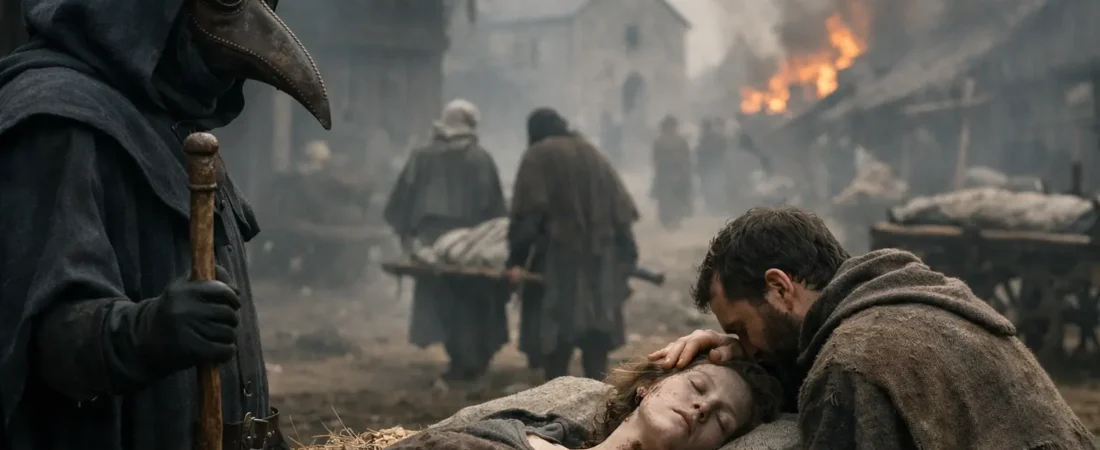
In the winter of 1348, carts moved through London toward a newly opened burial ground outside the city walls. Bodies were laid in long trenches, sometimes wrapped in simple shrouds, at a pace no parish churchyard could sustain. The people burying them did not know the bacterium’s name, or that the catastrophe would return in waves for centuries. But they were living through the answer to how plague changed medieval society: it broke the old rhythms of work, worship, family, and power, then forced survivors to build new ones.
The Black Death was not a single dramatic interruption between familiar medieval chapters. It was a demographic shock so profound that Europe after 1350 could not simply resume where Europe before 1347 had left off. Its effects differed by region, class, and decade, and older institutions did not vanish overnight. Yet the plague altered the terms on which ordinary people negotiated with landlords, employers, churches, and governments.
The catastrophe arrives
The disease now known as plague is caused by the bacterium Yersinia pestis. It likely traveled west along commercial and military routes from Central Asia, reaching Mediterranean ports in 1347. From there it spread rapidly through Europe, North Africa, and western Asia. Fleas carried by rodents played an important role, though historians and scientists continue to study how pneumonic transmission and local conditions accelerated particular outbreaks.
In Europe, the first great wave lasted roughly from 1347 to 1352. Mortality was devastating, although no single figure fits every place. Modern estimates often suggest that between one-third and one-half of Europe’s population died. Some villages lost far more; some communities suffered less. A mass burial ground at East Smithfield in London, excavated in the 1980s, offered stark physical evidence of the emergency. DNA recovered from victims has helped confirm plague as the cause.
Medieval observers described abandoned houses, silent marketplaces, and fields left unharvested. They also recorded fear with uncomfortable honesty: families separated, neighbors avoided one another, and the dead could not always receive customary rites. Such testimony should not be read as proof that all social bonds collapsed. Many people did care for relatives and organize burials under impossible conditions. But the scale of death exposed how much medieval life depended on countless workers whose labor was normally unnoticed.
How plague changed medieval society at work
Before the Black Death, much of western Europe had a large rural population and a limited supply of land. Peasants often owed labor services, rents, or dues to landlords. After the plague, land remained but people were scarce. Fields needed hands. Workshops needed apprentices. Households needed servants. Survivors suddenly possessed something with greater bargaining value: their labor.
Wages rose in many places, especially for agricultural laborers and skilled craftspeople. Some peasants could seek better terms, move to another manor, or rent land that had become available. Diets sometimes improved as survivors gained access to more meat, dairy, and land per person. This was not a universal prosperity story. Repeated outbreaks, local harvest failures, and regional warfare could erase gains quickly. Still, scarcity gave workers leverage that had been difficult to claim before 1348.
Landlords and governments recognized the threat to the old order. In England, the Ordinance of Laborers of 1349 and the Statute of Laborers of 1351 attempted to hold wages near pre-plague levels and compel able-bodied people to work. Their repeated enforcement reveals the problem: market conditions made the rules hard to sustain. Similar tensions appeared across Europe as elites tried to preserve customary obligations while laborers looked for opportunity.
The consequences unfolded over generations. The English Peasants’ Revolt of 1381 cannot be explained by plague alone. Poll taxes, war costs, political grievances, and local abuses mattered greatly. Yet a society already transformed by labor shortages and contested obligations was more volatile. The revolt showed that villagers and artisans could articulate claims about freedom, wages, and unjust authority in newly forceful ways.
A changed countryside
In some regions, marginal farmland was abandoned because too few people remained to cultivate it. Woodland and pasture expanded, while landlords shifted from grain farming toward livestock, which required fewer workers. Villages disappeared in parts of England and elsewhere, though abandonment had multiple causes, including economic change and later enclosure.
For survivors, the landscape itself became a record of loss. A ruined hamlet, an overgrown field, or a church with missing parishioners was not merely scenery. It marked property, inheritance, memory, and the disruption of a community’s future.
Faith tested, reshaped, and sometimes weaponized
The plague raised questions that medieval Christianity had no easy way to answer. Why had God permitted children, priests, and the devout to die alongside the powerful and corrupt? Clergy often ministered to the sick and died in large numbers themselves. Their losses left parishes without experienced priests and created openings for hastily trained replacements.
Some believers sought comfort through prayer, processions, charitable gifts, and devotion to saints associated with protection from disease. Others joined flagellant movements, publicly whipping themselves in hopes of divine mercy. Church authorities often opposed these movements when they became disorderly or promoted unauthorized religious claims.
The era’s religious response also carried a terrible stain. Across parts of Europe, Jewish communities were falsely accused of poisoning wells and causing the plague. These accusations led to expulsions, forced conversions, and massacres. The disease had no religious boundary, but fear made old prejudices more lethal. Any account of medieval plague must keep this persecution in view: catastrophe did not automatically unite society. It could intensify suspicion against those already treated as outsiders.
The Church did not collapse, nor did faith disappear. Instead, religious life changed in texture. Personal prayer, memorial masses, wills, and charitable foundations took on heightened significance. The demand for certainty in an uncertain world helped fuel new forms of lay devotion, while criticism of clerical shortcomings lingered into later centuries.
Death enters art, homes, and public memory
After 1348, death appeared more insistently in European art and literature. Skeletons danced with popes, kings, merchants, and peasants in images known as the Dance of Death. Tombs sometimes showed the deceased not as serene sleepers but as decaying bodies. These works were not simply morbid decoration. They insisted that rank could not shield anyone from mortality.
Household life changed too. Sudden deaths altered inheritance patterns and left widows, widowers, and children to manage property and trades. In some towns, women assumed wider economic responsibilities when male relatives died, running shops or maintaining workshops. Their opportunities remained constrained by law, guild rules, remarriage, and local custom, so it would be misleading to call plague an uncomplicated liberation. But demographic scarcity could create spaces in which women exercised visible authority.
A smaller population also meant that kinship networks were thinner. The loss of parents, siblings, business partners, and godparents changed who could provide care, credit, training, and protection. Medieval society was built through these relationships. Plague tore holes in the social fabric that legal documents alone cannot measure.
Cities learn to govern disease
The Black Death did not teach medieval people germ theory. That breakthrough lay centuries ahead. It did, however, push cities and port authorities to experiment with public health measures. Officials monitored travelers, isolated the sick, regulated burials, and sometimes restricted movement or commerce.
One notable development came in 1377, when the Adriatic port city of Ragusa, now Dubrovnik, required newcomers from infected areas to spend a period of isolation before entering. The initial period was thirty days, later extended to forty, helping give quarantine its familiar association with forty days. These measures were imperfect and could be harsh, but they marked a new idea: communities had a civic responsibility to manage epidemic risk.
Plague also strengthened certain forms of recordkeeping and municipal authority. Cities needed officials to count deaths, oversee grain supplies, manage burial space, and make decisions under pressure. The response was uneven, and many policies rested on mistaken medical assumptions. Still, the repeated return of plague made disease a matter of governance, not only private misfortune or religious fate.
The long aftermath
The Black Death returned repeatedly from the fourteenth through the seventeenth centuries. Each outbreak landed in a society already shaped by previous losses. Some communities developed practical habits of isolation; others faced fresh devastation when trade, war, or migration reopened routes of infection. Medieval people did not experience one plague, recover, and move on. They learned to live in the shadow of recurrence.
That is why the plague’s legacy cannot be reduced to a death toll. It changed the value of labor, unsettled inherited authority, redirected land use, tested religious institutions, and made public health a duty of cities. It also revealed both care and cruelty: neighbors nursing the ill, officials improvising relief, and persecuted minorities made scapegoats for a disaster they did not cause.
When we stand before a plague burial or read a hurried medieval will, the past feels close. These are reminders that societies are not fixed structures. Under pressure, they expose their inequalities, invent new practices, and ask ordinary people to decide what they owe one another. That question, carried forward from the plague years, remains worth bringing into our own crowded streets and quiet homes.