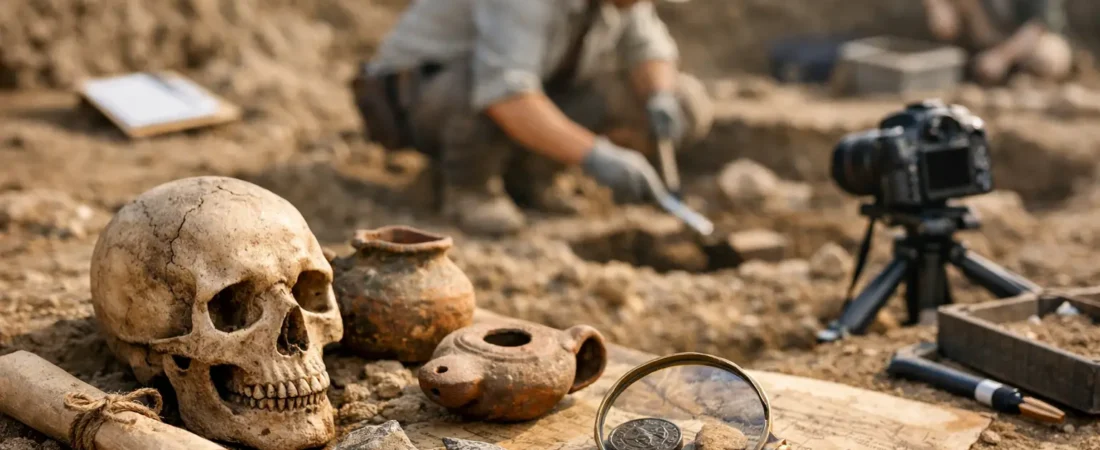
A wall emerges first.
Not a complete wall – just a line of shaped stone breaking through the soil, as if a building has taken one careful breath after centuries underground. Then come the smaller clues: a shard of painted pottery, a burned seed, a coin worn smooth by long-dead fingers. This is where archaeological discoveries explained properly begin – not with treasure, but with context. The object matters, certainly. But what matters more is where it lay, what rested beside it, and what story its surroundings can still tell.
Archaeology often arrives in popular culture as a dramatic reveal. A tomb opens. A statue appears. Headlines announce a “lost city.” The real work is slower, more disciplined, and far more interesting. Every discovery is a negotiation between evidence and interpretation. Archaeologists are not simply finding old things. They are reconstructing human lives from fragments, traces, damage, and silence.
What archaeological discoveries explained really means
To explain an archaeological discovery is to answer a larger question than “What was found?” It means asking how researchers know what they know. A gold mask can be dazzling, but without dating, site records, and material analysis, it is only an object separated from its past.
Context is the foundation. If a bronze tool is recovered from a sealed layer beside animal bones and hearth ash, that layer becomes a time capsule. If the same tool appears on the antiquities market with no known origin, much of its meaning is gone. Archaeology depends on provenience – the exact place an object was found – and association, which refers to the objects, structures, and environmental remains found around it.
This is why excavation can feel almost surgical. Soil is removed carefully because the ground is not just dirt. It is a record. Layers of earth, ash, collapse, flooding, rebuilding, and abandonment create a sequence, and that sequence helps scholars understand what came first, what changed, and what ended.
How archaeologists read the ground
Imagine standing in an ancient house after the roof has vanished and the walls have fallen. The floor may still preserve the rhythm of daily life: grinding stones where grain was prepared, storage jars near a wall, beads dropped in a doorway, charred wood from a final fire. Archaeologists read those traces much as a historian reads a manuscript.
Stratigraphy is one of their most important tools. In simple terms, deeper layers are often older than those above them, unless later digging has disturbed the site. That basic principle allows archaeologists to build a chronology. Dating methods refine it further. Radiocarbon dating can estimate the age of once-living material such as wood, bone, or seeds. Pottery styles can help identify a period. Inscriptions, coins, and construction techniques add more pieces to the puzzle.
Scientific methods have widened the picture. Pollen grains reveal ancient landscapes. Isotope analysis in human teeth can suggest where a person grew up and what they ate. DNA has transformed the study of migration, kinship, and disease. Ground-penetrating radar can detect buried structures before excavation begins. The romance of archaeology remains, but it now walks hand in hand with laboratory science.
Famous archaeological discoveries explained through context
Consider Pompeii. It is often remembered for plaster casts of victims and the sudden violence of Mount Vesuvius in 79 CE. Yet Pompeii matters just as much because it preserved ordinary urban life at remarkable scale. Shops, homes, graffiti, bakeries, gardens, temples, and street layouts survived beneath volcanic material. The city gave historians a textured view of Roman life that elite literature alone could never provide. The revelation was not merely that a city was buried. It was that a moment of everyday life was frozen in place.
Tutankhamun’s tomb offers another useful example. Popular memory focuses on gold, especially the famous funerary mask. But the tomb’s real importance lies in preservation and completeness. Many royal burials in ancient Egypt were looted in antiquity. Tutankhamun’s tomb, though disturbed, remained unusually intact. Its contents showed how an 18th Dynasty burial was organized, what materials were used, and how kingship was presented in death. Even then, interpretation remains cautious. The tomb tells us much about royal ritual, but less about the daily life of most Egyptians.
The Dead Sea Scrolls changed a different kind of historical landscape. Found in caves near Qumran, these manuscripts did not reveal a hidden empire or a vanished monument. Instead, they transformed the study of ancient Judaism and the textual history of the Hebrew Bible. Here the discovery was not architectural grandeur but documentary survival. Fragments of parchment and papyrus, handled with extraordinary care, opened a direct conversation with religious communities more than two thousand years old.
Then there is Gobekli Tepe in modern Turkey, a site that unsettled long-held assumptions. Massive carved stone enclosures date to a period before settled farming was fully established in the region. That does not mean everything once believed about prehistory was wrong. It means the relationship between ritual, social organization, and agriculture may have been more complex than older models allowed. Archaeology rarely replaces one neat story with another. More often, it reveals that the past was messier, stranger, and more inventive than expected.
Why small finds can matter more than spectacular ones
A broken pot may tell us more than a jeweled crown.
That sounds counterintuitive until you consider what survives in large numbers. Pottery is durable, common, and often locally distinctive. Changes in shape, decoration, and manufacturing technique help archaeologists date layers and trace trade networks. Residue inside vessels can show what people cooked or stored. Wear patterns reveal repeated use. From a humble sherd, entire systems of diet, exchange, and daily routine begin to emerge.
Seeds, bones, and insects can be just as revealing. Charred grain in a hearth might indicate crops grown nearby or foods eaten during a crisis. Animal bones can suggest hunting, herding, status, or ritual practice. Even ancient trash pits are valuable. What people discarded often preserves what official monuments ignore.
This is one of archaeology’s quiet strengths. It restores historical visibility to people who left no grand inscriptions behind – laborers, children, craftspeople, migrants, and households that never expected to be remembered.
Archaeological discoveries explained with caution
Not every interpretation holds forever. New evidence can overturn old conclusions, and responsible archaeology leaves room for uncertainty.
A structure first identified as a palace may later prove to be administrative. A burial once labeled “warrior” on the basis of grave goods may be reexamined through skeletal and DNA evidence. For years, archaeology sometimes imposed modern assumptions on ancient societies, especially around gender, ethnicity, and hierarchy. Better methods and broader perspectives have improved the field, but the lesson remains: the past should not be forced to fit modern expectations.
There is also the issue of looting. Objects removed illegally from sites may be visually impressive, but they are historical casualties. Once context is destroyed, knowledge is destroyed with it. A looted artifact can still be old. It can still be beautiful. But much of what would have made it meaningful has been stripped away.
The human side of discovery
What makes archaeology compelling is not just age. It is proximity.
A fingerprint pressed into drying clay. A repaired bowl kept in use after it cracked. A child’s footprint hardened in ancient mud. These finds narrow the distance between then and now. They remind us that the people archaeologists study were not abstractions arranged in textbook chapters. They were individuals making meals, building homes, honoring the dead, surviving disaster, and adapting to change.
That is why the most memorable archaeological discoveries often feel intimate rather than monumental. A city can impress us. A comb with strands of hair caught in its teeth can haunt us.
What readers should take from archaeological discoveries explained
When you encounter news of a new excavation or a dramatic headline about a lost world, pause before the reveal. Ask what was found, but also ask where, how, and with what evidence. Ask whether the interpretation is widely accepted or still developing. Ask what ordinary lives become visible because of the discovery.
Archaeology is less like opening a treasure chest and more like entering a dimly lit room where every surface carries traces of those who came before. The task is not simply to collect the objects in that room. It is to understand how they came to rest there, what they meant to the people who used them, and what they still say now if we listen carefully.
The next time the earth gives up a wall, a bone, a coin, or a pot, remember that history rarely returns in complete form. It comes back in fragments. Our job is to treat those fragments with patience, respect, and enough curiosity to let the past remain as complex as it truly was.