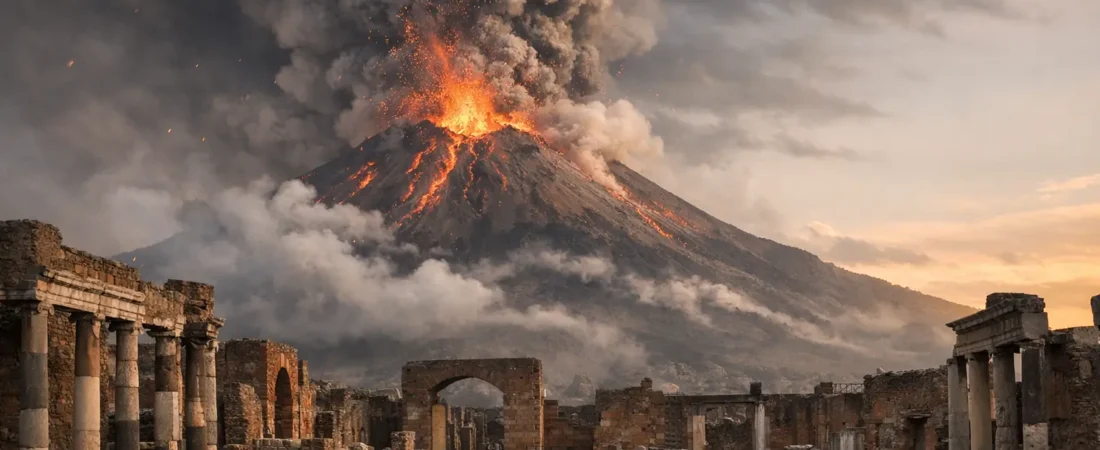
The first sign was not fire. It was a trembling beneath the feet, a nervous shiver in the ground that the people of Pompeii had felt before and learned, perhaps fatally, to live with. When readers ask what caused Pompeii destruction, the answer begins long before ash buried streets and rooftops. It begins with a volcano that stood so quietly over the Bay of Naples that many Romans did not fully understand it as a volcano at all.
Pompeii was not destroyed by a single dramatic blast in the way modern movies often imagine. It died in stages. Earthquakes weakened buildings, an eruption column darkened the sky, pumice rained down for hours, and then superheated surges of gas and ash swept across the city. The destruction was geological, sudden, and terrifying, but it was also a chain of events with its own grim timing.
What Caused Pompeii Destruction in AD 79?
Mount Vesuvius caused the destruction of Pompeii when it erupted in AD 79. Yet that simple statement leaves out the mechanism, and the mechanism matters. Vesuvius is part of a volcanic region shaped by the collision of tectonic plates beneath southern Italy. Deep underground, pressure built as molten rock and gas rose toward the surface. Once that pressure could no longer be contained, the mountain ruptured.
The eruption is usually described as Plinian, named after Pliny the Younger, whose eyewitness letters preserve one of the clearest ancient accounts of the disaster. He watched the eruption from across the Bay of Naples and described a vast cloud rising like a pine tree, towering upward before spreading out. That image still helps volcanologists picture the opening phase of the catastrophe.
For Pompeii, the first deadly phase was not lava. This surprises many people. Lava was not the main killer there. Instead, the city was pummeled by falling pumice and ash. Roofs began to sag and collapse under the growing weight. Streets filled. Breathing became difficult. Escape routes narrowed by the hour.
Then came the most lethal phase: pyroclastic surges and flows. These were fast-moving currents of scorching gas, ash, and volcanic fragments. They could race across the landscape at devastating speed and with temperatures high enough to kill within moments. Archaeology and volcanology together now show that these surges were central to Pompeii’s destruction.
The Disaster Before the Disaster
Seventeen years before the eruption, in AD 62, a major earthquake struck the region. Pompeii was still repairing damage when Vesuvius erupted. Temples, houses, and public buildings had been under renovation for years. This earlier quake matters because it reveals a city already living with geological unrest.
To Roman residents, earthquakes were alarming but not unheard of. They did not read them as modern volcanologists would. There was no scientific warning system, no hazard map, no evacuation protocol. A rumbling earth might feel like a hardship to endure rather than a signal to flee forever.
That is one of the tragic trade-offs in Pompeii’s story. Fertile volcanic soil made the region prosperous. Vineyards and farms thrived. The bay supported trade and travel. People built lives in the shadow of danger because the land was generous, and because the danger was poorly understood.
How the Eruption Unfolded
On the day of the eruption, Vesuvius sent a column of ash and gas high into the atmosphere. Winds carried much of the falling material toward Pompeii. White pumice began to rain down first, then darker fragments. Over many hours, the accumulation grew deep enough to crush roofs and trap those still sheltering indoors.
Some residents likely escaped during this stage. Others stayed, perhaps to protect family, gather valuables, or wait out what they assumed would pass. Archaeologists have found evidence of both choices: abandoned homes and victims discovered in rooms, corridors, and near city gates.
As the eruption intensified, the eruption column became unstable. Parts of it collapsed, generating pyroclastic surges. These surges spread outward from the volcano like ground-hugging storms. Pompeii was struck by several of them, especially in the later stages. The final surges buried the city under layers of ash and volcanic debris, sealing buildings, streets, frescoes, tools, and the last positions of many victims.
That sequence helps answer what caused Pompeii destruction more precisely. Pompeii was not simply covered in ash. It was first battered by fallout from the eruption column and then overwhelmed by lethal surges that finished what the pumice rain had begun.
Why So Many People Could Not Escape
Distance offered only partial protection. Pompeii lay several miles from Vesuvius, far enough that some inhabitants may have believed they still had time. In the opening hours, that may even have been true for many. But disasters like this punish hesitation.
Visibility would have deteriorated as ash thickened the air. Breathing became painful. Travel was harder under falling debris. Buildings collapsed unpredictably. Families were separated. The city’s social realities also mattered. Not everyone had equal mobility, transport, or access to information.
There is another point worth keeping in view. Ancient people were not foolish for failing to respond as modern readers think they should have. They were making decisions inside confusion, darkness, noise, and fear, without knowing the full shape of the threat. That human fact gives Pompeii much of its emotional force. This was not a doomed legend. It was an ordinary city caught in extraordinary violence.
What Archaeology Revealed About Pompeii’s End
For centuries, Pompeii’s burial preserved a snapshot of Roman life so vivid that walking its streets still feels like overhearing the ancient world. Bakers’ ovens, election graffiti, garden walls, shrines, amphorae, and workshops survived because volcanic deposits sealed them away.
Among the most haunting discoveries were the voids left by bodies decomposed within hardened ash layers. In the nineteenth century, archaeologists poured plaster into these cavities, creating casts of victims in their final positions. The technique turned absence into presence. A curled figure, a hand over the face, a child beside adults – these were not symbols but individuals.
Modern research has added nuance to older assumptions. Earlier generations sometimes overstated death by slow suffocation alone. New studies suggest that the intense heat of pyroclastic surges played a major role for many victims, especially in the final phases. As with many ancient disasters, the answer is not one cause in isolation but a deadly combination of collapse, ash inhalation, thermal shock, and burial.
This is where Pompeii differs from popular myth. The city’s preservation can create the illusion of stillness, as if time stopped gently. In reality, its end was violent, chaotic, and physically destructive.
The Science Behind Vesuvius
Vesuvius sits in a volcanically active zone shaped by the subduction of the African tectonic plate beneath the Eurasian plate. That movement helps generate magma. Gas dissolved within rising magma expands as pressure changes, much like a shaken bottle suddenly opened but on an immense and catastrophic scale.
Whether an eruption becomes explosive depends on the chemistry of the magma, the amount of gas, and the structure of the volcanic system. Vesuvius has a history of highly explosive eruptions, which makes it especially dangerous. The AD 79 event was not unique in the volcano’s life, though it became the most famous because of Pompeii and nearby Herculaneum.
Herculaneum, in fact, suffered differently. Closer to the volcano, it was hit by even more intense pyroclastic flows. Comparing the two cities reminds us that volcanic destruction is not uniform. Wind direction, distance, topography, and eruption phases all shape who suffers first and how.
A City Frozen, Not Forgotten
Pompeii’s destruction also became its preservation. Because the city was entombed so quickly, delicate traces of daily life survived that are rarely visible elsewhere in the Roman world. Wall paintings retained color. Carbonized food remained in place. Inscriptions captured jokes, debts, ambitions, and affection.
That is why the question of what caused Pompeii destruction continues to matter. It is not only about a volcano. It is about how landscapes sustain civilizations and threaten them at the same time. It is about what archaeology can rescue from catastrophe. And it is about the thin margin between an ordinary afternoon and a historical turning point.
If you stand in Pompeii today, the silence can be misleading. The stones look settled. The streets seem patient. But beneath every doorway and courtyard is the memory of a city that did not vanish in mythic fire. It was overwhelmed by geology, preserved by ash, and returned to us as one of history’s most intimate warnings: the earth does not always announce its full power in time for us to understand it.