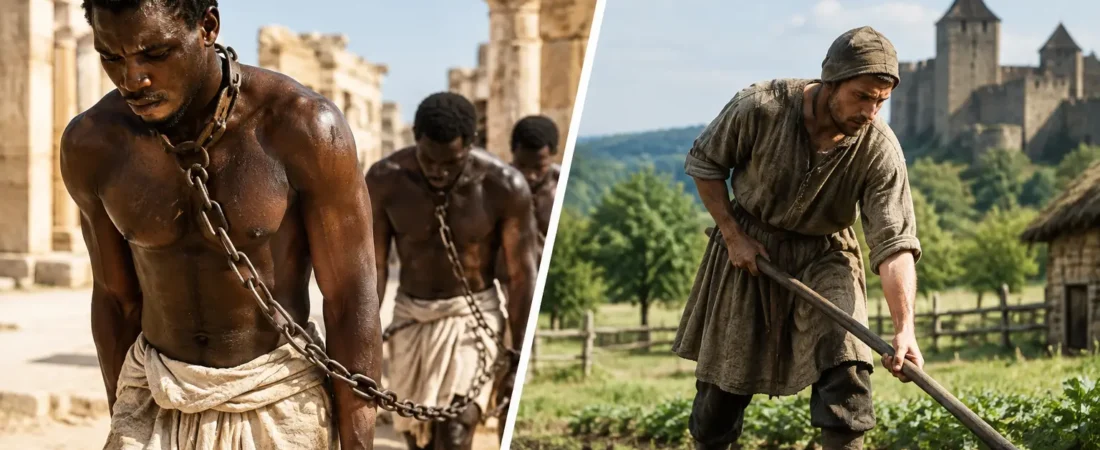
At first glance, the fields look similar. A laborer bends over grain beneath a hot sky, watched by someone who owns the land and claims a share of the harvest. Yet the legal world around that worker could be profoundly different. In the debate over ancient slavery versus serfdom, the decisive question is not whether people labored under harsh masters. It is what, under the law and in daily practice, they were allowed to be.
A Roman enslaved person could be bought, sold, punished, inherited, or freed as property. A medieval serf was not ordinarily property in the same direct sense. He or she was bound to a particular estate, owed labor and payments to a lord, and faced serious restrictions on movement, but retained recognized family ties and certain customary claims. Neither condition was freedom. Treating them as identical, however, blurs two systems that shaped human lives in distinct ways.
Two worlds of unfreedom
Slavery has existed in many forms across ancient societies, from Mesopotamia and Greece to Rome and Egypt. It was never one uniform institution. Some enslaved people worked in homes, workshops, mines, fields, ships, or government offices. Their experiences varied sharply according to place, skill, owner, gender, and luck. But the central feature remained: an enslaved person was legally subject to another person’s ownership or near-total control.
Serfdom emerged much later, especially in medieval Europe. It became most visible between roughly the ninth and fifteenth centuries, although its timing and intensity differed from region to region. Serfs were attached to land within a manor, the local economic and legal unit dominated by a lord. They might farm strips in open fields, maintain their own household, and owe the lord several days of labor each week, along with rent in grain, animals, money, or services.
This difference in setting matters. Ancient slavery often supplied labor for households, estates, construction projects, mines, and commercial enterprises. Serfdom was rooted more firmly in an agrarian village economy, where land, obligation, and local custom bound people together.
Ancient slavery versus serfdom: the legal divide
The clearest contrast lies in ownership. In Roman law, enslaved people were property. They could not generally make legally independent contracts or own property in their own right. An owner could transfer them far from spouses, children, and familiar landscapes. Roman writers discussed enslaved people as part of an estate’s assets, alongside land, livestock, and tools – language that reveals the cold legal logic behind the system.
That did not mean enslaved people lacked agency. They formed families, worshiped, resisted, saved money when permitted, developed skills, and sometimes negotiated better positions. A household slave might manage finances; a trained secretary could handle correspondence; a craft worker might earn income for an owner. Some accumulated a fund called a peculium, which could sometimes be used to purchase freedom. Yet this depended on the owner’s permission. It was not a secure right.
A serf, by contrast, was generally not bought and sold separately from the land. If an estate changed hands, the serf’s obligations went with the manor. This was still coercive: a person could be transferred in effect because the estate was transferred. But the legal idea was different. The lord possessed rights over labor, dues, and movement, not uncomplicated ownership of a human being as a movable object.
Serfs also commonly held customary rights to use land. A family might cultivate inherited strips, graze animals on common pasture, gather firewood under local rules, or pass a holding to children after paying a fee. These rights could be narrow, vulnerable, and expensive, but they gave serf households a recognized place in the village economy that many enslaved people did not possess.
What daily life could look like
Picture a large Roman agricultural estate. Enslaved laborers might live in cramped barracks, work under overseers, and face corporal punishment or confinement. The worst conditions were often found in mines and brutal agricultural settings, where ancient authors themselves acknowledged extraordinary suffering. Enslaved people could also be hired out, sent to cities, or separated from kin at an owner’s decision.
Now enter a medieval manor at harvest. A serf may work several days on the lord’s demesne, the land reserved for the lord’s own profit, then rush back to his family’s plot before rain threatens the crop. His wife may owe seasonal labor, produce payments, or fees for using the lord’s mill or oven. Their home is modest and their choices constrained, but their household is usually recognized as a continuing unit in the community.
That relative stability should not be romanticized. A serf might need permission to leave the manor, marry outside it, or pass property to an heir. Manor courts could enforce obligations, levy fines, and favor the lord’s interests. In some regions, lords demanded heavy labor services; in others, payments in cash gradually replaced labor. Serfdom was a spectrum, not a single experience.
Family, movement, and the possibility of freedom
Both slavery and serfdom placed family life under pressure, but the risks were different. Enslaved families could be broken apart through sale, gift, debt settlement, or inheritance. Roman inscriptions and literature preserve fragments of affection, grief, and reunion that make the human cost visible. A child’s status could also follow that of an enslaved mother, allowing slavery to reproduce itself across generations.
Serfs were usually tied to a village and manor rather than to an owner’s household. Their marriages and children were more likely to remain connected to the same plot of land, though lords could still interfere through marriage fees and inheritance claims. A serf’s relationship to place was restrictive, but it could also preserve access to a home, kin network, and customary livelihood.
Paths out of bondage also differed. In the Roman world, manumission – formal freeing by an owner – was common enough to shape society. Freed people could become citizens under certain conditions, though they often retained duties to former owners and faced social stigma. Manumission was an act within a slaveholding system, not proof that the system was humane.
A medieval serf might gain freedom by purchasing release, receiving a charter, moving to a town, or benefiting from political and economic change. In parts of England, a later tradition held that a fugitive who lived openly in a chartered town for a year and a day could claim freedom, though real outcomes depended on local law and enforcement. After the Black Death in the fourteenth century, labor shortages strengthened many workers’ bargaining power in Western Europe, accelerating the decline of some labor services. Elsewhere, particularly in parts of Eastern Europe, serfdom hardened for centuries.
Why the distinction matters
Calling all premodern forced labor “slavery” can make history feel simpler, but it erases the mechanisms that held societies together. Slavery centered on ownership of people. Serfdom centered on binding cultivators to land and extracting labor through lordship, custom, and local courts. Both created steep hierarchies. Both relied on violence or the threat of it. Both narrowed lives that should have been free.
The distinction also explains why change took different forms. Roman slavery could be reshaped by warfare, trade, manumission, and imperial law. Serfdom shifted with population, land values, urban growth, plague, peasant resistance, and the changing balance between kings, nobles, towns, and villages. No single event simply replaced slavery with serfdom across Europe. The transformation was uneven, with older forms of dependency surviving beside newer ones.
Archaeology helps restore the human scale often lost in legal definitions. Rural villas, slave quarters, manorial settlements, grinding stones, animal bones, and storage pits reveal systems built from ordinary routines: baking bread, repairing tools, tending livestock, counting harvests, and enduring another season of demands. The surviving record is often written by elites, but the landscape itself preserves traces of the people whose labor sustained them.
When you encounter an ancient estate or a medieval manor in a museum, look beyond the owner’s villa or the lord’s hall. Ask who planted the grain, who repaired the walls, who could leave, who could keep a child close, and who had a recognized claim to tomorrow’s work. Those questions turn ancient slavery versus serfdom from a vocabulary exercise into a more honest encounter with the lives beneath history’s grand monuments.