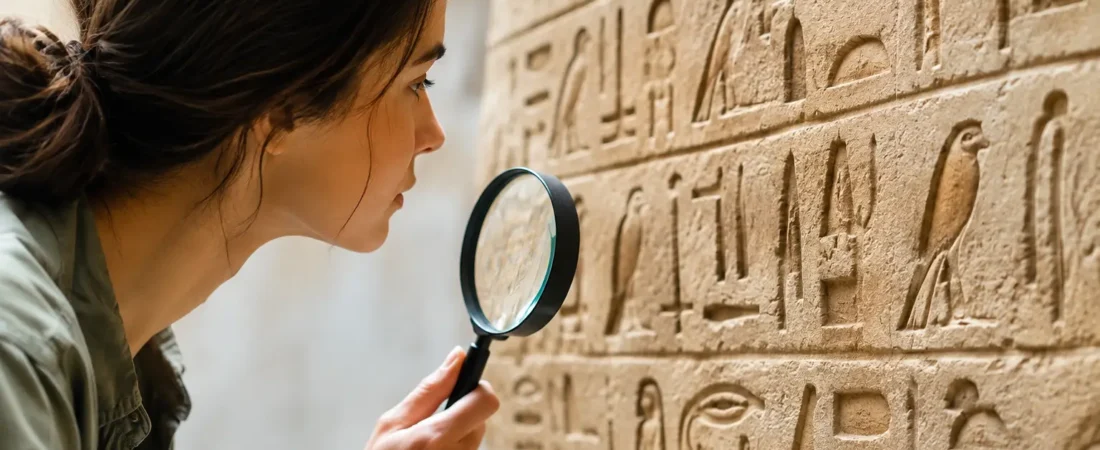
A temple wall can appear silent at first: a falcon faces a reed, a seated figure holds a staff, and tiny water ripples run beneath a sun disk. Yet these are not decorative fragments scattered at random. They are a carefully ordered written language. This guide to deciphering hieroglyphs offers a way to approach those signs as an ancient Egyptian reader might have done – patiently, visually, and with attention to context.
Hieroglyphs are often treated as a code waiting for a one-to-one English translation. The truth is more interesting. A single sign could represent a sound, an entire word, or an idea that clarified the category of a word. Reading them means learning to recognize how those roles work together. It also means accepting a useful limitation: Egyptian writing usually omitted vowels, so a modern reader cannot recover every ancient pronunciation with certainty.
A Script Made for Monument and Memory
Ancient Egyptian hieroglyphs emerged around 3200 BC and remained in use for more than three thousand years. They appeared on tomb walls, temple gateways, royal statues, coffins, jewelry, and everyday objects. Their pictorial beauty was not separate from their function. A carved owl was both a recognizable creature and, in many contexts, a sign for the consonant sound m.
The word “hieroglyph” comes from Greek and means “sacred carving.” Egyptians called their monumental script medu netjer, often translated as “god’s words.” That name reflects the script’s authority, especially in religious and royal settings. But hieroglyphs were not restricted to solemn declarations. They could record titles, prayers, offerings, names, administrative statements, and personal hopes for life after death.
A monumental inscription was often designed to be seen as well as read. Signs could be compressed into balanced squares or arranged around an image. A scribe might shift a sign’s position to make a column look harmonious without changing the intended reading. This is why hieroglyphic texts reward slow observation. Their visual order is part of their historical presence, but not always their grammatical order.
The Breakthrough at Rosetta
For centuries, the ability to read hieroglyphs had been lost. The final known dated hieroglyphic inscription was carved at the temple of Philae in AD 394. By the time European travelers began recording Egyptian monuments in detail, the signs were widely misunderstood as pure symbols of hidden wisdom rather than a language with grammar and sound.
The decisive clue came from a broken slab of granodiorite found by French soldiers near Rashid, or Rosetta, in 1799. Its decree was written in three scripts: Greek, Demotic, and hieroglyphs. Because scholars could read the Greek text, they knew all three versions expressed broadly the same decree, issued in 196 BC for King Ptolemy V.
The Rosetta Stone did not instantly solve the script. It supplied a comparison, not a ready-made alphabet. Thomas Young made important early advances, especially with royal names enclosed in oval frames called cartouches. Jean-François Champollion carried the work further. In 1822, he showed that hieroglyphs could represent sounds as well as ideas, using evidence from Greek-derived royal names such as Ptolemy and Cleopatra. His insight opened the door to the language behind the images.
How to Begin Deciphering Hieroglyphs
The most practical way to start is not with a long temple inscription. Begin with a short, well-photographed text whose translation is known, ideally a royal cartouche or offering formula. You are not trying to become a professional Egyptologist in an afternoon. You are training your eye to distinguish the jobs signs perform.
First, find the direction of reading
Hieroglyphs can run from right to left, left to right, or from top to bottom. The figures provide the clue. Human and animal signs usually face the beginning of the line. If a bird faces right, begin reading from the right and move left, toward its face. In vertical columns, read from the top down.
This rule is simple but powerful. It turns a carved wall from an apparent jumble into a directional text. Still, damaged inscriptions and stylized layouts can make the orientation difficult to judge. When in doubt, look for several figures rather than relying on one sign.
Then, identify the three main kinds of signs
Hieroglyphic writing combines phonograms, logograms, and determinatives. A phonogram represents one or more consonant sounds. Some are single-consonant signs, often introduced in beginner charts as an “alphabet,” though that label can mislead. Others represent two or three consonants.
A logogram represents a complete word. It may be followed by a small vertical stroke, signaling that the pictured object is being read as the word it depicts. The sun disk, for example, can stand for the word ra, “sun,” and also appears in the name of the sun god Ra.
Determinatives are perhaps the most revealing signs for a beginner. They are generally not pronounced. Instead, they appear near the end of a word to indicate its meaning: a walking pair of legs may point to movement, a scroll may suggest an abstract concept, and a seated man may identify words connected to people or occupations. Think of a determinative as a quiet guide placed beside a word, helping the reader choose the right sense.
Read sound groups, not pictures alone
The trap of beginning hieroglyph reading is assuming every picture names what it shows. A mouth sign may represent the sound r, not necessarily the word “mouth.” A basket may contribute the sound k. The pictured form matters, but its reading depends on context.
Egyptian scribes also used phonetic complements. These are extra sound signs that confirm part of the reading of a larger sign. They may seem repetitive at first, but they gave readers valuable guidance. In a language that usually wrote consonants and could use the same sign in more than one way, such reinforcement reduced ambiguity.
For this reason, translate only after you have attempted a transliteration – a scholarly rendering of the Egyptian consonants in Roman letters. A word written as nfr, often translated “beautiful,” “good,” or “perfect,” cannot tell us its exact ancient vowel pattern. Egyptologists conventionally pronounce it nefer for convenience. That familiar spoken form is helpful, but it should not be mistaken for a recording from ancient Thebes.
A Small Reading Exercise: The Cartouche
A cartouche is an oval rope shape tied at one end, enclosing a royal name. Its purpose was protective as well as practical: the ring suggested an encircling boundary, safeguarding the king’s name. On monuments from the Ptolemaic period, cartouches became a crucial foothold for modern decipherment because scholars already knew the Greek versions of royal names.
Suppose you encounter a cartouche containing a sun disk followed by other phonetic signs. Do not announce the name from the sun disk alone. First ask whether the surrounding signs support a known royal name, whether the inscription’s date makes that ruler plausible, and whether titles nearby identify a king, queen, or deity. Context is not an optional extra. It is the evidence that turns a possible reading into a credible one.
This is also why a museum label, site plan, or reliable inscription catalog can be more useful than a decorative “hieroglyph translator.” Many online converters simply substitute English letters with Egyptian-looking symbols. Ancient Egyptian did not work that way.
What Hieroglyphs Can and Cannot Tell You
A successful reading is rarely just a translation. It can reveal who commissioned an object, which god received an offering, how a deceased person wished to be remembered, or how a ruler presented power. Yet inscriptions also have limits. A king’s temple text is often political and religious messaging, not a neutral report. Repeated claims of victory or divine favor need to be weighed against archaeological evidence and texts from other places.
Damage creates another challenge. Missing signs may be reconstructed from standard formulas, but a reconstruction should remain clearly different from what survives. Names were sometimes deliberately erased in antiquity, while reused blocks could carry inscriptions from earlier monuments. The gaps and alterations are part of the object’s biography.
There is a preservation lesson here, too. Hieroglyphs are not just puzzles. They are cultural records, carved by people whose language, beliefs, labor, and identities deserve more than a quick decoding game. Photograph an inscription when permitted, avoid touching painted or carved surfaces, and treat uncertain readings as invitations to learn rather than license to invent.
A Guide to Deciphering Hieroglyphs With Patience
Start small: establish direction, separate phonetic signs from determinatives, write a cautious transliteration, and only then consult a translation. As your eye improves, repeated formulas begin to emerge from the stone – names, titles, offerings, and invocations that once carried real weight in an Egyptian temple or tomb.
The reward is not merely the ability to recognize a few signs. It is the moment an ancient wall stops feeling mute. A falcon, a reed, a basket, and a ripple of water become the trace of a human voice, still arranged on the surface of history, waiting to be heard carefully.