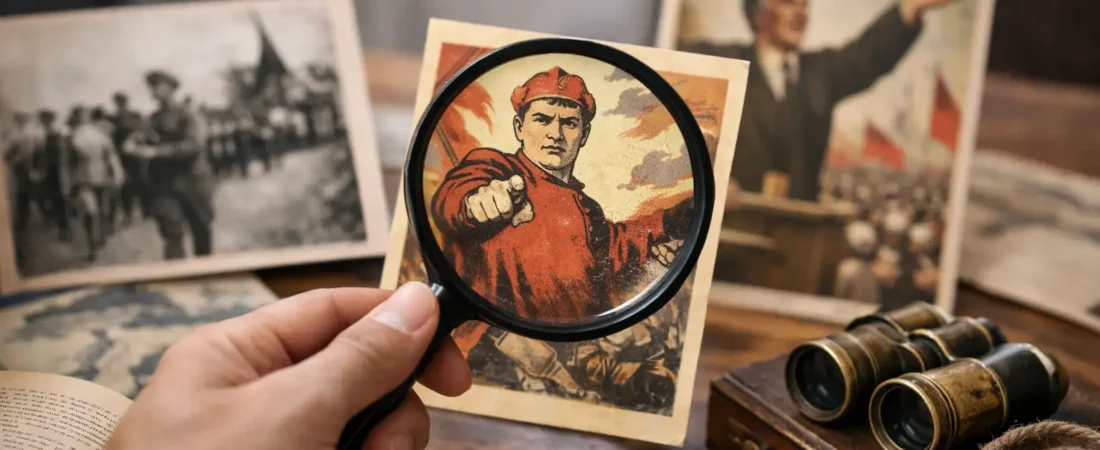
A wartime poster can feel like a direct voice from the past: a stern soldier points outward, a smiling family buys bonds, an enemy is drawn as a monster at the gate. But these artifacts were rarely neutral windows into their age. They were designed to move people – to enlist, obey, sacrifice, fear, blame, or believe. Learning how to identify historical propaganda lets you look beyond the commanding image and hear the machinery behind it.
Propaganda is not always a crude lie. Some of the most effective examples use real events, recognizable symbols, and selective facts. Their power lies in what they emphasize, what they simplify, and what they leave outside the frame. Read carefully, and an old poster, newspaper, film reel, or schoolbook becomes a record not only of what a society said, but of what it wanted its people to feel.
Start with the moment the source was made
Before judging a source by modern standards, place it back in its original room: the crowded city street, village schoolhouse, cinema, factory break room, or military barracks where people first encountered it. Propaganda is shaped by immediate pressures. A British recruitment poster from 1914, a Soviet factory newspaper from the 1930s, and an American civil-defense film from the Cold War each spoke to different fears and expectations.
Ask when it appeared and what had just happened. Was a nation entering a war, coping with economic collapse, occupying another territory, facing labor unrest, or preparing for an election? The timing often explains the message better than the image alone.
Consider the famous U.S. “Uncle Sam” recruitment poster, widely associated with World War I. Its direct command, “I Want You,” did not attempt a balanced discussion of military service. It transformed a government request into a personal challenge. The pointing finger closes the distance between state and viewer. That does not make the poster historically useless. It makes its purpose unusually visible.
Identify the creator, sponsor, and intended audience
Every historical source has an author, even when that author is hidden. A government ministry, political party, newspaper editor, military office, corporation, religious organization, or activist group may have funded and distributed the material. Knowing who paid for the printing press or controlled the film studio is often the first clue to its purpose.
Then ask who was meant to see it. A polished newsreel shown in urban movie theaters may target middle-class civilians. A leaflet dropped over enemy lines has a different audience: soldiers whose morale the sender hopes to weaken. A textbook can carry messages over generations, presenting one version of a nation’s past as natural and inevitable.
Audience changes tone. Propaganda aimed at children often uses simple heroes, bright colors, and moral certainty. Material aimed at workers may promise dignity, prosperity, or national renewal. Material aimed at soldiers may appeal to comradeship, duty, revenge, or fear of humiliation.
Read the language for pressure, not just information
Propaganda often announces itself through urgency. Watch for commands such as “Join,” “Remember,” “Defend,” “Destroy,” and “Never forget.” Also notice broad labels: “the people,” “traitors,” “patriots,” “invaders,” “parasites,” or “enemies within.” Such words can compress millions of individuals into a single obedient group or a single threatening caricature.
Emotional language is not proof that a source is propaganda. A survivor’s letter after a disaster may be emotional because disaster is emotional. The more revealing question is whether the emotion is being directed toward a political or social action. Does the source invite the viewer to donate, report a neighbor, accept a hardship, support a policy, or despise a group?
Look for false choices as well. A message may imply that only two paths exist: loyalty or treason, courage or cowardice, order or chaos. History is usually more crowded than that. When a source erases alternatives, it may be trying to narrow the viewer’s imagination.
Examine the visual world inside the frame
Historical propaganda is frequently visual because pictures make an argument before the reader has time to question it. Study posture, scale, color, clothing, and placement. Who stands tall? Who is reduced to a shadow, an animal, a skull, or a swarm? Who is clean, youthful, and bathed in light? Who is dirty, distorted, or pushed to the margins?
During the Second World War, propaganda in several countries portrayed opponents with exaggerated racial features and animal-like forms. These images did not merely express wartime hostility. They helped normalize dehumanization, making violence and exclusion seem easier to justify. Such material must be approached with care, especially when teaching or sharing it, because its original harm was part of its design.
Symbols do similar work. Flags, religious imagery, maps, uniforms, mothers, children, and idealized landscapes can make a political message feel timeless or sacred. A map with arrows sweeping across a continent can suggest inevitability, even when military events were uncertain. A photograph of a happy factory worker may be genuine, staged, or selected from hundreds of less useful images. Either way, the choice of image is part of the argument.
Notice what is missing
The silence around a source can be as revealing as its loudest slogan. A poster praising industrial achievement may omit dangerous working conditions. A colonial exhibition may celebrate exploration while ignoring dispossession and forced labor. A newspaper may report battlefield victories without naming civilian casualties or military setbacks.
This does not mean every omission is deliberate deceit. No source can contain all of history. Space, audience, censorship, and the creator’s own limited knowledge all matter. The key is to ask whether the missing material would complicate the message. If it would, the absence deserves attention.
A useful museum habit is to turn the object over, literally or mentally. Read the small print. Check publication dates. Look for official seals, printer marks, captions, and evidence of alteration. Then place the object beside sources that had different interests: private diaries, foreign newspapers, government records, oral histories, photographs, or later scholarship. One artifact can be vivid. Several perspectives can reveal its boundaries.
Distinguish propaganda from persuasion, patriotism, and reporting
Not all persuasive communication is propaganda, and not all propaganda is false. A public health campaign can use persuasive imagery while offering sound guidance. A newspaper editorial argues for a position but may still acknowledge evidence and disagreement. Patriotic art can express sincere attachment to a country without demanding conformity.
The distinction depends on method and context. Propaganda tends to pursue a coordinated objective through repetition, emotional leverage, simplified narratives, selective evidence, and strong in-group versus out-group divisions. It often works alongside institutions with power to censor, punish, reward, or control information.
There are gray areas. A wartime government may suppress operational details for legitimate security reasons while also promoting an exaggerated story of national unity. A resistance movement may produce posters that rally hope against an occupying power. Their cause and circumstances matter, but they do not remove the need for source criticism. Identifying propaganda is not the same as declaring every creator morally equivalent. It is a way of seeing clearly.
A practical method for analyzing historical propaganda
When you encounter a compelling historical image or text, pause before accepting its version of events. Work through four questions in sequence:
- What does it want me to think, feel, or do? Name the desired response as specifically as possible.
- Who created it, and who had the power to circulate it? Funding and distribution can expose the larger campaign.
- Which techniques create its force? Look for repetition, fear, pride, scapegoating, idealized imagery, testimonials, or claims of inevitability.
- What evidence or human experiences are absent? Compare the source with accounts that complicate its story.
This method works beyond posters. Apply it to speeches, monuments, radio broadcasts, school maps, postage stamps, cartoons, and even architecture. Monumental buildings and parades can be propaganda in physical form, designed to make authority appear permanent, unified, and overwhelming.
Preserve the evidence, resist the message
Propaganda deserves preservation because it shows how power tried to shape public memory. Destroying or dismissing it can make the past feel simpler than it was. Yet preserving a source does not require repeating its claims uncritically. A museum label, classroom discussion, or careful article can provide the context that the original creators wanted to deny.
The next time an old image seems to speak with absolute certainty, linger at its edges. Ask who selected the scene, who was meant to be persuaded, and whose face never entered the frame. That small act of historical curiosity turns a commanding message into evidence – and lets the past reveal more than it intended.