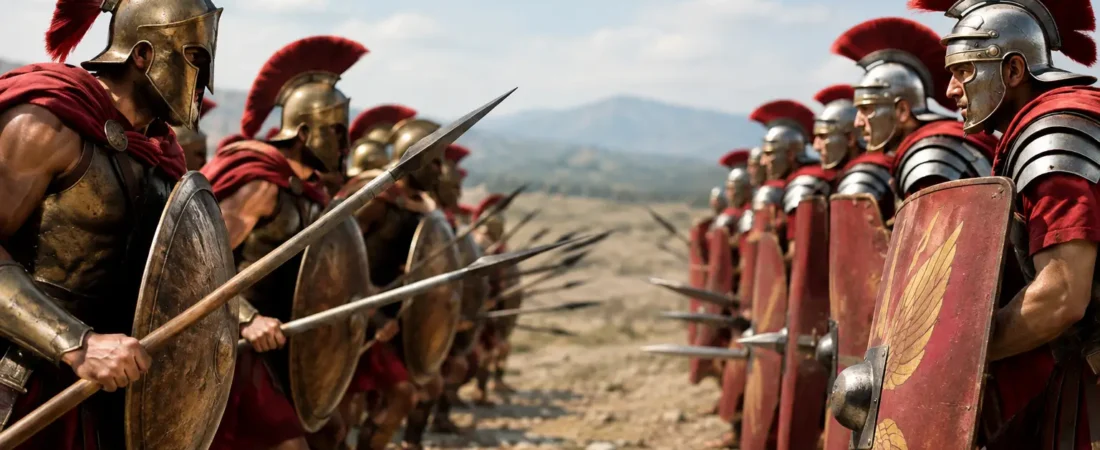
At dawn, a Greek hoplite tightened the grip on his round shield, knowing the man beside him depended on it. Centuries later, a Roman legionary drove wooden stakes into the earth to raise a fortified camp before nightfall. Ancient Greek versus Roman warfare was not simply a contest between spear and sword, phalanx and legion. It was a story of two military cultures shaped by their landscapes, political systems, fears, and ambitions.
The contrast matters because Rome did not replace a single, static Greek way of war. Greek warfare changed dramatically from the citizen armies of the classical city-states to the professional forces of Macedon and the Hellenistic kingdoms. Rome learned from each phase, then built a military machine suited to ruling a vast and increasingly connected Mediterranean world.
Ancient Greek Versus Roman Warfare: The Central Difference
Greek warfare, particularly in the classical period of the fifth and fourth centuries BCE, was often rooted in the independent polis, or city-state. Athens, Sparta, Corinth, Thebes, and dozens of smaller communities fielded armies made largely of citizens with a direct stake in their homeland. Their battles could be brief, brutal decisions over farmland, borders, honor, or political survival.
Rome began with a similar citizen-soldier tradition. Yet as the republic expanded across Italy and then overseas, Roman warfare became more systematic, durable, and adaptable. A Roman army was not merely a force sent to win one battle. It was an institution designed to march far, build roads, maintain supply lines, absorb setbacks, recruit allies, and return year after year.
That distinction should not be pushed too far. Greek states could conduct long campaigns and create sophisticated navies. Roman soldiers still carried civic obligations and political identities. But the broad pattern is clear: Greek armies often reflected the scale and priorities of individual city-states, while Roman armies increasingly served an expansionist republic and, later, an empire.
The Greek Way of War: Shields Locked in the Dust
Imagine a line of bronze helmets moving across a dry plain. In its classical form, the Greek phalanx was a dense formation of hoplites, heavily armed infantrymen carrying a large circular shield called an aspis, a thrusting spear, and a short sword for desperate close fighting. Each man’s shield protected part of the soldier to his left. Holding formation was therefore a practical necessity and a moral obligation.
A hoplite battle was terrifyingly intimate. Two lines advanced, clashed, shoved, stabbed, and struggled to break the enemy’s cohesion. Ancient sources sometimes present these encounters as orderly tests of courage, but the experience was likely confused, noisy, and physically exhausting. Armor varied by wealth and period, and not every Greek army looked alike, yet the image of the citizen hoplite remained powerful.
Sparta became the most famous practitioner of disciplined infantry warfare, but it was not automatically unbeatable. At Leuctra in 371 BCE, the Theban general Epaminondas concentrated his troops in an unusually deep left wing and shattered Spartan expectations. The battle exposed a weakness in rigid assumptions: a phalanx was formidable, but formation, terrain, leadership, and numbers could change everything.
Athens and the sea
Greek warfare was never only a matter of infantry. Athens built its power on the trireme, a lean warship driven by crews of rowers. At Salamis in 480 BCE, Greek naval forces used the constricted waters near the island to help defeat a much larger Persian fleet. The victory preserved the possibility of Greek independence and demonstrated that trained crews, local knowledge, and tactical positioning could be as decisive as armored soldiers on land.
A trireme was also a social machine. Its oars were commonly pulled by free citizens, including poorer Athenians who could not afford hoplite equipment. Naval power therefore gave them an enlarged role in the democracy and in the city’s empire. In Greece, military service could reshape politics as surely as politics shaped military service.
Macedon changes the phalanx
By the fourth century BCE, Philip II of Macedon had transformed Greek military practice. His infantry carried the sarissa, a pike far longer than the traditional hoplite spear. Several ranks of spear points projected beyond the front of the formation, creating a bristling barrier that was difficult to approach head-on.
Philip’s son, Alexander the Great, used this Macedonian phalanx as one part of a combined-arms army. Infantry fixed an enemy in place; cavalry, especially the Companion cavalry, struck at openings; light troops screened advances and harassed opponents. Alexander’s victories against the Persian Empire were not achieved by the phalanx alone. They depended on coordination, speed, command, and a willingness to campaign across astonishing distances.
Roman Warfare: Discipline, Adaptation, and Endurance
Roman armies are often remembered for the legion, but the legion’s strength lay less in a single weapon than in its flexibility. During the middle republic, Roman heavy infantry was arranged in maniples, smaller tactical units able to move through uneven terrain more readily than a massive phalanx. This was useful in the hills and broken ground of Italy, where a perfectly level battlefield could not be assumed.
Roman soldiers carried the scutum, a large curved shield, and usually fought with a short sword, the gladius. Before closing, they could throw heavy javelins known as pila. A pilum might wound an enemy or bend after impact, making a struck shield awkward to use. The familiar sequence of javelin volley followed by sword combat was effective, although real battles never unfolded as neatly as a training demonstration.
Romans also made warfare an exercise in organization. A marching army could lay out a camp with streets, gates, ditches, and earthworks. The remains of Roman camps are often hard to identify because many were temporary, but the pattern appears repeatedly in ancient accounts and archaeology. A camp reduced surprise attacks and imposed order on the vulnerable hours between marches and battles.
Roman commanders understood that victory could arrive through engineering as well as courage. They built bridges, siege ramps, towers, roads, and fortified lines around enemy cities. At Alesia in 52 BCE, Julius Caesar’s army enclosed the Gallic stronghold with fortifications facing inward, then constructed another defensive line facing outward to resist a relief army. It was an extraordinary feat of labor under pressure, and a reminder that Roman military power relied on pickaxes and shovels as much as blades.
Rome learns from defeat
The Roman Republic suffered disasters that would have destroyed many states. In 216 BCE, Hannibal’s Carthaginian army surrounded and annihilated a vast Roman force at Cannae. Rome did not surrender. It raised new armies, drew on its network of Italian allies, avoided another battle on Hannibal’s preferred terms, and carried the war into other theaters.
That resilience was one of Rome’s most consequential advantages. Rome could lose commanders, legions, and battles while retaining the political capacity to continue the war. Its allied manpower was immense, though the burden placed on Italian communities was real and sometimes deeply resented. Roman endurance was a strength, not evidence that every Roman ally shared equal power or enthusiasm.
Phalanx Versus Legion: A Useful Comparison With Limits
The phalanx-versus-legion comparison has become a historical shorthand, but it can mislead. A Macedonian phalanx was devastating on suitable ground, particularly when protected by cavalry and lighter troops. Its long pikes created a frontal danger that Roman soldiers could not casually rush.
Yet the formation had vulnerabilities. It required cohesion, room to maneuver, and relatively even terrain. If its line fractured, if an enemy reached its flanks, or if combat became disordered at close range, the long sarissa could become difficult to manage. Roman maniples, and later cohorts, offered commanders more tactical subdivisions and a greater ability to exploit gaps.
Roman victories over Hellenistic kingdoms, including Cynoscephalae in 197 BCE and Pydna in 168 BCE, revealed these weaknesses. They did not prove that Romans possessed a magical formation that defeated every phalanx. Terrain, timing, morale, leadership, and the wider campaign all mattered. At Pydna, uneven ground reportedly disrupted the Macedonian line, creating the openings Roman infantry needed.
Four Turning Points in Greek and Roman Military History
- 480 BCE – Salamis: Greek triremes help defeat the Persian fleet in confined waters, showing the strategic importance of naval skill and geography.
- 371 BCE – Leuctra: Thebes defeats Sparta, proving that tactical innovation can overturn a feared military reputation.
- 334-323 BCE – Alexander’s campaigns: Macedonian combined-arms warfare carries Greek-speaking power from the Aegean to Egypt and India.
- 197-168 BCE – Cynoscephalae and Pydna: Roman victories over Macedon accelerate Rome’s rise as the dominant power in the eastern Mediterranean.
What the Armies Reveal About Their Worlds
Greek and Roman warfare was never separate from civilian life. A Greek citizen’s armor could signal status and obligation. An Athenian rower could connect naval service to democratic power. A Roman soldier’s oath, pay, retirement prospects, and loyalty to commanders became increasingly important as the republic’s wars stretched farther from Italy.
By the late republic and imperial era, the Roman army had become more professional, stationed on distant frontiers from Britain to Syria. This made conquest and border defense possible on an enormous scale, but it also gave armies immense political weight. Generals with devoted troops could threaten the state they claimed to serve.
The archaeological record brings these systems close: corroded helmet fragments, piles of sling stones, weapon fittings, camp ditches, ship sheds, and the quiet graves of men who did not return. Such evidence corrects the clean diagrams of modern textbooks. Ancient warfare was organized, strategic, and often technologically inventive. It was also exhausting human labor, terror in close quarters, and irreversible loss.
To stand between the Greek phalanx and the Roman legion is to see more than two battlefield formations. One reveals the intense rivalries of city-states and the astonishing experiments of Macedonian conquest; the other reveals a republic that turned military persistence into Mediterranean power. Their legacy invites a harder, more human question: not which army was simply better, but what kind of society could keep sending its people into the dust, the surf, and the long road to war.