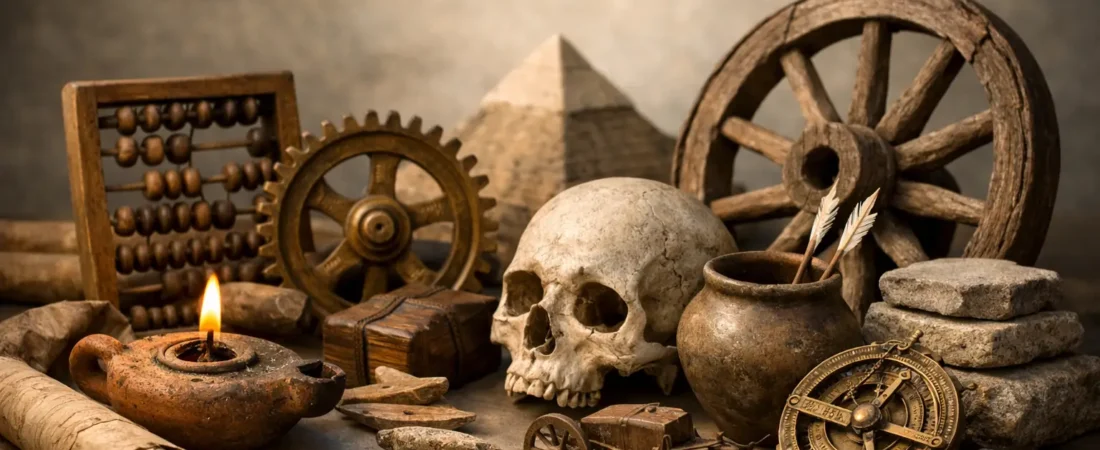
A clay tablet is pressed with the marks of a reed stylus. A ship’s crew watches a magnetized needle settle toward north. Somewhere beneath a Roman street, clean water runs through a lead pipe. These moments feel distant, yet they belong to the same story: ancient inventions that changed history were rarely grand displays of genius. More often, they were practical answers to stubborn human problems – how to move goods, record debts, build higher, heal wounds, or find the way home.
No single civilization invented progress. Ideas traveled with merchants, soldiers, captives, migrants, and pilgrims. They were copied, adapted, sometimes forgotten, and invented again under new conditions. To enter the ancient world through its tools is to see history not as a parade of rulers, but as a workshop filled with clay, wood, metal, fiber, water, and patient experiment.
A brief timeline of ancient innovation
- Around 3400 BCE, writing appears in Mesopotamia for accounting and administration.
- By the fourth millennium BCE, wheeled vehicles emerge in parts of Eurasia.
- Around 3000 BCE, Egyptian and Mesopotamian healers record medical treatments.
- By the third millennium BCE, the Indus Valley is building sophisticated urban drainage systems.
- By the second century BCE, Chinese experiments with lodestone point toward the compass.
- In 105 CE, the Chinese court official Cai Lun is traditionally credited with improving papermaking.
- From the first century BCE onward, Romans refine durable hydraulic concrete.
- By the 11th century CE, Bi Sheng develops movable type printing in China.
Dates in ancient history are often approximate. Archaeology can show when an object was used, but it does not always reveal the first person to imagine it.
Writing gave memory a durable body
The first known writing systems did not begin as poetry or royal propaganda. In southern Mesopotamia, scribes used pictographs and then cuneiform marks on clay tablets to track grain, livestock, labor, and trade. A temple or palace could now manage obligations beyond the limits of a single person’s memory.
That administrative purpose may sound ordinary, but its consequences were enormous. Written records helped states collect taxes, enforce contracts, preserve laws, and coordinate large projects. Later, writing carried epics, prayers, letters, scientific observations, and private grief across generations.
It also created a new kind of power. Literacy was often restricted to trained scribes and elites, meaning control of records could mean control of land, labor, and law. Yet without writing, much of what we know about ancient lives would have vanished. A receipt for beer rations or a child’s school exercise can bring an otherwise invisible person back into view.
The wheel transformed transport, but not everywhere
The wheel is often treated as the defining ancient invention, though its history is more complicated than a textbook sketch. Wheeled vehicles appeared in Eurasia around the fourth millennium BCE, while the potter’s wheel developed in several regions as a way to shape clay more quickly and evenly.
For carts and chariots, the wheel mattered most where roads, animals capable of draft work, and terrain made rolling practical. It was not universally useful. In mountains, forests, wetlands, and regions without suitable draft animals, sleds, pack animals, boats, and human carriers could be more effective. The civilizations of the Americas, for example, used wheeled toys but did not develop large wheeled transport before European colonization.
That trade-off makes the wheel more interesting, not less. An invention changes history when a society has the surrounding conditions to use it. In Bronze Age Eurasia, carts moved harvests and supplies; later chariots reshaped warfare, ceremony, and royal display.
Cities learned to manage water
Walk through the ruins of Mohenjo-daro in present-day Pakistan, and one of the most striking features is not a palace but the city beneath your feet. Houses connected to drains. Brick-lined channels carried wastewater away. Many homes had bathing areas and wells. The Indus Valley Civilization did not invent sanitation alone, but its urban planning remains among the ancient world’s most impressive achievements.
Water systems were equally central in Egypt, Mesopotamia, Persia, Rome, and Mesoamerica. Canals turned seasonal rivers into agricultural landscapes. Aqueducts brought water to Roman cities. Underground qanats carried groundwater across dry Iranian plateaus with remarkably little evaporation.
These systems allowed dense populations to survive, but they demanded constant maintenance and social organization. A blocked drain, silted canal, or neglected aqueduct could become a public crisis. Ancient water engineering reminds us that cities are living systems, dependent on shared infrastructure that is easiest to notice only after it fails.
Paper made knowledge lighter and more mobile
Before paper, writing could be carved into stone, impressed into clay, brushed onto silk, or written on papyrus and parchment. Each material had strengths. Clay could last for millennia; parchment was durable; papyrus could be produced in quantity along the Nile. But none combined paper’s relative lightness, flexibility, and economy.
Paper developed in China from plant fibers, rags, bark, and other pulped materials. Cai Lun, an official at the Han court, is traditionally associated with presenting an improved process in 105 CE, though archaeological finds show paper existed earlier. His importance lies in helping standardize and promote a method that could be widely adopted.
Over centuries, papermaking traveled westward through Central Asia and the Islamic world before reaching Europe. Its effect was gradual rather than immediate. Paper did not automatically make everyone literate, and parchment remained valuable for important documents. Still, it made bureaucracies, correspondence, education, illustration, and eventually book production far more practical on a large scale.
The compass turned a natural force into a guide
Long before sailors trusted a compass at sea, Chinese observers recognized the unusual behavior of lodestone, a naturally magnetized mineral. Early south-pointing devices may have had ritual or geomantic uses. By the Song dynasty, navigational compasses helped mariners travel when skies, shorelines, and familiar landmarks disappeared.
The compass did not replace skill. A sailor still needed to read winds, currents, stars, and seasons. A compass could be affected by poor construction or local magnetic variation, and early instruments were not as precise as modern ones. Yet it offered something precious: direction when other guides failed.
As compass knowledge spread and navigation improved, sea routes became more dependable. The technology helped support trade networks that moved spices, ceramics, textiles, ideas, religions, and diseases between distant ports. A small floating needle could alter the scale of human contact.
Roman concrete outlasted the empire that made it famous
Roman builders understood that mixing lime with volcanic ash, known as pozzolana, could create a binder that hardened even in wet conditions. Combined with stone aggregate, this concrete allowed construction on a scale that would have been difficult with cut stone alone. Vaults, domes, bath complexes, harbors, and aqueducts became possible in new forms.
The Pantheon in Rome remains the most celebrated example. Its immense unreinforced concrete dome has stood for nearly two millennia, aided by careful design and increasingly light materials toward the top. Roman concrete was not identical to modern Portland cement, and its performance depended heavily on local materials and skilled construction.
Its legacy is not simply that the Romans built strong structures. They showed how a material could change the architecture of public life. Baths, markets, temples, and arenas made imperial power visible in the daily experience of cities.
Printing multiplied voices, records, and arguments
Woodblock printing appeared in China centuries before movable type. It was particularly effective for reproducing religious texts, calendars, images, and official materials. In the 11th century, the inventor Bi Sheng created movable type from fired clay, an extraordinary technical achievement described by the scholar Shen Kuo.
Movable type was not automatically the best choice for every language or printing task. For Chinese writing, with its vast number of characters, preparing and organizing individual types was demanding. Woodblocks remained useful and widely used. The significance of printing lies less in one machine than in the ability to reproduce texts more reliably and in greater numbers than hand copying allowed.
That shift strengthened education, administration, religion, and commerce. It also preserved works that might otherwise have disappeared. Every printed page carries a quiet revolution: knowledge can travel beyond the room where it was first written.
Why ancient inventions still matter
The most revealing lesson of these inventions is that history changes through systems, not isolated objects. A wheel needs roads and animals. Writing needs trained scribes and institutions. Paper needs fiber, water, craftspeople, and readers. Concrete needs quarries, kilns, engineers, and labor. An invention becomes transformative when communities build a world around it.
When you encounter an ancient artifact in a museum case, pause before seeing it as a relic of a finished past. Imagine the hand that made it, the person who relied on it, and the network of knowledge that kept it working. That is where the past becomes present again: not in the object alone, but in the human problem it helped solve.