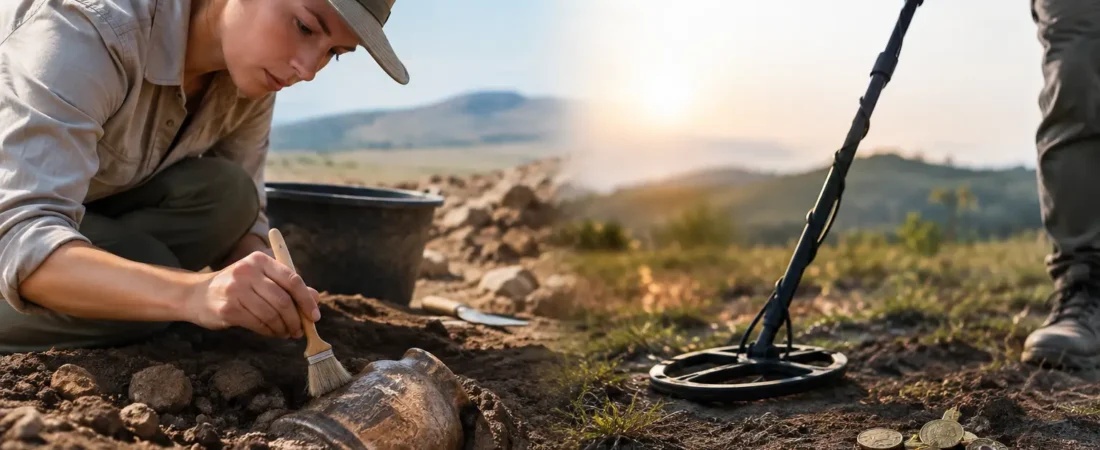
A gold coin emerges from dark soil, still bright after centuries underground. It is easy to understand the thrill. But archaeology versus treasure hunting begins at the very moment that object is lifted: is it a prize to own, or a clue to a much larger human story?
The distinction is not about whether someone loves old things, nor is it a simple contest between professionals and amateurs. It is about context, care, documentation, and what happens to the evidence after discovery. A single brooch can be beautiful in a display case. Found exactly where its owner dropped it, beside a hearth, a workshop, or a grave, it can also reveal a life.
Archaeology Versus Treasure Hunting: The Essential Difference
Archaeology is the study of people through the material traces they leave behind. Archaeologists investigate artifacts, buildings, burials, food remains, landscapes, inscriptions, and even microscopic pollen. Their purpose is not merely to recover objects. It is to ask questions: Who lived here? What did they eat? How did they trade, worship, build, mourn, and survive?
Treasure hunting, by contrast, centers on finding objects with monetary, collectible, or spectacular value. The sought-after find may be gold, silver, jewelry, coins, weapons, or shipwreck cargo. The object is usually the destination.
That difference changes every decision at a site. Archaeology treats an artifact’s location, depth, nearby materials, and relationship to soil layers as evidence. Treasure hunting can remove the same artifact from its setting before those relationships are recorded. Once that happens, much of the information cannot be recovered.
Imagine opening a sealed letter from the past. The artifact is one sentence. Its surrounding context is the rest of the page, the handwriting, the date, the envelope, and the person who received it. Taking only the most valuable sentence leaves historians with a much thinner story.
Context Is the Part You Cannot Put Back
Archaeological sites are built in layers. A Roman floor may lie beneath a medieval wall; beneath both may be traces of an earlier settlement. These layers, called stratigraphy, help establish sequence and date. Carefully excavating them allows researchers to reconstruct change over time.
An object without a recorded findspot is described as unprovenanced. It may still be genuine, rare, and visually stunning. Yet its ability to answer historical questions is sharply reduced. A coin found in a documented household deposit may help date that household’s final years. The same coin, stripped of its location and sold anonymously, becomes little more than an isolated specimen.
This is why archaeologists often seem painstakingly slow. They photograph, map, measure, label, sieve soil, collect samples, and write field notes before removing an item. Excavation is a destructive process: once a layer is dug away, it cannot be excavated again. Documentation is the only way to preserve the site after the soil has moved.
That patience has produced some of history’s most moving discoveries. At Pompeii, ordinary items such as lamps, loaves of bread, graffiti, and kitchen vessels reveal daily routines alongside catastrophe. At Sutton Hoo in England, the famous treasures of a seventh-century ship burial mattered enormously, but so did the ship’s ghostly outline in the sand, the placement of every object, and the evidence of a royal funeral. Without that setting, the helmets and gold would tell a far smaller story.
The Damage Behind the Glitter
Illegal digging and looting do more than remove artifacts. They can erase graves, tear through ancient walls, disturb human remains, and feed a market that encourages further destruction. During periods of conflict, when museums and sites are especially vulnerable, this damage can accelerate with devastating speed.
The loss is often invisible to buyers. A small ancient figurine on a shelf may have come from a looted sanctuary where its original position could have identified a forgotten deity, ritual, or local community. A group of coins may have been part of a buried savings hoard, a merchant’s purse, or a funerary offering. Once dispersed through dealers and private collections, those connections may disappear forever.
There is also an ethical question that reaches beyond scholarship. Cultural heritage belongs to more than the person who finds it or can afford to purchase it. Descendant communities, local residents, and the public have a stake in places that hold collective memory. Museums increasingly grapple with this reality when examining the histories of objects in their collections.
Not every disputed object has the same legal or moral history. Laws differ by country, time period, land ownership, and the circumstances of discovery. Some objects were acquired legally under past rules that would not be accepted now. That complexity requires careful provenance research, not easy assumptions. Still, a clear principle remains: the more thoroughly an object’s history of ownership and discovery is documented, the more securely its story can be understood.
Can Metal Detecting Support Archaeology?
Yes, under the right conditions. Responsible metal detecting can contribute valuable discoveries when it follows local laws, has landowner permission, reports finds, and works with archaeologists or official recording programs. In parts of the United Kingdom, for example, recorded finds from detectorists have expanded knowledge of Roman and medieval settlement, trade, and coin circulation.
The crucial issue is conduct, not simply the tool. A detector can locate an object that might otherwise remain unknown. But the finder should record the exact location, avoid disturbing a sensitive site, preserve associated material, and notify the appropriate authority when required. Reporting allows specialists to identify patterns that a single find cannot reveal.
In the United States, rules vary widely. Removing artifacts from federal land is generally prohibited, and state, tribal, municipal, and private lands may each have different protections. Archaeological sites and burial places deserve particular respect. Before searching, a responsible enthusiast checks the law, gains explicit permission, and understands that human remains and culturally sensitive materials require immediate professional guidance.
The best collaborations replace the old image of rival camps. Archaeologists bring methods for interpreting context; local historians and responsible hobbyists may bring sharp eyes, time in the field, and knowledge of a landscape. When both sides share information, the past gains more defenders.
Why Shipwrecks Make the Conflict So Visible
Few settings reveal the divide more dramatically than a shipwreck. On the seabed, a wreck can look like a vault of silver, porcelain, and gold. It is also a time capsule of labor, commerce, technology, diet, migration, and disaster.
A cargo manifest may tell us what a ship carried, but the wreck itself can show how goods were packed, what sailors ate, which repairs were made at sea, and how a vessel broke apart. Even ballast stones, broken ceramics, and discarded personal items can matter. For underwater archaeologists, the position of objects across the wreck field helps reconstruct the final moments of a voyage.
Commercial salvage can recover artifacts from difficult environments and sometimes preserves material that is at risk from currents or corrosion. Yet recovery for sale creates a fundamental tension. If the most marketable objects are removed first, and the remainder is poorly documented, the ship’s historical record is fractured. The question is not whether recovery should ever occur. It is whether recovery serves knowledge and preservation, or treats a graveyard and archive as inventory.
What a Responsible Discovery Looks Like
When someone encounters a possible artifact, restraint is often the most valuable first action. Photograph it in place if conditions allow, note its precise location, and avoid cleaning or digging further. Harsh cleaning can destroy residues, inscriptions, or surfaces that specialists need to examine.
Then contact the appropriate local authority: a state historic preservation office, park manager, tribal historic preservation office, museum, university archaeology department, or law enforcement agency where looting is suspected. The right contact depends on the land and the nature of the find. A clear record made early can preserve evidence that would otherwise vanish.
For visitors to museums and historic sites, curiosity can take a similarly respectful form. Ask where an object was found, how it was excavated, and what evidence supports its interpretation. Notice the humble items beside the famous gold. They are often the objects that restore voices to people who never appeared in written history.
The Real Treasure Is a Connected Past
Treasure hunting promises the rush of possession: the gleam of metal, the secret cache, the dramatic reveal. Archaeology offers a quieter and deeper reward. It allows a broken pot, a seed, a footprint, or a corroded nail to take its place in a shared human record.
The next time a remarkable object appears from the earth or sea, look beyond its price and rarity. Ask what lay beside it, who last touched it, and what its resting place can still tell us. That is where the past stops being a collection of prizes and becomes a world we can almost step into.