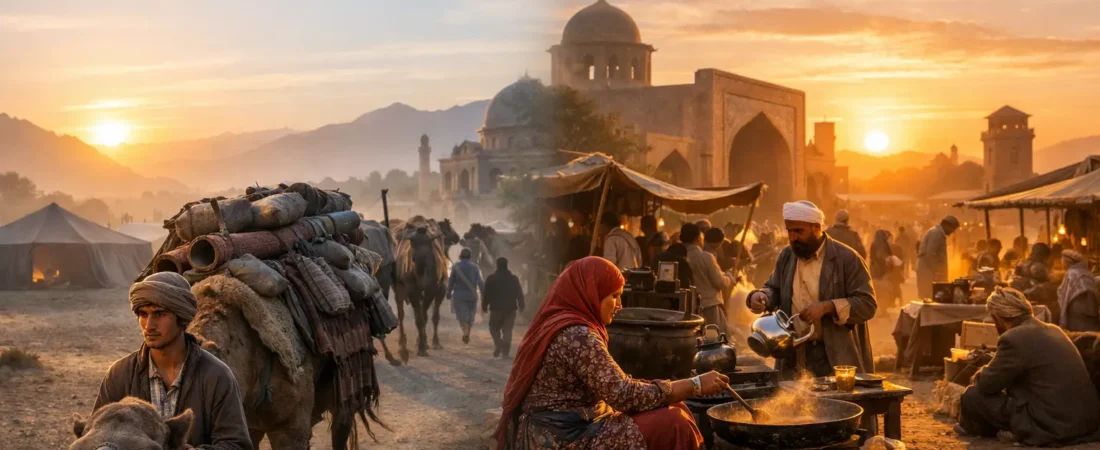
Before a camel bell sounded beyond the city gate, a Silk Road household was already awake. Bread dough rose near a clay oven. Water was carried from a canal or well. A child might be sent to buy onions, while a craftsperson checked a loom, a potter prepared clay, or a clerk opened a ledger. The famous caravan was only one part of a far larger world. Everyday life on the Silk Road unfolded in kitchens, workshops, bathhouses, farms, and crowded neighborhoods across thousands of miles.
The Silk Road was not a single road, nor was it used only by bold merchants crossing deserts. It was a shifting network of land and sea routes that connected East Asia, Central Asia, South Asia, the Middle East, East Africa, and Europe. Its busiest centuries varied by region, but from roughly the second century BCE through the fifteenth century CE, these connections carried more than silk. They carried habits, languages, recipes, technologies, religious ideas, and ordinary human concerns.
A Morning Inside a Silk Road City
Imagine entering Samarkand, the great Central Asian city in present-day Uzbekistan, during the early medieval period. Its streets did not belong solely to travelers. Residents made up the city’s living fabric: Sogdian merchants, farmers from nearby villages, artisans, religious communities, officials, laborers, and visitors who might stay for a season or a lifetime.
Homes differed sharply by wealth and climate. In many arid cities, families lived behind plain exterior walls that protected privacy and softened the heat. Inside could be a courtyard, storage jars, sleeping rooms, work spaces, and a small garden or fruit tree if water allowed. Wealthier houses might have decorated plasterwork, painted walls, or carved wooden fittings. More modest households often combined living and working space, with every room serving more than one purpose.
Archaeology gives these spaces a voice. At sites such as Panjikent, near Samarkand, excavated homes have revealed painted murals of banquets, myths, battles, and musicians. They remind us that private walls could hold public imagination. A household might end its day beneath images of heroes and feasts, much as later families gathered around stories, songs, and cherished objects.
The Market Was a Meeting Place, Not Just a Marketplace
A bazaar near the center of town brought together the local and the faraway. Grain, wool, leather, lamp oil, pottery, fruit, and livestock mattered more to most people than precious silk. Yet imported goods caught the eye: Chinese ceramics, Indian spices, Roman glass, Persian textiles, or silver vessels shaped by styles that had traveled across continents.
Trade was rarely a simple exchange between strangers. It depended on trust, credit, family partnerships, translators, hostels, tax officials, and brokers who knew the value of goods in different regions. Merchants often traveled only part of a route. A bale of silk could pass through many hands before reaching a Mediterranean port.
The documents from the oasis settlement of Niya, in the Tarim Basin of western China, preserve a more intimate side of commerce and administration. Written on wooden tablets, they record contracts, taxes, disputes, household matters, and official orders. The Silk Road was sustained not only by dramatic journeys, but also by paperwork, promises, and the familiar problem of who owed what to whom.
Food offered perhaps the most immediate evidence of cultural exchange. Wheat breads, millet porridges, rice dishes, yogurt, dried fruit, nuts, and mutton appeared in different combinations from one region to another. Grapes, pomegranates, melons, and apricots flourished in many irrigated oases. Some ingredients traveled gradually, taking root far from their original homes. A meal could quietly preserve the history of migration and trade.
Work, Skill, and the Rhythm of the Seasons
For most people, the Silk Road was not a journey but a workplace. Farmers cultivated grain and tended orchards outside city walls. In oasis regions, irrigation was survival. Canals, dams, and underground water channels required shared labor and careful management. A failed water supply could turn a prosperous settlement into a vulnerable one.
Within towns, artisans transformed raw materials into objects useful enough to survive centuries underground. Weavers produced cloth for clothing, furnishings, and trade. Metalworkers made tools, jewelry, weapons, and vessels. Paper makers, where the craft was established, prepared sheets that could carry religious texts, letters, and account records across great distances. Ceramic workshops supplied daily bowls and storage jars, though elite wares traveled farther and became prized possessions.
Silk itself was a luxury, but textiles were everywhere. Clothing signaled occupation, status, local custom, and sometimes religious identity. A traveler on a wall painting from the Mogao Caves near Dunhuang may wear boots and a close-fitting coat suited to horseback travel, while another figure wears a flowing robe. Such images are not photographs of daily life, yet they preserve clues about fabric, fashion, and the multicultural crowds moving through frontier towns.
Work was divided by age, gender, wealth, and custom, but no single pattern governed the entire network. Women could manage households, produce textiles, participate in trade, and, in some communities, hold property or appear in legal documents. Their experiences varied greatly by place and period. The surviving evidence is uneven, often written by officials or religious institutions, so historians must resist treating a fragmentary record as a complete portrait.
Faith Traveled With Families and Travelers
The Silk Road is often described as a highway for religions, and that is true. Buddhism moved from South Asia into Central Asia and China. Christianity, including the Church of the East, reached communities far to the east. Zoroastrianism flourished in Iranian and Central Asian worlds. Manichaeism gained followers across multiple regions. Islam later became a major force along many routes.
But faith was experienced in daily routines, not only in monumental temples. It shaped calendars, food customs, charitable giving, funerals, family rituals, and the places people visited for comfort or blessing. A merchant could make an offering before departure. A mother might teach prayers at home. A traveler could find shelter and community at a monastery, shrine, or religious hostel.
At Dunhuang, hundreds of caves preserve Buddhist paintings, manuscripts, and objects deposited over centuries. The discovery of the Library Cave in the early twentieth century revealed an extraordinary archive of religious texts, contracts, letters, medical writings, and exercises for students. It shows a frontier community where sacred life and practical life were closely intertwined.
The Road Could Be Dangerous, but It Was Not Empty Wilderness
The romance of the Silk Road can make it seem like a chain of lonely caravans beneath endless stars. Travel could indeed be punishing. Deserts brought thirst, sandstorms, and disorientation. Mountain passes brought cold, altitude, and sudden weather. Banditry, warfare, political borders, and disease added risk.
Yet routes endured because people built support systems around them. Caravanserais offered sheltered courtyards, animal space, food, and a place to exchange information. Wells, watchtowers, fortified outposts, and oasis towns created stopping points. Local guides knew which paths were open and which rulers were demanding new tolls.
Disease also moved along connected routes. The Black Death of the fourteenth century spread through complex pathways that involved trade, armies, animals, and human movement. It is tempting to blame a single road, but the reality was broader and more tangled. Connectivity brought opportunity, but it also made distant crises feel suddenly close.
What Everyday Life on the Silk Road Really Means
The Silk Road did not erase local identities. A baker in Chang’an, a farmer near Merv, a sailor in the Indian Ocean, and a monk at Dunhuang lived in distinct societies with their own languages, laws, landscapes, and beliefs. What connected them was not sameness, but contact.
That contact could be profitable, creative, unsettling, and unequal. Imported luxuries were often available only to elites, while laborers bore much of the physical burden of transport and production. New ideas could inspire artistic change, but they could also challenge established customs. The road was never a simple story of peaceful exchange.
Still, its most enduring legacy may be found in the ordinary acts that left the faintest traces: a letter carried to a distant relative, a repaired sandal, a recipe altered by a new spice, a child learning to write on a wooden tablet. The Silk Road was built by rulers and merchants, but it was lived by millions of people whose names are mostly lost. To pause beside their hearths, workshops, and market stalls is to see history at its most human: not a distant procession of treasures, but a shared world made one day at a time.