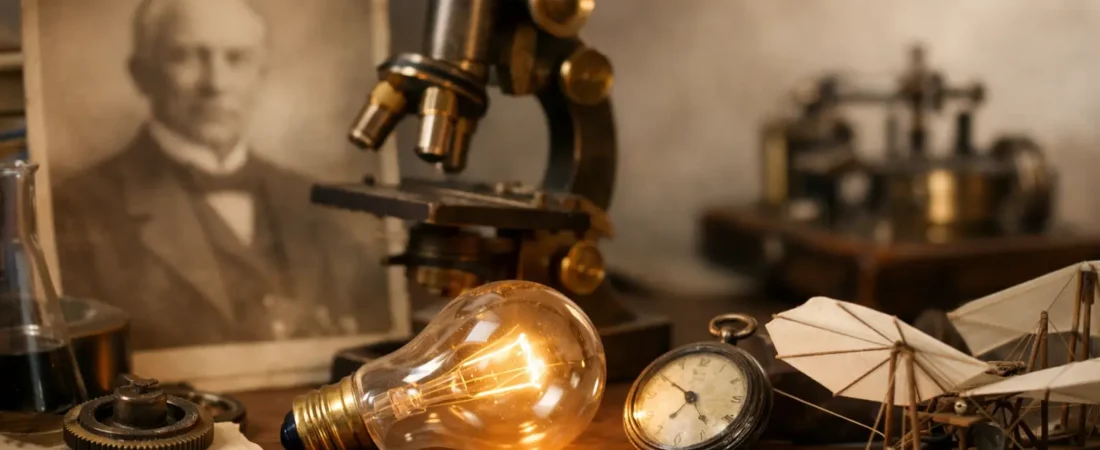
A city street after rain, a room lit long past sunset, a driver braking at a busy intersection, a voice carried through a telephone line – each scene contains the work of people history has too often placed in the margins. The most influential forgotten inventors were not always invisible in their own lifetimes. Many earned patents, ran businesses, or received praise. Yet their names faded while the technologies they improved became ordinary.
That is one of history’s quietest ironies. An invention can become so useful that people stop asking who made it possible. Some inventors were also eclipsed by famous employers, constrained by racism and sexism, or remembered only as a footnote to a larger story. Recovering their work is not about replacing one set of heroes with another. It is about seeing invention as it actually happens: through persistence, collaboration, technical skill, and the determination to solve a problem close at hand.
Why Some Inventors Slip From Memory
Patents tell only part of the story. They record a legal claim, not necessarily who had money to manufacture an idea, advertise it, or defend it in court. In the 19th and early 20th centuries, those advantages were distributed unevenly. Women could struggle to secure credit for mechanical work; Black inventors often faced discrimination in finance, employment, and the marketplace; immigrant innovators could be detached from the institutions that preserved reputations.
There is another complication. Many breakthroughs are improvements rather than single flashes of genius. A practical technology may require dozens of refinements before it changes daily life. The public tends to remember one celebrated name, while the people who made a device safer, cheaper, longer-lasting, or possible to mass-produce disappear from the familiar version of the story.
The Most Influential Forgotten Inventors
Lewis Latimer and the light that could last
In a workshop filled with the smell of heated carbon and machine oil, Lewis Howard Latimer helped make electric lighting more practical. Born in 1848 to parents who had escaped slavery, Latimer taught himself mechanical drawing after serving in the Union Navy. His drafting skill brought him into the fast-moving world of electrical patents.
Latimer did not invent the first incandescent bulb, a distinction commonly associated with several earlier experimenters and later commercialized by Thomas Edison. His achievement was no less consequential. In 1882, he received a patent for a process for manufacturing carbon filaments used in incandescent lamps. These filaments were more durable and helped lower the cost of producing bulbs. He later worked for Edison’s company and became one of the small group known as the Edison Pioneers.
Latimer’s career also reveals how invention extended beyond the workbench. He drew patent applications with exceptional precision, wrote a technical book about incandescent lighting, and helped spread electrical knowledge at a moment when homes and streets were beginning to glow after dark. The next time a light appears at the touch of a switch, it is worth remembering the painstaking material science behind that ordinary act.
Mary Anderson and the clear windshield
In 1902, Mary Anderson visited New York City during a snowy winter. From a streetcar window, she watched the driver repeatedly open the front pane to clear snow and sleet from the glass. It was cold, inconvenient, and dangerous. Anderson returned to Alabama with a design for a hand-operated device that could sweep a windshield from inside the vehicle.
Her 1903 patent described a swinging arm with a rubber blade, controlled by a lever in the cabin. It sounds immediately familiar because it is the ancestor of the windshield wiper. At the time, however, automobiles were still a novelty, and one company reportedly considered the idea impractical. Anderson’s patent expired before the rapidly expanding auto industry made windshield wipers standard equipment.
Her story is a useful correction to the myth that inventors work only in laboratories. Anderson saw a repeated inconvenience, imagined a mechanical answer, and protected it through a patent. Road safety later depended on that simple principle: a driver must be able to see.
Garrett Morgan and survival in smoke
The scene that defined Garrett Morgan’s public reputation came in 1916, beneath Cleveland’s Lake Erie. An explosion in a tunnel trapped workers amid smoke and toxic gases. Morgan, a Black businessman and inventor, entered wearing a breathing device of his own design. Alongside his brother Frank and other rescuers, he helped bring survivors out. The rescue was hazardous, and several people involved later died from the effects of the disaster.
Morgan had patented his “safety hood and smoke protector” in 1914. It used a system of tubes to draw cleaner air from nearer the ground, where smoke and harmful gases could be less concentrated. It was not equivalent to a modern gas mask, but it offered meaningful protection in certain smoke-filled conditions and became an important predecessor to later respiratory safety equipment.
He also patented a traffic signal in 1923. Its most notable feature was an intermediate stop position, giving traffic a pause before movement changed direction. Modern signals developed through many inventors and systems, so it would be inaccurate to call Morgan the sole creator of the traffic light. But his design addressed a genuine problem of the automobile age: intersections needed a safer rhythm than simple stop-and-go commands could provide.
Alice Parker and the promise of central heating
On a cold winter night in the early 20th century, heating a home often meant tending a fireplace or stove room by room. Alice H. Parker imagined a more organized solution. Her 1919 patent described a heating furnace using natural gas, with ductwork intended to distribute warm air through a building.
Parker did not invent the modern central heating system outright, and the historical record does not show that her exact design was manufactured as a complete household system. That distinction matters. Still, her patent is remarkable because it anticipated a key principle of modern forced-air heating: producing heat centrally and directing it where people need it. It also proposed gas as an alternative to the coal and wood that made many homes smoky and labor-intensive.
Parker’s name is often repeated in simplified online accounts, sometimes with claims that go beyond the evidence. The more compelling truth needs no exaggeration. At a time when women inventors were rarely welcomed into engineering circles, she patented a thoughtful design addressing domestic comfort, fuel use, and household labor.
Margaret Knight and the paper bag machine
A paper bag seems almost too modest to carry a story of industrial ingenuity. Yet in the 1860s, factory workers typically folded paper bags by hand. Margaret E. Knight, who had begun working in textile mills as a child, devised a machine that cut, folded, and glued flat-bottomed bags. The resulting bag could stand upright and carry heavier goods.
Before her patent was granted in 1871, another man attempted to claim the design as his own. Knight successfully proved that she had created it, using her models and detailed knowledge of the mechanism. Her victory was significant in an era when a woman’s technical testimony was easily dismissed.
Knight received more than two dozen patents during her lifetime, covering devices from textile machinery to a dress and skirt shield. But the bag machine remains her clearest legacy. It transformed an everyday container into a mass-produced tool of commerce, helping stores package the growing volume of goods moving through industrial America.
James West and the microphone in your pocket
Some forgotten inventors belong not to the distant Victorian past but to the technological landscape still surrounding us. In 1964, James E. West and Gerhard M. Sessler patented the electret microphone at Bell Laboratories. Their design used an electrically charged material to create a small, sensitive, and inexpensive microphone.
Electret microphones became widespread in telephones, hearing aids, recording equipment, and countless consumer devices. The details are easy to miss because the component is often hidden behind a tiny opening. Yet much of the modern soundscape – calls, interviews, voice notes, and portable electronics – depended on this breakthrough.
West also became a prominent advocate for greater diversity in science and engineering. His career reminds us that recognition is not fixed. An inventor may be highly respected within a field and still absent from the public history taught outside it.
A Timeline of Ideas That Became Everyday Life
- 1871: Margaret Knight receives her patent for a machine that makes flat-bottomed paper bags.
- 1882: Lewis Latimer patents an improved process for manufacturing carbon filaments for electric lamps.
- 1903: Mary Anderson receives a patent for a window-cleaning device for vehicles.
- 1914: Garrett Morgan patents his safety hood and smoke protector.
- 1919: Alice Parker patents a gas-fueled heating furnace design with heat distribution.
- 1923: Morgan patents his traffic signal design.
- 1964: James West and Gerhard Sessler patent the electret microphone.
How to Look for Hidden Hands in History
The most rewarding way to encounter these figures is to resist the tidy single-inventor story. Ask what problem a device solved, who improved it, who manufactured it, and whose name was left off the classroom poster. A patent date can open a door, but so can a factory ledger, a newspaper report, a surviving prototype, or an engineer’s notebook.
These questions make history feel less like a gallery of distant geniuses and more like a workshop still alive with effort. The next familiar object you hold may carry the trace of an inventor who noticed a small frustration, built an answer, and left the world changed – even if the world forgot to say their name.