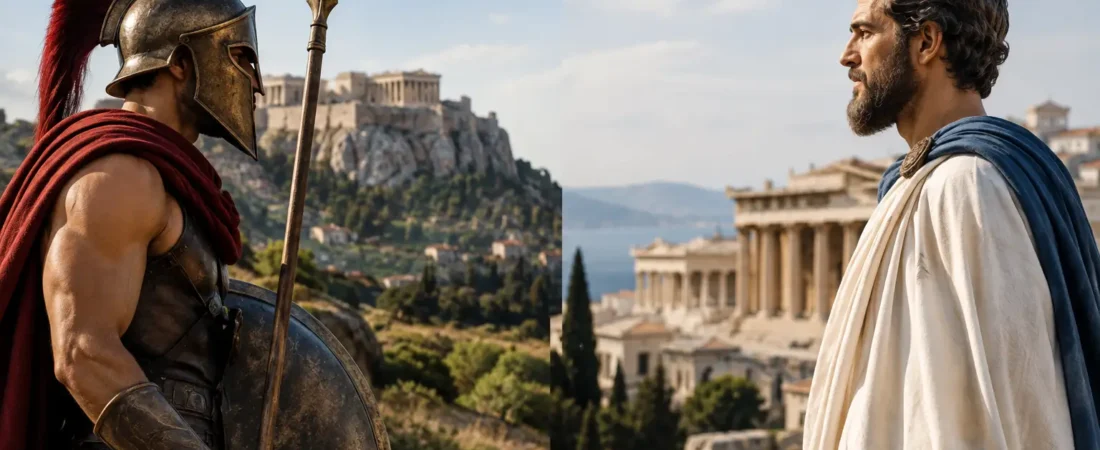
A visitor arriving in Greece around 430 BC could have crossed only a few hundred miles and entered what felt like two different worlds. Sparta versus Athens was not simply a contest between armies or governments. It was a struggle between rival answers to a lasting question: What should a citizen’s life be for?
Athens rose in terraces of pale stone beneath the Acropolis, alive with shipbuilders, potters, jurors, merchants, philosophers, and sailors. Sparta lay inland on the Eurotas River, with no grand city walls and far fewer monuments, its public identity built around discipline, military service, and control. Each city admired qualities the other regarded with suspicion. Their collision reshaped the Greek world.
Sparta versus Athens: Two Visions of Citizenship
Neither Sparta nor Athens was a modern nation. Both were independent Greek city-states, or poleis, bound by language, religious traditions, and shared festivals but fiercely protective of local customs. Citizenship was limited in both places, and neither society offered equality in the modern sense. Still, their political systems created strikingly different civic ideals.
Athens developed a direct democracy during the late sixth and fifth centuries BC. Its male citizens could gather in the Assembly, debate policy, vote on laws, serve on large juries, and hold public office, often selected by lot. The system grew from reforms associated with Solon and Cleisthenes, then expanded during the city’s imperial age.
This democracy was energetic, participatory, and deeply imperfect. Women could not vote. Enslaved people had no political rights. Resident foreigners, known as metics, contributed enormously to Athenian trade and culture but remained outside citizenship. Yet for eligible Athenian men, politics was not a distant institution. It was a public duty performed face to face.
Sparta placed power in a mixed system designed to restrain any single group. It had two hereditary kings, a council of elders called the Gerousia, five annually elected overseers known as ephors, and an assembly of male Spartan citizens. The Assembly could approve or reject proposals, but debate was limited and real influence rested heavily with the elders and ephors.
A Spartan citizen was expected first to be a soldier. Boys entered the agoge, a state-directed training system, at about age seven. They learned endurance, obedience, communal discipline, and the skills expected of infantrymen. The image of Sparta as a city where every moment was military training is exaggerated, but military readiness undeniably stood at the center of its social order.
The Price Behind Spartan Strength
Sparta’s famous army did not exist because every inhabitant was a full-time warrior. It existed because others carried much of the labor.
The largest group was the helots, an unfree population, many descended from the conquered people of Messenia. Helots worked agricultural land and supplied produce to Spartan households. Their numbers probably exceeded those of the Spartans by a wide margin. That imbalance haunted Sparta for centuries. Fear of revolt helped explain its caution abroad, harsh internal controls, and relentless emphasis on military cohesion.
Between helots and full citizens stood the perioikoi, free communities living around Spartan territory. They handled trade, manufacturing, and crafts, and they served in Sparta’s forces, but they lacked Spartan political rights. The celebrated simplicity of Sparta was therefore sustained by a complex and unequal social structure.
Spartan women occupied a position that surprised many other Greeks. They did not vote or hold office, but they generally received physical training, could own and inherit property, and managed estates while men lived in barracks or campaigned. Athenian observers sometimes viewed this independence as shocking. It did not make Sparta egalitarian, but it marked a real contrast with Athens, where respectable women’s public roles were more constrained.
Our picture of Spartan life requires caution. Much of the surviving evidence comes from outsiders, including the Athenian writer Xenophon, or from authors writing generations later, such as Plutarch. Sparta was already becoming a legend in the ancient world. The hard-edged image survives because Spartans cultivated it and their admirers repeated it.
Athens and the Dangerous Energy of Democracy
Athens looked outward to the sea. Its harbor at Piraeus connected Attica to grain routes, timber supplies, luxury goods, and ideas from across the Mediterranean. After the Greek victories over Persia in 490 and 480-479 BC, Athens became the leading power in the Delian League, an alliance originally formed to resist renewed Persian attacks.
Over time, that alliance became an Athenian empire. Allied communities paid tribute, supplied ships, or faced pressure when they tried to leave. Tribute helped Athens maintain its fleet and funded ambitious building projects, including the Parthenon. The glittering monuments of the Acropolis were expressions of religious devotion and civic pride, but they also advertised imperial wealth.
Athens made room for pursuits that Sparta treated less warmly. Its theaters staged tragedies by Aeschylus, Sophocles, and Euripides before vast civic audiences. Its workshops produced painted pottery that still carries scenes of daily life and myth across museum galleries. Philosophical inquiry flourished in its streets. Socrates questioned Athenians in public, not as an ornament of democracy, but often as one of its most uncomfortable critics.
This cultural brilliance came with volatility. The Athenian Assembly could make bold decisions quickly, but it could also be swayed by fear, anger, and persuasive speakers. Citizens voted to send fleets, punish allies, and continue wars whose human cost was devastating. Democracy gave Athenians a voice. It did not guarantee wisdom.
A Rivalry That Became a War
The tension between the land power of Sparta and the naval empire of Athens erupted into the Peloponnesian War in 431 BC. The conflict was not inevitable, but fear and competition made peace increasingly fragile. As the historian Thucydides observed, Sparta’s fear of growing Athenian power was a fundamental cause.
Athens relied on its walls, fleet, and access to the sea. Sparta invaded Attica, hoping to force a decisive land battle. Then a plague swept through crowded Athens in 430 BC, killing perhaps a quarter of the population and claiming the life of the statesman Pericles. The city’s strategy, morale, and political balance were never the same.
The war dragged on for nearly three decades, interrupted by uneasy truces and marked by atrocities on both sides. Athens launched the disastrous Sicilian Expedition in 415 BC, losing enormous numbers of ships and men far from home. Sparta eventually built a fleet with Persian financial support. In 405 BC, the Spartan commander Lysander destroyed the Athenian navy at Aegospotami. Athens surrendered the following year.
Sparta had won, but victory exposed the limits of its system. It lacked the population and administrative machinery needed to manage a wide empire. Its short-lived dominance provoked resistance, while its own citizen body declined. In 371 BC, Thebes defeated Sparta at Leuctra, shattering the aura of Spartan invincibility and helping free Messenia from Spartan control.
What the Ruins Still Correct
The familiar comparison can become too neat: Sparta as disciplined warriors, Athens as enlightened thinkers. Both labels contain a fragment of truth and conceal much else. Athens possessed formidable soldiers and pursued empire with ruthless force. Sparta valued music, poetry, religion, and communal ritual alongside warfare. Both depended on slavery. Both excluded many residents from political power. Both could be creative, courageous, cruel, and fearful.
Archaeology helps complicate the old stereotypes. Athens leaves abundant traces in inscriptions, pottery, public buildings, and the crowded remains of its agora. Sparta’s material record is less monumental, but sanctuaries, dedications, and excavated settlements reveal a society more varied than the silent military camp imagined by later tradition. Ruins do not speak on their own, but they can challenge stories that have become too convenient.
The greater legacy of Sparta versus Athens is not a scorecard. Athens invites us to consider participation, debate, culture, and the risks of popular power. Sparta forces us to confront how security, discipline, and collective purpose can be purchased at terrible human cost. When we stand before a Greek temple, a battered helmet, or a shard of painted clay, the useful question is not which city was better. It is what each society asked its people to sacrifice, and who was left to bear that sacrifice.