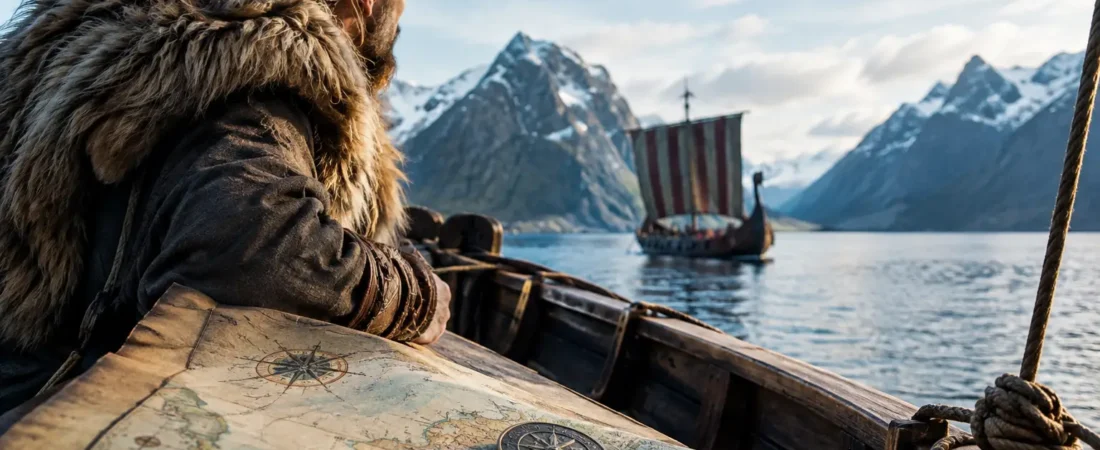
Cold spray breaks over the bow as a long, narrow hull rises and falls on the North Atlantic. There is no compass in the modern sense, no chart marked with safe harbors, and no certainty that land waits beyond the horizon. Yet for the crew aboard a Viking ship, the sea is not an empty boundary. It is a road. Viking voyages carried Scandinavian sailors toward monasteries in Britain, markets on the rivers of Eastern Europe, farms in Iceland and Greenland, and, briefly, the shores of North America.
Their reach can seem almost unbelievable when measured against the tools available to them. But these journeys were not random acts of daring. They grew from skilled shipbuilding, intimate knowledge of coasts and currents, networks of trade, and a willingness to take risks when land and wealth were scarce.
Viking Voyages Began With the Ship
The Viking Age is conventionally dated from 793 to 1066, beginning with the raid on the monastery of Lindisfarne in northeastern England and ending with the Norwegian king Harald Hardrada’s defeat at Stamford Bridge. Those dates are useful landmarks, but Scandinavian seafaring had much deeper roots. By the late eighth century, Norse shipbuilders had developed vessels that could cross open water while also traveling far up shallow rivers.
The famous longship was built for speed, flexibility, and war. Its overlapping wooden planks, known as clinker construction, created a hull that was light but strong. A shallow draft allowed a crew to beach the vessel almost anywhere, avoiding the need for a proper harbor. One square sail supplied power in open water; oars gave control near shore, on rivers, or when the wind failed.
Not every vessel was a longship. Broader cargo ships, often called knarrs, carried settlers, livestock, timber, wool, iron, walrus ivory, and food stores. A raiding ship could bring armed men to a vulnerable coast. A cargo vessel made permanent communities possible. The difference matters: Viking history was shaped as much by farmers and merchants as by warriors.
Why the Norse Took to Sea
Scandinavia offered productive farmland in some regions, but cultivable land was limited by mountains, forests, and a demanding climate. Overseas travel presented opportunities for younger sons, ambitious chieftains, traders, and families seeking new ground. Political rivalry also played a role. As rulers consolidated power in Norway, some elites may have looked westward to preserve independence or find fresh prospects.
We should be cautious about reducing migration to one cause. People left for different reasons, and the evidence rarely reveals a single individual’s motives. Still, the pattern is clear. The sea connected communities that might otherwise have been isolated by difficult terrain.
For some, the first contact was violent. Raids on monasteries and coastal settlements brought portable wealth, enslaved people, and prestige. For others, the goal was exchange. Norse merchants moved furs, amber, soapstone, iron, and ivory through commercial routes that reached the Islamic world. Silver coins from the Middle East have been found in Scandinavian hoards, quiet evidence of how far these networks extended.
East, West, and South
To the west, Norse sailors traveled through the British Isles and into the North Atlantic. They settled in the Faroe Islands, Iceland, and Greenland, while also establishing communities in parts of Ireland, Scotland, England, and the Isle of Man. Dublin, founded as a Viking settlement in the ninth century, became a major trading center.
To the east, Swedish-associated Norse groups often known as Rus traveled river systems through what are now Russia, Ukraine, and Belarus. Their routes linked the Baltic to the Black Sea and the Caspian Sea. Some served as mercenaries in Constantinople, the wealthy Byzantine capital they called Miklagard, or the Great City.
These directions were not separate worlds. A silver coin, a sword style, a glass bead, or a carved piece of ivory could travel through a chain of exchanges spanning thousands of miles.
The Atlantic Crossing to Iceland and Greenland
Iceland was settled largely by Norse migrants in the late ninth century, though people from the British Isles, including many of Gaelic ancestry, were also part of its early population. The island’s settlement was a formidable logistical achievement. Colonists had to bring animals, tools, seed grain, and enough knowledge to survive volcanic terrain and brutal winters.
Around 985, according to medieval Icelandic traditions, Erik the Red led settlers from Iceland to Greenland after being outlawed for killings. The name Greenland may have been a persuasive piece of marketing, but the southwestern coast did contain grazing land during the warmer medieval climate conditions of the period. Norse communities endured there for centuries, building farms and churches and trading valuable walrus ivory with Europe.
Their survival was always precarious. Greenland’s settlements depended on a narrow coastal environment, uncertain shipping, and connections to Europe. By the fifteenth century they had disappeared. Cooling temperatures, changing trade patterns, environmental pressures, and isolation probably all contributed. Historians continue to debate the balance of causes, and the story resists a simple tale of collapse.
Viking Voyages Reached North America
The most astonishing westward journey led beyond Greenland. The Icelandic sagas describe voyages to lands called Helluland, Markland, and Vinland. Sagas were written down centuries after the events they describe, so they cannot be read as straightforward logbooks. They preserve memory, storytelling, and historical fragments in the same text.
Archaeology, however, confirms the central claim. At L’Anse aux Meadows, on the northern tip of Newfoundland, archaeologists uncovered the remains of an eleventh-century Norse site: turf buildings, ironworking evidence, and artifacts associated with Norse craftsmanship. It is the first securely identified European settlement in the Americas, centuries before Columbus’s first Atlantic crossing.
The site was likely a small, temporary base rather than a large colony. It may have supported exploration farther south, where wild grapes or butternuts could be found. Encounters with Indigenous peoples, called Skrælings in the sagas, were marked by uncertainty and violence. Norse visitors entered lands already inhabited by diverse Indigenous communities with deep histories of travel, trade, and survival. Any account of Vinland must keep that fact at its center.
Navigation Without Modern Instruments
Norse sailors did not navigate blindly. They used practical observation: the angle of the sun, the stars, wind direction, waves, sea color, drifting ice, and the behavior of birds. Migrating whales and the presence of certain seabirds could suggest proximity to land. Coastal sailing remained important, but open-ocean crossings required experience shared across generations.
Popular stories often claim Vikings used a magical sunstone to find the sun through cloud cover. Certain transparent crystals can indeed help detect polarized light, and medieval texts mention a sunstone. But the direct evidence that Viking mariners routinely used one as a navigational instrument remains limited. The more certain explanation is less dramatic and more impressive: expert sailors learned to read an entire environment.
Life aboard was physically punishing. Crews slept where they could, protected themselves with woolen clothing and oilskin-like coverings, and ate preserved foods such as dried fish, grains, and salted meat. Water could become stale. Storms threatened sails, rigging, and cargo. A voyage’s success often depended less on heroic command than on constant repair, disciplined labor, and collective endurance.
What the Voyages Changed
Viking expansion transformed the medieval world. It accelerated the movement of goods, people, artistic styles, languages, and religious ideas. Scandinavian settlers adapted to local societies, intermarried, adopted Christianity over time, and created hybrid cultures. English absorbed many Old Norse words, including sky, window, husband, and law.
The age of large-scale Viking raids faded not because the Norse suddenly abandoned the sea, but because political conditions changed. Stronger kingdoms improved defenses, Scandinavian rulers became Christian monarchs, and overseas settlements became part of ordinary regional life. The ships kept sailing, but the world that had made rapid raiding so profitable was changing.
When standing before a reconstructed longship or looking at a weathered rivet in a museum case, it is worth remembering what such objects represent. They are not symbols of an endlessly violent people, nor proof of fearless adventurers untouched by hardship. They are evidence of human skill applied to an unforgiving sea. Viking voyages remind us that maps are never finished by rulers alone. They are extended by crews who watch the horizon, trust hard-won knowledge, and decide to sail beyond it.