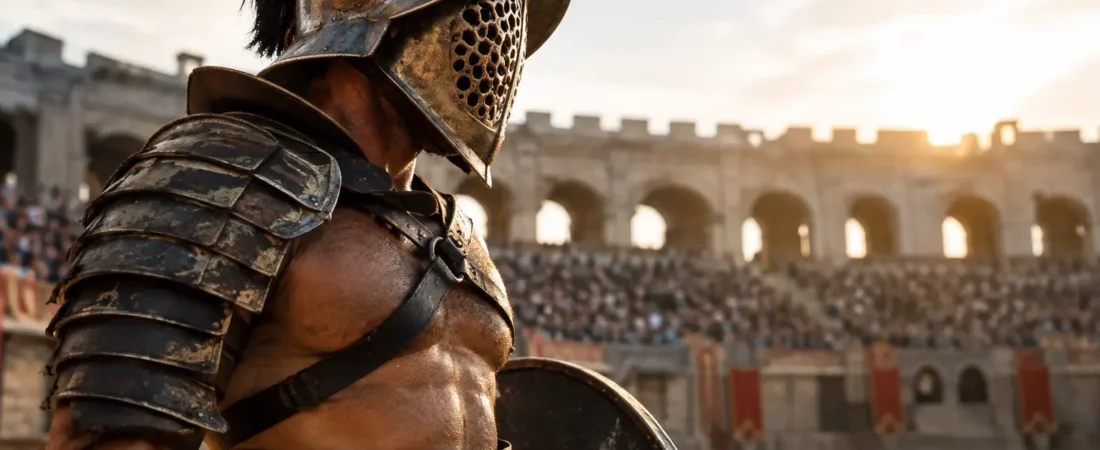
The iron gate lifts. Sunlight strikes the sand, the crowd swells into a single roar, and a fighter steps forward beneath the painted awnings of a Roman amphitheater. He may be a captive taken in war. He may be a condemned criminal. Or, surprisingly, he may be a free Roman who signed away much of his legal standing for a chance at money, fame, and survival. Were gladiators always enslaved? No. But the fuller answer reveals a world in which freedom, status, and spectacle were far more complicated than the movies suggest.
Were Gladiators Always Enslaved in Ancient Rome?
Most gladiators were enslaved, but not all were born into slavery or remained enslaved forever. Rome’s arenas drew fighters from several groups: prisoners of war, people enslaved through trade or birth, condemned criminals, and volunteers known as auctorati. Each entered the arena under different circumstances, though all faced the same brutal expectation: entertain the public.
The word gladiator comes from gladius, the short Roman sword. Yet a gladiator was not simply a soldier forced into combat. He was a trained performer in a tightly managed profession, owned or contracted by a trainer-manager called a lanista. His weapons, armor, opponents, and appearances were carefully selected to create dramatic contests.
For an enslaved person, the gladiatorial school, or ludus, could be a prison with better food and medical care than many labor camps offered. That does not make it humane. It reflects a cold economic fact: a skilled fighter was valuable property. For a volunteer, the same school meant accepting confinement and punishment in exchange for pay, possible celebrity, and sometimes a way out of crushing debt.
The Captives Who Filled Rome’s Arenas
Rome’s expansion produced a vast population of captives. After campaigns in Gaul, Thrace, Dacia, Britain, and elsewhere, prisoners could be sold into slavery, sent to mines, forced into labor, or selected for the arena. Their origins sometimes shaped their fighting persona. A man presented as a Thracian gladiator, for example, wore distinctive equipment associated in Roman eyes with Thracia. But the category was a stage role, not always a statement of the fighter’s actual birthplace.
Other men were sentenced ad ludum, meaning they were condemned to a gladiatorial school. This punishment differed from a death sentence, though it was hardly a hopeful outcome. Some convicted criminals were assigned ad bestias, to face wild animals in public executions. These victims were not gladiators in the professional sense. They were part of the same arena culture, but they were often given little training and little prospect of survival.
For enslaved fighters, combat offered a narrow and dangerous route to recognition. A successful gladiator could earn gifts, prize money, and public admiration. He might eventually receive a wooden sword called a rudis, the traditional symbol of release from gladiatorial service. In some cases, that meant legal freedom. In others, it meant retirement from fighting while remaining tied to an owner or school. The evidence varies by place and period, so no single rule explains every career.
Free Men Who Volunteered for the Arena
The most startling exception to the image of the enslaved gladiator is the auctoratus, a free man who volunteered. By signing a contract, he accepted the authority of a lanista and endured the discipline of the school. Ancient writers describe this arrangement with discomfort because it involved a free citizen submitting to conditions associated with slavery.
Why make that choice? Money was one reason. Gladiators could receive payment for appearances and victories, and financial desperation could make the arena seem preferable to hunger, debt, or social failure. Some recruits were also drawn by the possibility of fame. A famous fighter could command devoted followers, receive gifts from admirers, and become a recognizable figure in city life.
There was a steep cost. Gladiators carried the stigma of infamia, a loss of social respectability that also affected actors, sex workers, and others whose work involved public display. A free volunteer might still be legally free, but he surrendered significant control over his body and reputation. His contract made him subject to the trainer’s discipline, and ancient sources suggest that recruits swore an oath to endure burning, binding, beating, and death by the sword if required.
This is why calling every gladiator a slave misses the point, while calling them independent athletes is equally misleading. Volunteers had agency, but it was often constrained by poverty, ambition, or desperation. Their choice was real, yet made inside a deeply unequal society.
Women and the Arena
Women also appeared in the arena, though far less often and amid considerable controversy. Literary references, reliefs, and inscriptions indicate that female gladiators existed, especially during the early imperial period. They were probably not all enslaved either. Elite women participating in public spectacle scandalized Roman moralists, while women of lower status may have entered under harsher pressures.
A famous relief, now in the British Museum, depicts two female fighters named Amazon and Achillia. They appear equipped for a matched contest, not an execution. Their carved names and dramatic poses preserve a rare glimpse of women who were presented as trained arena combatants. By the early second century CE, Emperor Septimius Severus reportedly prohibited women from competing, perhaps because the practice had become too visible for conservative taste.
Training, Not Constant Slaughter
The arena was violent, but its violence was organized. A lanista invested heavily in training, housing, diet, armor, and medical treatment. Gladiators practiced with wooden weapons, learned specific styles, and fought opponents selected to produce contrast: a heavily armored secutor against a nimble, net-wielding retiarius, for example.
Not every match ended in death. Killing a trained fighter could be expensive, and a crowd often valued skillful combat over a quick execution. Referees supervised bouts. Rules governed equipment and intervention. A defeated gladiator might appeal for mercy, while the sponsor of the games, responding to the audience and the circumstances of the match, decided whether he lived.
Still, survival should not be romanticized. Infections, injuries, repeated trauma, punishment, and the ever-present possibility of fatal combat shaped daily life. Archaeologists studying a gladiator cemetery at Ephesus in modern Turkey found skeletal evidence of healed injuries as well as violent wounds. The dead reveal trained bodies built for a dangerous profession, not invincible heroes of legend.
Freedom Could Be Won, but It Was Not Simple
The rudis has become a powerful image of liberation: a wooden sword held aloft after years of bloodshed. Some retired gladiators became trainers, referees, or members of a school’s staff. A few returned to the arena after receiving release, attracted by money or status. The Roman public could remain fascinated by a veteran fighter long after his formal career ended.
But freedom did not erase the past. A formerly enslaved gladiator could still carry social stigma. A volunteer who left the arena had to rebuild a life after accepting infamia. The odds of reaching retirement also depended on age, health, the quality of one’s school, and the whims of sponsors. For every celebrated champion commemorated on a tombstone, countless names have vanished into the sand.
What the Gladiator’s Story Really Tells Us
Rome’s gladiators were neither a single class of enslaved victims nor a band of willing sports stars. They were captives, enslaved people, condemned criminals, debt-ridden volunteers, and occasionally women whose public presence unsettled Roman society. Their shared identity was created by the arena, where the state and wealthy sponsors transformed human risk into spectacle.
That complexity is worth carrying beyond the amphitheater. When we picture a gladiator, we should picture more than a helmet and a sword. We should see the contract, the chain, the training yard, the crowd, and the fragile possibility that one more victory might change a life.