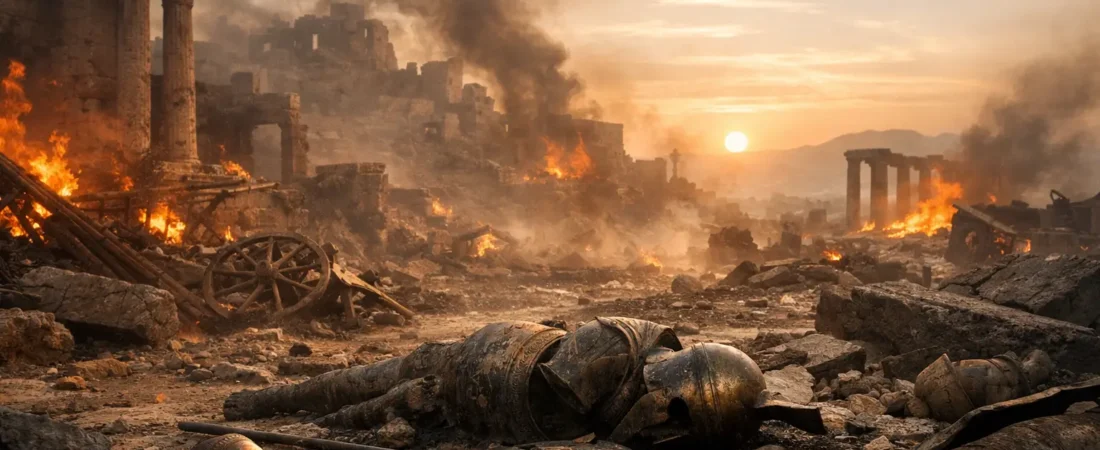
A royal scribe at Ugarit, on the coast of present-day Syria, pressed a desperate message into wet clay around 1190 BCE. Enemy ships had appeared offshore. The city’s forces and fleet were away. “The country is abandoned to itself,” the letter warned. Soon afterward, Ugarit burned. Its tablets were baked hard by the fire that destroyed the palace, preserving a final archive from a world on the edge.
So, what was the Bronze Age Collapse? It was a far-reaching breakdown of kingdoms, cities, trade networks, and political systems across the eastern Mediterranean and Near East between roughly 1200 and 1150 BCE. It did not erase every society, nor did it happen everywhere at once. But it ended an international age that had connected Egypt, the Hittite Empire, Mycenaean Greece, Cyprus, Canaan, and Mesopotamia through diplomacy, luxury trade, warfare, and royal marriage.
For centuries, bronze had helped power that world. Then the palaces went dark.
A Connected World Before the Fall
The Late Bronze Age was not a primitive prelude to later civilizations. It was a sophisticated international system. Kings exchanged letters in Akkadian, then the diplomatic language of the region. Egyptian pharaohs corresponded with rulers in Babylon, Assyria, and Hatti. Merchant ships moved copper from Cyprus, tin from distant sources, ivory, glass, timber, textiles, spices, and finely worked gold across the sea.
Bronze itself reveals how interdependent this world had become. It is an alloy of copper and tin, and those materials were rarely found together. A sword forged in Mycenaean Greece or a tool used in Canaan could depend on mines, caravans, ports, scribes, and merchants far beyond its maker’s homeland.
Palaces stood at the center of this system. At places such as Mycenae and Pylos in Greece, Hattusa in Anatolia, Ugarit in Syria, and Thebes in Egypt, administrators tracked grain, livestock, labor, weapons, and tribute. Their records were written on clay tablets or other perishable materials. The system was wealthy, organized, and impressive. It was also tightly controlled, which made it vulnerable when one failure triggered another.
What Was the Bronze Age Collapse? Not One Disaster
Older accounts often pictured a single invading force sweeping through the eastern Mediterranean. Egyptian inscriptions do describe attacks by groups modern historians call the Sea Peoples, especially during the reign of Ramesses III. At his mortuary temple at Medinet Habu, scenes show naval and land battles against enemies arriving with warriors, ships, carts, women, and children.
These records matter, but they are not the whole explanation. “Sea Peoples” was an Egyptian label for several groups, not the name of one united nation. Some may have been migrants displaced by crisis. Others may have been raiders, mercenaries, or populations seeking land. They were part of the upheaval, but historians cannot responsibly treat them as its sole cause.
The stronger explanation is a convergence of pressures. Different regions suffered different combinations of war, migration, drought, famine, earthquakes, internal revolt, and political fragmentation. A palace system already strained by shortages could be shattered by an attack. A city weakened by conflict might be unable to restore its trade routes after an earthquake. Collapse was less like a single falling wall and more like a web of ropes snapping one after another.
Climate Stress and Hunger
Evidence from pollen, lake sediments, and other environmental records suggests that parts of the eastern Mediterranean experienced prolonged dry conditions near the end of the Late Bronze Age. The timing and severity varied by location, and climate evidence cannot explain every destruction layer. Still, drought would have reduced harvests, driven up food prices, and placed severe strain on palace authorities expected to feed workers, soldiers, and urban populations.
Ancient letters offer unsettling glimpses of scarcity. A Hittite king requested grain from Egypt, calling it a matter of life and death. Egypt did send shipments, demonstrating both the scale of the emergency and the continuing importance of international exchange. But food aid could not permanently solve a regional system under pressure.
War, Raiding, and Migration
The archaeological record contains widespread destruction: burned buildings, toppled walls, abandoned settlements, and fortifications rebuilt in haste. Yet fire alone does not identify an attacker. Cities burn in warfare, accidents, revolts, and even deliberate abandonment. Each site must be examined on its own evidence.
Some communities responded by moving inland or uphill, away from exposed coasts and vulnerable plains. Others fortified settlements. In Cyprus, many coastal centers were damaged or abandoned, while new settlements appeared in defensible locations. In the southern Levant, the political map changed dramatically as Egyptian control weakened and new communities emerged.
Migration was both a cause and a consequence. People fleeing hunger, war, or insecurity could place new pressure on neighboring regions. The story is not simply one of invaders and victims. It is also the story of families seeking safety as the institutions around them failed.
Earthquakes and Fragile Palaces
The Aegean and eastern Mediterranean sit along active fault zones. Some scholars have proposed an “earthquake storm,” a series of destructive quakes affecting several cities within a relatively short period. Earthquakes certainly damaged ancient settlements, and rebuilding after one disaster could drain a kingdom’s resources.
But this idea has limits. Not every destroyed city shows clear earthquake damage, and earthquakes cannot by themselves account for the political changes that followed. They may have been one shock among many. The key point is that a centralized palace, dependent on storage, taxation, trained administrators, and distant suppliers, was not easily rebuilt after repeated disruptions.
The Kingdoms That Fell and the Ones That Endured
The Hittite Empire was among the greatest casualties. Its capital, Hattusa, was abandoned around the early 12th century BCE. The reasons remain debated, but the empire’s central authority vanished. In Greece, Mycenaean palaces at Pylos, Tiryns, and elsewhere were destroyed or declined. The Linear B writing used by palace administrators disappeared for centuries.
Ugarit, once a thriving port where languages and goods met, was destroyed and never restored to its former place. Its final tablets are among the most poignant artifacts of the period because they capture administration continuing almost until the end: shipments, personnel, legal matters, and alarms, all recorded as normal life was breaking apart.
Egypt survived, though not unchanged. Ramesses III defeated attackers in battles traditionally dated to around 1177 BCE, but victory did not restore the old order. Egypt faced economic strain, labor unrest, and a weakening grip on its eastern Mediterranean territories. One of the earliest documented labor strikes occurred during his reign, when workers at Deir el-Medina stopped work after their grain rations failed to arrive.
Assyria also endured and later expanded, although it faced its own hardships. Phoenician coastal cities, including Byblos, Sidon, and Tyre, remained or recovered and would become major maritime powers in the centuries ahead. Survival depended on geography, local resources, political flexibility, and, sometimes, simple timing.
After the Palaces: A Different Ancient World
The decades after 1200 BCE are often called a dark age because written records became scarcer in some regions, especially Greece. That phrase can mislead. The period was difficult, and much knowledge held by palace scribes was lost. Yet it was not empty.
Smaller communities adapted to a less centralized world. Iron gradually became more common, not because it was immediately superior to bronze, but because iron ore was more widely available and old trade routes for tin had become unreliable. New identities and states formed. In the Levant, the Phoenician city-states expanded their seafaring influence. In Greece, the foundations were laid for the later city-states, epic traditions, and alphabetic writing.
The Bronze Age Collapse was therefore an ending, but also a reorganization. Grand palaces and their international court culture disappeared in many places. In their wake came smaller-scale societies that developed new ways to govern, trade, worship, and remember the past.
Why the Collapse Still Matters
The enduring lesson is not that complex societies are doomed. It is that complexity brings dependencies. Late Bronze Age rulers relied on harvests, shipping lanes, metals, loyal officials, and the ability to move food and soldiers quickly. When several of those systems failed together, even powerful kingdoms struggled to respond.
Archaeology keeps refining this picture. A burned room, a hoard of weapons, a grain tablet, or a layer of drought-sensitive pollen can change how we understand a city’s last years. The evidence rarely gives us a single dramatic answer. It gives us something more valuable: a human record of adaptation, fear, resilience, and change.
When you encounter a museum case holding a clay tablet from Ugarit or a broken Mycenaean sword, pause over what survived. These are not merely remnants of a vanished age. They are messages from people who lived through a world becoming unfamiliar, and who left enough behind for us to listen.