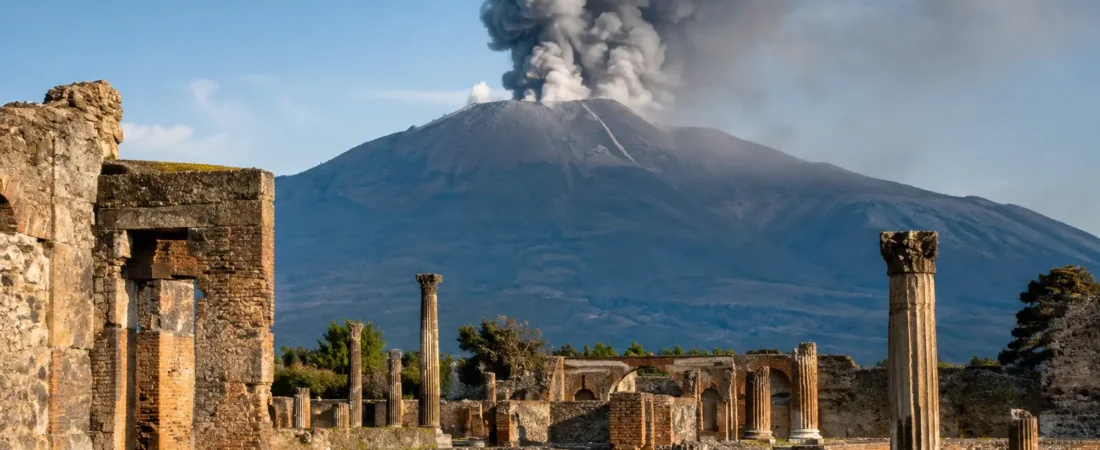
For centuries, travelers crossed the fertile slopes below Mount Vesuvius with little idea that a Roman city lay beneath their feet. So, why did Pompeii disappear? It did not slowly fade through war, abandonment, or legend. In the span of roughly 24 hours in 79 CE, a volcanic eruption buried Pompeii under layers of ash, pumice, and debris so deep that its streets, homes, shops, and public buildings vanished from view.
Pompeii’s destruction was terrible, but the same material that ended thousands of lives preserved extraordinary traces of ordinary Roman life. Bread remained in ovens. Paint still clung to villa walls. Graffiti lingered on street corners. The city disappeared from the landscape, but not from history.
Pompeii Before the Eruption
Pompeii was not a remote village waiting to be swallowed by a volcano. It was a busy Roman town of perhaps 10,000 to 12,000 people, standing near the Bay of Naples in southern Italy. Its residents included merchants, craftspeople, laborers, enslaved people, wealthy landowners, sailors, and visitors passing through a region celebrated for its rich soil and coastal trade.
The city had paved streets, inns, bakeries, bathhouses, temples, theaters, taverns, and an amphitheater. In its homes, frescoes showed mythological scenes, gardens, birds, and fountains. In its markets, people bought fish sauce, wine, fruit, bread, cloth, and household goods. Pompeii was unmistakably Roman, yet it also carried older Greek, Oscan, and Samnite influences from the region’s long past.
Vesuvius rose nearby, green with vineyards and farms. The mountain had been quiet for generations. Most people living around it did not understand that it was an active volcano. Earthquakes had shaken the region for years, including a destructive quake in 62 CE, but tremors were familiar in Campania. Repairs were still underway when the mountain finally awakened.
Why Did Pompeii Disappear So Completely?
The answer lies in the force and sequence of Vesuvius’s eruption. On the first day, the volcano blasted a towering column of ash, gas, and rock high into the sky. Pliny the Younger, whose eyewitness account is our most important written source, compared the shape of the cloud to an umbrella pine: narrow at its base, spreading wide at the top.
Pumice stones began falling over Pompeii. They were light enough to be carried by the wind, but heavy enough to collapse roofs as they accumulated. Many residents fled during this early phase, carrying valuables or seeking shelter beyond the city walls. Others stayed behind, perhaps believing the danger would pass, protecting their property, aiding relatives, or finding themselves trapped by darkness and falling debris.
During the night and into the following morning, the eruption became even more deadly. Vesuvius released pyroclastic surges – fast-moving, ground-hugging clouds of scorching gas, ash, and volcanic fragments. These surges swept through Pompeii and nearby settlements. They were not slow rivers of lava. They arrived with devastating speed, filling buildings, courtyards, and streets.
By the end, Pompeii lay under several yards of volcanic material. Its harbor access was altered, its roads vanished, and its structures were buried so thoroughly that the city no longer functioned as a place people could simply return to and rebuild. The disaster transformed a recognizable town into a hidden layer beneath farms and later settlements.
The exact date remains debated. For many years, historians accepted August 24, based on copies of Pliny’s letters. Yet seasonal evidence and a charcoal inscription discovered at Pompeii suggest the eruption may have occurred in late October, possibly October 24. The central fact is unchanged: in autumn of 79 CE, Vesuvius overwhelmed the city.
The final hours of Pompeii
The catastrophe unfolded in stages, which helps explain why Pompeii preserves both signs of escape and scenes of sudden death:
- Early eruption: A vast ash-and-pumice column rose from Vesuvius as stones began raining down.
- Afternoon and evening: Roofs weakened or collapsed under the mounting weight of pumice.
- Overnight: Darkness, ash, earthquakes, and panic made escape increasingly difficult.
- Final phase: Pyroclastic surges engulfed the city, killing many who remained.
- Burial: Ash and debris sealed Pompeii beneath a deep volcanic blanket.
Not everyone died in the city. Archaeologists have found evidence that many residents escaped, and inscriptions elsewhere suggest that some survivors rebuilt their lives in neighboring communities. Pompeii’s population was not frozen in one final instant. It was scattered – some fleeing successfully, some perishing on the roads, and some caught within the city they knew best.
Buried, Not Forgotten Forever
Pompeii was gradually lost from memory as a city, though people in the area knew ancient ruins existed underground. Small-scale discoveries occurred over time, but systematic excavation began in the 18th century, after workers digging for a palace project encountered buried structures near the modern town of Pompei.
At first, excavations often treated the site as a source of statues, paintings, and precious objects for elite collections. Over time, the approach changed. Archaeologists began to recognize Pompeii as something rarer: an entire urban environment preserved in remarkable detail.
One of the most haunting discoveries came in 1863, when Italian archaeologist Giuseppe Fiorelli developed a method for making plaster casts. Bodies buried in ash had decomposed, leaving hollow spaces in the hardened volcanic deposits. By carefully pouring plaster into those cavities, excavators could reveal the forms of people, animals, clothing, and even expressions shaped in their final moments.
These casts are powerful, but they should be approached with care. They are not statues made by ancient Romans, nor are they perfect photographs of death. They are archaeological records created through a modern technique, preserving the spaces once occupied by bodies. Their value is not only emotional. They help researchers study posture, age, health, clothing, and the physical realities of the disaster.
What the Ash Preserved
Pompeii’s disappearance created one of archaeology’s most detailed records of daily life in the Roman world. Grand monuments survive in many ancient cities, but Pompeii also preserves the spaces between them: kitchens, workshops, laundry facilities, election notices, storage jars, street fountains, and humble rooms where enslaved people worked and slept.
Its walls speak in many voices. Political slogans urged residents to support local candidates. Romantic messages and insults appeared beside advertisements and prices. One famous piece of graffiti reminds us that Pompeii was not a silent museum of marble and mosaics. It was noisy, commercial, humorous, unequal, and intensely human.
The city also corrects a common misunderstanding. Pompeii was not preserved exactly as it stood on an ordinary morning. The eruption damaged, shifted, crushed, and buried objects. Looting, early excavation methods, weather exposure, and modern conservation challenges have altered the site further. Still, the ash preserved materials that would usually decay, including wooden objects, food remains, textiles, and organic traces.
That preservation comes with a difficult trade-off. Excavating Pompeii reveals its stories, but exposure also makes walls, paintings, and buildings vulnerable to rain, plants, pollution, and time. Archaeologists now often choose careful conservation and targeted excavation over opening every buried area at once. Parts of Pompeii remain unexcavated, protected beneath the ground that once concealed them.
Pompeii Did Not Simply Vanish
To ask why did Pompeii disappear is also to ask what disappearance means. The city vanished from the visible world because Vesuvius buried it. But it survived in another form – as a sealed archive of Roman life, tragedy, resilience, and memory.
Its ruins have shaped how we imagine the ancient world. They show us wealthy villas and crowded apartments, elegant banquets and rough taverns, religious rituals and practical labor. They also reveal the limits of human certainty. A mountain that seemed familiar became, without warning, a source of unimaginable destruction.
When viewing Pompeii’s casts, painted rooms, or wheel-rutted streets, resist the urge to see only a disaster frozen in ash. Look for the life that came before it: a loaf prepared for sale, a message scratched into plaster, a garden arranged around a fountain. Those small details are Pompeii’s most enduring answer to oblivion. The city disappeared beneath Vesuvius, but its people still invite us to pause, look closely, and remember how much of history survives in the everyday things we leave behind.