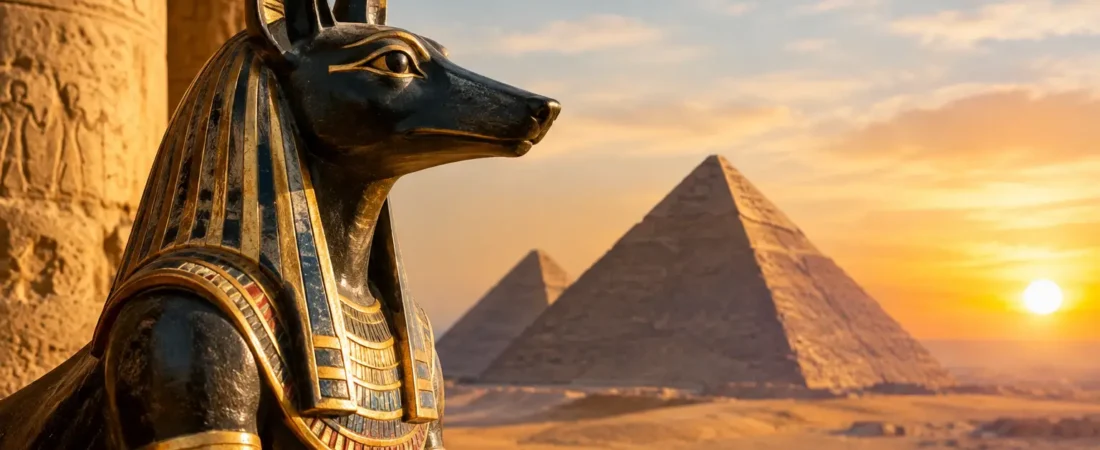
Before sunrise, the Nile’s edge stirred with labor. Farmers checked water channels, fishermen pushed reed boats into the current, and temple staff prepared offerings for gods believed to keep the universe in balance. Far beyond the riverbank, limestone pyramids caught the first light. This was ancient Egypt: not a frozen kingdom of gold masks and silent tombs, but a society whose people worked, worshiped, argued, created, and planned for an afterlife they hoped would never end.
Its civilization endured, in changing forms, for more than 3,000 years. That longevity was no accident. Egypt’s landscape, political ideals, religious traditions, and written records created a culture remarkably skilled at turning fragile human lives into lasting memory.
Ancient Egypt Began With the Nile
Egypt was shaped by a narrow ribbon of fertile land running through desert. Each year, the Nile flooded its banks, leaving behind dark, rich silt suitable for crops. Ancient Egyptians called this fertile region Kemet, often translated as “the Black Land.” Beyond it lay the Red Land, the dry desert that was difficult to farm but rich in stone, minerals, and protective distance from many would-be invaders.
The annual flood was not merely useful. It set the rhythm of life. Farmers planted after the waters withdrew, harvested before the next inundation, and paid taxes in grain. A failed flood could bring hunger; an abundant one could fill storehouses. The river was highway, pantry, boundary, and sacred presence all at once.
This geography encouraged political unity. Communities along the Nile were connected more easily by boat than by desert travel, and by about 3100 BCE, Upper and Lower Egypt had been united under one ruler. Later tradition credited King Narmer with this achievement, although the real process was likely gradual and complex. Still, the image of one king ruling “the Two Lands” became central to Egyptian identity.
A brief journey through the dynasties
Egyptian history did not move in a straight line. Periods of strong centralized rule alternated with eras of regional division, foreign rule, and recovery. Yet certain ages left monuments that still define how we picture the civilization:
- Early Dynastic Period, c. 3100-2686 BCE: royal government and writing took firmer shape.
- Old Kingdom, c. 2686-2181 BCE: the age of the great pyramid builders, including Khufu at Giza.
- Middle Kingdom, c. 2055-1650 BCE: a period of reunification, literary achievement, and expanded administration.
- New Kingdom, c. 1550-1070 BCE: Egypt became a major imperial power under rulers such as Hatshepsut, Akhenaten, Tutankhamun, and Ramesses II.
These dates are useful landmarks, not walls. Egyptian customs changed across centuries, and people in a village during the Middle Kingdom did not experience the world in the same way as courtiers in Ramesses II’s capital.
Pharaoh Was a Sacred Office, Not Just a Crown
The pharaoh stood at the center of Egyptian political and religious life. To modern eyes, this can seem like absolute personal power. In practice, even a powerful king depended on officials, priests, soldiers, scribes, craft workers, and local administrators. Egypt ran on paperwork, measured grain, and human cooperation as much as royal decree.
The king’s essential duty was to uphold ma’at, a concept that joined truth, justice, order, and cosmic balance. When Egyptians saw the sun rise or the Nile return, they could understand these events as signs that proper order continued. A ruler who failed to protect the land from chaos, famine, or invasion risked being viewed as failing that sacred obligation.
Royal monuments expressed this responsibility in stone. Temples were not simply places for public worship in the modern sense. They were divine estates, managed by priests who performed daily rituals for a god’s image. In vast temple complexes such as Karnak, walls recorded military victories, donations, processions, and offerings. Their carvings were messages to gods and future generations, carefully designed to outlast the people who commissioned them.
Pyramids Were Only the Beginning
The pyramids at Giza remain extraordinary not because they are mysterious, but because they reveal immense organization. They required quarrying, transport, engineering, food supplies, medical care, planning, and a large labor force. Archaeological evidence from workers’ settlements suggests that many laborers were not enslaved captives in chains, as older popular stories claimed. They included skilled workers and seasonal crews supported by the state, though conditions were certainly demanding.
A pyramid was part of a larger sacred landscape. It stood beside temples, causeways, storage areas, and cemeteries. Its purpose was tied to the king’s death and continuing existence, but it was also a public statement: the king could marshal resources on a scale few others could imagine.
Over time, royal burial practices changed. New Kingdom pharaohs were often buried in rock-cut tombs in the Valley of the Kings rather than beneath visible pyramids. The hidden location offered some protection from robbers, though not enough. Most royal tombs were plundered in antiquity. Tutankhamun’s tomb became famous partly because it survived comparatively intact, preserving a rare, crowded glimpse of royal burial goods.
Death Was a Journey That Required Preparation
Ancient Egyptians did not think death erased a person. They believed different aspects of the self could continue, but only if the dead were properly cared for and remembered. The body mattered. The name mattered. Food offerings mattered. Images, spells, and rituals mattered.
Mummification was therefore more than preservation. It prepared the deceased for transformation. The process varied dramatically according to wealth and period. Elite burials could involve elaborate treatment, nested coffins, painted masks, amulets, and scrolls containing funerary texts. Ordinary Egyptians had simpler burials, but they too sought protection and remembrance.
One of the most moving beliefs concerned the heart. In funerary texts, the deceased’s heart could be weighed against the feather of ma’at. A life lived in proper balance allowed the dead to enter the blessed realm. The scene did not promise automatic salvation to the wealthy. It imagined moral accountability, however differently Egyptians defined it from later cultures.
This is why tomb inscriptions speak so insistently. “Speak my name,” they seem to ask across thousands of years. To erase a person’s name was not a minor insult. It threatened their continued existence.
The Egypt Beyond the Tomb Walls
Tombs and temples survived because stone and desert preserved them. Everyday life was more easily lost. Homes made of mudbrick collapsed; linen garments decayed; wooden furniture was reused or destroyed. Archaeology, however, has recovered remarkable fragments.
At Deir el-Medina, a village of artisans who worked on royal tombs, letters and ostraca – flakes of limestone or pottery used like scrap paper – reveal a vivid community. Workers recorded absences because of illness, family duties, brewing beer, or even being bitten by a scorpion. They complained about rations and organized what is often described as the earliest documented labor strike, during the reign of Ramesses III.
Such evidence corrects the impression that Egypt consisted only of pharaohs. Most people were farmers, craftspeople, laborers, traders, and household members. Women could own property, make contracts, inherit wealth, and initiate divorce in ways that were notable in the ancient Mediterranean, though legal possibility did not erase social inequality. Status, occupation, gender, and access to resources shaped daily life.
Scribes occupied a particularly valued position. Literacy was limited, and writing carried authority. Hieroglyphs served monumental and sacred purposes, while hieratic and later demotic scripts allowed faster administrative writing. A scribe could record harvests, calculate supplies, compose letters, or preserve literature. Without these writers, Egypt’s vast bureaucracy and much of its surviving voice would be unimaginable.
What the Ruins Still Ask of Us
Ancient Egypt has often been reduced to treasure, curses, and spectacle. Those images can spark curiosity, but they also risk treating a living historical culture as a cabinet of exotic objects. Archaeology is most meaningful when it restores context: a sandal beside a bed, a child’s toy, a worker’s complaint, fingerprints in a brick, a name cut into a wall.
The monuments endure because Egyptians built for eternity. Yet their world also depended on ordinary, repeated acts: sowing grain after floodwater receded, preparing bread, copying a document, repairing a boat, leaving offerings for the dead. That combination of grand ambition and daily endurance is what makes their story feel close.
When you encounter a pyramid, a painted coffin, or a line of hieroglyphs, pause before asking what secret it hides. Ask instead whose hands made it, who expected it to last, and what they hoped the future would remember. In that quiet exchange across time, the past becomes more than a ruin. It becomes a human presence.