Before sunrise, laborers at a Roman aqueduct quarry could already hear iron striking stone. Hundreds of miles away, water was beginning its carefully measured journey toward a crowded city. In ancient engineering marvels, the wonder is rarely one dramatic object alone. It is the hidden planning behind it: the survey line, the drainage channel, the supply chain, the repair access, and the hard-won understanding of materials.
The ancient world did not possess modern steel, electric pumps, computer models, or combustion engines. Yet its builders reshaped rivers, crossed valleys, lifted immense stone blocks, and created urban systems that supported populations on a scale that can still feel startling. Their achievements deserve awe, but also close attention. They were not magic. They were evidence of patient observation, skilled labor, political power, and generations of practical knowledge.
Why Ancient Engineering Marvels Matter
A monument can survive because it was built magnificently, but infrastructure survives only when it works. That distinction is central to understanding the past. Temples, tombs, walls, canals, roads, and reservoirs were answers to immediate human needs: secure water, reliable food, safe movement, prestige, defense, and connection.
Many ancient projects also reveal a difficult truth about engineering. Great works required organization as much as invention. A ruler might commission a canal or pyramid, but surveyors, masons, potters, boat crews, farmers, and seasonal laborers made it real. The physical remains preserve the ambitions of elites, while tool marks, worker settlements, and unfinished sections preserve the presence of ordinary people.
What follows is not a contest to name the most impressive civilization. It is a walk through several places where ancient builders confronted recurring problems that remain familiar: How do you move heavy loads? How do you control water? How do you build for earthquakes, floods, or heat? And how do you maintain a system after the original builders are gone?
Stone on a Monumental Scale: The Great Pyramid
At Giza, the Great Pyramid of Khufu rises from the desert plateau with an authority that photographs cannot quite convey. Built around 2600 BCE, it originally stood about 481 feet tall and was composed of an estimated 2.3 million blocks. Its survival has made it a symbol of ancient construction, though its exact building sequence remains debated.
Archaeology has replaced many older fantasies with a more human story. Evidence from the nearby workers’ settlement points to organized crews who were housed, fed, and medically treated. Inscriptions identify work gangs with spirited names. The workforce likely included skilled permanent laborers and seasonal workers recruited when Nile flooding limited agricultural work.
The engineering challenge was not simply lifting stone. Builders had to quarry limestone, transport it by boat and sled, prepare a level foundation, orient the structure with remarkable accuracy, and coordinate work across decades. Wetting sand in front of sledges may have reduced friction, an insight supported by experiments and ancient Egyptian imagery. Ramps almost certainly played a role, but their precise forms remain uncertain. Straight ramps, zigzagging ramps, and systems that wrapped around the structure have all been proposed.
That uncertainty matters. Respect for the evidence means admitting what archaeology can show and what it cannot. The pyramid is no less extraordinary because some of its methods remain unresolved. If anything, the gaps remind us how much technical skill can disappear when its manuals, tools, and spoken traditions do not survive.
Cities Built Around Water: Mohenjo-daro and the Indus Valley
Around 2600 BCE, in what is now Pakistan, Mohenjo-daro developed a different kind of engineering achievement. Its drama lay not in a single towering monument but in an urban system. Streets followed a planned grid in many areas. Houses often included bathing spaces and wells. Covered brick drains carried wastewater away from residences.
The city was built with standardized fired bricks, commonly made in a 1:2:4 ratio. Standardization may sound mundane beside a pyramid, yet it is one of the clearest signs of coordinated construction. When bricks, street widths, and drainage channels follow shared conventions, repairs and expansions become easier to manage.
Mohenjo-daro’s Great Bath, a large brick-lined tank sealed with bitumen, shows how carefully builders managed water containment. Stairs descended into the pool, while surrounding rooms suggest that bathing may have carried ritual or communal significance. The tank was not merely decorative. It required durable brickwork, waterproofing, water supply, and drainage.
Still, planned sanitation was not a guarantee against environmental change. The Indus cities faced shifting river systems, flooding, and broader social transformations. Engineering can reduce risk, but it cannot permanently command a landscape. This is one lesson modern readers should carry away: infrastructure is a continuing relationship with nature, not a final victory over it.
The Long, Patient Slope of Roman Aqueducts
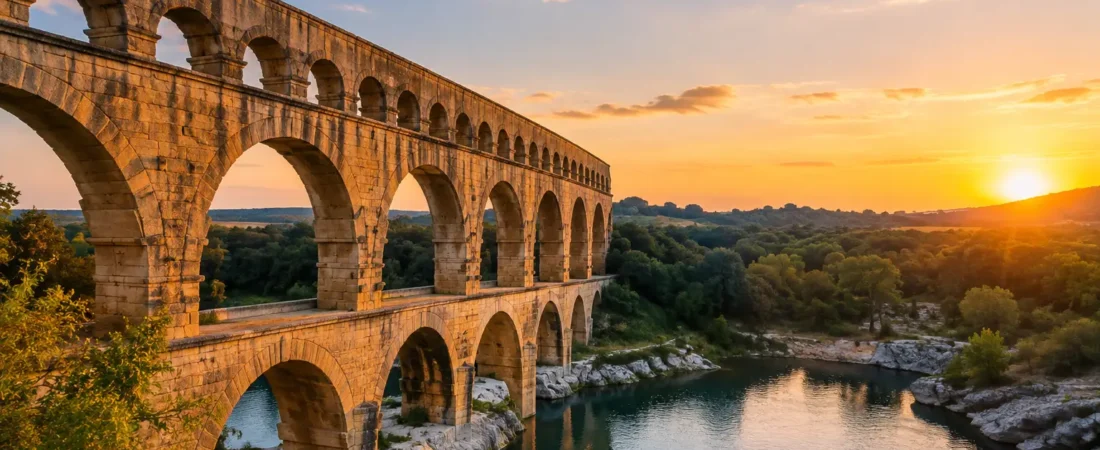
Roman aqueducts are often remembered for their towering arches, especially at places such as Pont du Gard in southern France. But the arches are only the visible punctuation marks in a much longer sentence. Most aqueduct channels ran underground or along slopes, protected from contamination, evaporation, and damage.
Water moved largely by gravity. That demanded meticulous surveying. A channel that fell too sharply could erode; one that was too level would stagnate or fail to flow. Roman engineers used tools such as the chorobates, a long leveling instrument, to establish gradients across uneven country. Settling tanks helped remove sediment, while distribution structures directed water into baths, fountains, workshops, and private homes.
Rome’s system was not a single pipe serving everyone equally. Access reflected wealth, legal rights, and public priorities. Public fountains and baths benefited broad sections of the population, while some private users received authorized connections. The system also demanded constant maintenance. Mineral deposits narrowed channels. Leaks developed. Unauthorized taps appeared.
The lesson is wonderfully practical: an aqueduct was not just a construction project. It was an institution. It depended on inspectors, funding, regulations, and repair crews. A beautiful structure without a maintenance culture is only half an engineering solution.
Persia’s Underground Answer to a Dry Climate
In the Iranian Plateau and surrounding regions, ancient communities perfected another water technology: the qanat. A qanat is a gently sloping underground tunnel that carries groundwater from foothills to farms and settlements in arid lowlands. Vertical shafts, sometimes stretching across long distances, allowed workers to excavate, ventilate, and maintain the channel.
The design was elegant because it used gravity while keeping water below ground, where the fierce sun could not easily evaporate it. Qanats could sustain orchards and villages where surface water was scarce, but they were demanding to build and maintain. A collapse or neglected shaft could threaten the entire system. Their success depended on local knowledge of geology, seasonal flow, and communal water rights.
This was engineering shaped by restraint. Instead of forcing a river into a new course through massive dams, qanat builders worked with the slow movement of groundwater. It is a powerful reminder that technical sophistication does not always mean building bigger. Sometimes it means taking only the water a landscape can reliably provide.
Earthquakes, Ash, and Roman Concrete
Roman builders also left a material legacy. Their concrete, made from lime, water, aggregates, and often volcanic ash called pozzolana, allowed construction on a scale and in shapes that cut stone alone could not easily achieve. Vaults, domes, harbor works, and massive public buildings became possible through this adaptable material.
The Pantheon in Rome remains the great demonstration. Completed in its present form in the second century CE, its coffered concrete dome spans about 142 feet. The builders reduced weight toward the top through its design and by using lighter aggregate in upper portions. The central oculus removes material while admitting rain and daylight into the vast interior.
Roman concrete was not indestructible, and not every recipe behaved the same way. Yet research into ancient harbor concrete has shown that some mixtures interacted with seawater in ways that contributed to long-term durability. The past does not hand modern engineers a ready-made formula, but it can offer valuable questions about local materials, repairability, and building for centuries rather than decades.
What the Ruins Ask of Us
The most enduring ancient engineering marvels were rarely isolated strokes of genius. They were systems: people trained to read a slope, organize a workforce, test a material, clear a drain, and pass methods onward. Their ruins can tempt us to admire only grandeur. Look closer, and the smaller details become equally moving – a drainage cover fitted into a street, a survey line cut into rock, a mason’s mark hidden inside a wall.
Those details invite a more generous view of history. The ancient world was not waiting for modernity to begin solving practical problems. Its builders were already measuring, adapting, failing, repairing, and trying again. When we stand before their surviving works, we are not only looking at lost civilizations. We are meeting fellow problem-solvers, still asking water, stone, and time to cooperate.