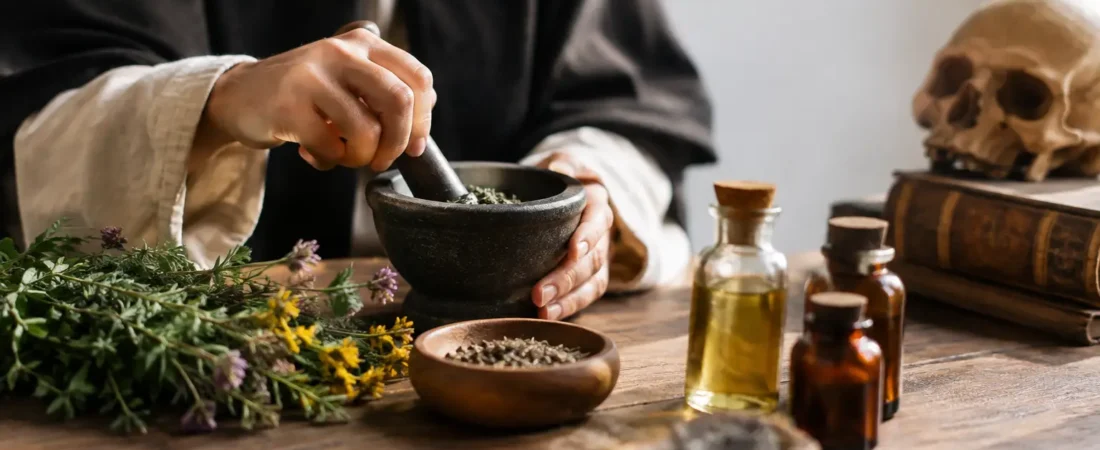
A sickroom in medieval Europe could be frightening: candle smoke in the rafters, a feverish child beneath wool blankets, jars of dried herbs beside a basin of water. That vivid scene has encouraged many medieval medicine myths, especially the idea that people before modern science knew nothing and did nothing but bleed patients or pray over them. The truth is more human, and more complicated. Medieval medicine could be perceptive, organized, and occasionally effective. It could also be painfully limited by the knowledge of its age.
To enter this world fairly, we need to set aside the caricature of a filthy, helpless past. Medieval people lived without germ theory, antibiotics, anesthesia, or modern imaging. Yet they observed bodies closely, preserved classical learning, built hospitals, trained practitioners, and tested remedies through repeated experience. Their failures were real. So were their skills.
Why Medieval Medicine Myths Persist
The Middle Ages cover roughly a thousand years, from the fall of the western Roman Empire to the Renaissance, across regions with very different traditions. A physician at a university in Bologna, a midwife in an English village, a Jewish doctor in Iberia, and a healer in the Islamic world did not practice the same medicine. Treating all of them as one ignorant crowd flattens history.
Later writers helped create the distortion. Renaissance thinkers often defined themselves against the medieval past. Victorian popular culture added dungeons, leeches, and plague carts. Modern viewers, accustomed to sterile clinics and laboratory tests, understandably see old treatments as bizarre. But strange is not the same as senseless. A remedy can rest on a flawed theory while still containing useful ingredients or reflecting careful observation.
The records that survive also favor the unusual: sensational trials, rare operations, lavishly illustrated manuscripts, and medical warnings. Everyday care was quieter. It took place in kitchens, monasteries, marketplaces, bathhouses, and at bedsides, carried out by relatives, midwives, barber-surgeons, apothecaries, and physicians.
Myth: Medieval People Were Universally Filthy
Medieval towns had serious sanitation problems. Waste disposal was inconsistent, crowded neighborhoods could be foul-smelling, and contaminated water contributed to disease. It would be wrong to romanticize those conditions. But the claim that medieval people never washed is equally wrong.
Bathing was a regular part of life in many places. Public bathhouses operated in European cities, while communal bathing traditions were especially well developed in Byzantine and Islamic societies. People washed hands, faces, and feet; combed their hair; cleaned garments; and used soaps, scented waters, and herbal preparations. Archaeological finds such as combs, tweezers, bowls, and bathing equipment offer a material reminder that grooming mattered.
After the Black Death, some Europeans grew wary of public baths because they believed open pores admitted dangerous air. That change was tied to prevailing ideas about disease, not to indifference toward cleanliness. Washing remained common, but practices shifted with local custom, class, season, and fear of epidemic illness.
Myth: Doctors Only Bled Their Patients
Bloodletting was unquestionably common. Under the ancient theory of the four humors, health depended on the balance of blood, phlegm, black bile, and yellow bile. Fever, swelling, melancholy, and other symptoms could be interpreted as signs of imbalance. Physicians prescribed bleeding, purging, dietary changes, and medicines intended to restore equilibrium.
From a modern perspective, much of this was mistaken, and bloodletting could weaken patients who were already dangerously ill. Still, it was not the only treatment in the medieval medical chest. Practitioners advised rest, sleep, fresh air, controlled diets, warm or cool compresses, and medicinal plants. They treated wounds with cleaning, bandaging, stitches, cautery, ointments, and splints.
Some remedies had real potential. Honey has antimicrobial properties and was used on wounds. Willow bark contains compounds related to aspirin. Poppy preparations could ease pain, although their risks were not understood in modern terms. Other treatments did little or caused harm. The key distinction is that medieval care was not a single ritual of blood and leeches. It was a broad, uneven body of practice shaped by inherited theory and lived experience.
Myth: Surgery Was Impossible Before Modern Medicine
Medieval surgery was dangerous, but it was not absent. Surgeons treated fractures, dislocations, abscesses, hernias, cataracts, bladder stones, and battlefield injuries. They amputated damaged limbs when necessary. Without effective anesthesia or antisepsis, every invasive procedure carried enormous risks of shock, infection, and bleeding. Even a technically successful operation could end badly days later.
Yet surgical manuals reveal impressive practical knowledge. The influential 14th-century French surgeon Guy de Chauliac described methods for treating wounds and fractures, drawing on Greek, Roman, Arabic, and personal experience. In the Islamic world, the 10th-century physician al-Zahrawi produced a major illustrated surgical work that documented instruments and procedures. His descriptions circulated widely and influenced later European medicine.
Battlefields were brutal classrooms. Surgeons learned that foreign material needed removal from wounds, that broken bones required stabilization, and that careful dressings mattered. Their explanations for why these measures worked were often wrong. Their observations, however, could be precise.
The painful boundary of skill
A medieval surgeon might set a bone with remarkable competence and still lose the patient to infection. This is the central tension in the history of medicine. Technical ability does not automatically overcome a missing scientific framework. Before microbes were understood, no practitioner could reliably prevent sepsis after major trauma.
Myth: The Church Banned All Medical Learning
Religious institutions were deeply involved in medieval health care. Monasteries preserved and copied medical texts, cultivated herb gardens, and offered hospitality and nursing. Hospitals, many founded through religious charity, cared for the poor, pilgrims, orphans, elderly people, and the sick. They were not modern hospitals with intensive treatment wards, but they were vital places of shelter and care.
The relationship between religion and medicine was not simple opposition. Prayer and relics could be part of a patient’s treatment, while physicians also examined urine, felt pulses, discussed diet, and prescribed drugs. A person could believe illness had spiritual meaning and still seek practical treatment. Those ideas coexisted.
Human dissection was restricted, controversial, and uncommon in some settings, but it was not universally prohibited. By the late Middle Ages, dissections were carried out at several European universities for anatomical teaching. Their frequency and purpose varied, and access to bodies was limited. Still, the familiar claim of a blanket church ban obscures a more complicated record.
Myth: The Black Death Was Treated by Plague Masks and Superstition Alone
When plague arrived in Europe in 1347, it killed with a speed no medieval system could control. Physicians lacked knowledge of the bacterium now known as Yersinia pestis, its flea vectors, and the role of rodents. Their advice often followed the theory of corrupted air: burn fragrant substances, avoid foul smells, alter the diet, or flee infected places. None could reliably cure plague.
But medieval communities did not respond with superstition alone. Italian port cities developed quarantine measures, isolating ships and travelers for set periods before allowing entry. The word quarantine comes from the Italian practice of forty days, or quaranta giorni. These policies were imperfect and not based on germ theory, yet they recognized a crucial practical fact: proximity to an outbreak could be dangerous.
The famous beaked plague doctor mask belongs mostly to the 17th century, not the first wave of the Black Death. It has become a visual shortcut for all medieval plague, but chronology matters. The image is memorable precisely because it is so often misplaced.
What the Medieval Sickroom Really Teaches Us
Medieval medicine was neither a dark void nor a lost golden age. It was a serious attempt to confront pain, injury, childbirth, contagion, and death with the tools available. Its practitioners inherited ancient ideas, exchanged knowledge across cultures, and accumulated practical lessons. They also worked within theories that could lead them badly astray.
The next time a medieval medicine myth appears in a film, classroom, or casual conversation, picture the actual sickroom instead. There is fear there, certainly, but also care: someone steeping herbs, washing a wound, setting a splint, recording a symptom, or staying awake through the night beside a patient. History becomes more revealing when we allow the people in it both their limitations and their intelligence.